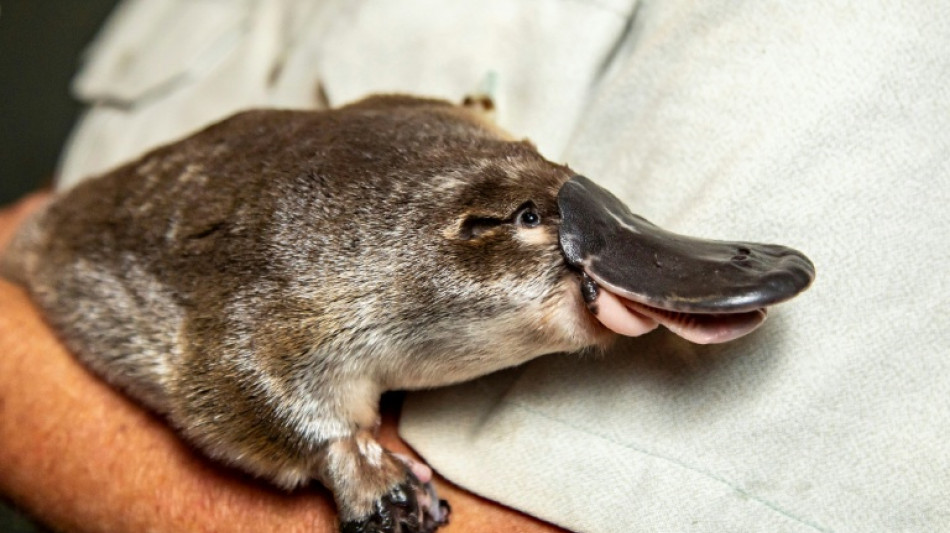
The platypus is even weirder than thought, scientists discover / Photo: RICK STEVENS - TARONGA ZOO/AFP/File

 Bank of Japan hikes rates to 31-year high to battle inflation

 AI doomsday warnings unlikely to slow IPOs but questions linger

 In Brazil's Amazon, the hunt for oil fuels hopes and fears

 Baby orangutans in India expose 'frightening' scale of trafficking

 Oversight Board blasts 'inadequate' Meta safeguards for AI deepfakes

 Harry makes first public appearance since return to UK

 Princess Diana's brother makes new explosive claims against Charles

 Trump admin overhauls key protection for endangered species

 Mbappe draws political fire over Ceuta t-shirt controversy

 Third malaria death in Germany from outbreak tied to Frankfurt airport

 AtlasClear Holdings Reports Preliminary Fiscal 2026 Revenue of Approximately $20.1 Million, Up 85%; Revenue Plus Interest Income of Approximately $21.9 Million

 'Another arrow to the quiver': World Bank posts record private capital mobilization

 Ireland to boycott Eurovision 2027 over Gaza

 India's Tata Sons reappoints N. Chandrasekaran as chairman

 Germany urges EU action against China to defend carmakers

 Japan eyes changing prostitution law to punish sex buyers

 Modi pitches India as global chipmaking hub

 Ukraine plans record defence spending in 2027

 NASA scan discovers new, 'once in a century' Moon crater

 Most stocks rise as Fed hikes and indicates drive to curb inflation

 UK-Sudanese author pens book to give children 'African history of Africa'

 Argentine judge orders suspension of Falklands oil project

 US Fed raises rates to tackle 'too high' inflation, irking Trump

 Turkey releases 106 protesters, jails more LGBTQ activists

 Candidate for UN chief calls for AI regulation akin to nuclear weapons

They already have the bill of a duck, the tail of a beaver, lay eggs like reptiles and have venom like snakes.
Yet the humble platypus, a small creature which quietly swims in the rivers of eastern Australia, has found yet another way to amaze scientists.
It is the only mammal that has hollow structures of the pigment melanin, a trait normally found in birds, biologists said in a new study on Wednesday.
When the first taxidermied specimen of a platypus was brought back from Australia in 1799, European naturalists began looking for the seams -- they assumed it was a hoax.
The animal has been surprising scientists ever since.
The platypus is one of only five mammal species that lay eggs, which are called monotremes. The other four are all types of echidna -- spiny creatures that waddle through the Australian bush.
It is also one of the few poisonous mammals -- males have a spur on their hind legs that releases venom at their enemies.
Now another oddity has been added to the unusual platypus characteristics, according to the study published in the Biology Letters journal of the UK's Royal Society.
In animals with spines, called vertebrates, the pigment called melanin protects against UV radiation, helps regulate body temperature and is responsible for the colour of skin, fur or feathers.
Melanin is contained in tiny, specialised structures inside cells called melanosomes, the shape of which is linked to their colour.
For example, eumelanin -- which produces black, grey and dark brown hues -- is usually found in elongated melanosomes.
Pheomelanin, which produces reds, reddish-browns and some shades of orange and yellow, is found in spherical melanosomes.
And in mammals, these melanosomes are always solid.
However in birds, sometimes the structures are hollow or flat, with only a thin layer of melanin. This helps birds have the dazzling and varied colours seen across the world.
Birds also have melanosomes that are organised into smaller "nanostructures" which create iridescent colours that interact with light, such as the feathers of a peacock.
- 'Surprising and exciting' -
Jessica Leigh Dobson, a biologist at Ghent University in Belgium and the study's lead author, told AFP the team was compiling a database of mammal melanosomes when they made an "extremely surprising and exciting" discovery.
Platypus melanosomes were mostly spherical -- which should give it reddish-orange fur. But the animal is merely dark brown.
Then the scientists discovered that some of its melanosomes are hollow -- like those of birds.
They checked their database for other mammals, including marsupials, rodents and primates.
"To the best of our knowledge, this is the only example of hollow melanosomes in mammals," Dobson said.
The melanosomes were "scattered randomly throughout the hair cortex" and do not create iridescence, she said.
"Further work is definitely needed to find out why they have them," Dobson added.
Why these animals evolved these unusual features in the first place is also unclear.
The ancestors of the platypus and echidna are thought to have been aquatic burrowing animals, so their hollow melanosomes could have helped them adapt to life in the water, giving them warmer insulation.
But this theory raises more questions.
If this was the case, why is this trait "not more widespread among aquatic mammals?" the study asked.
Ng.A.Adebayo--CPN