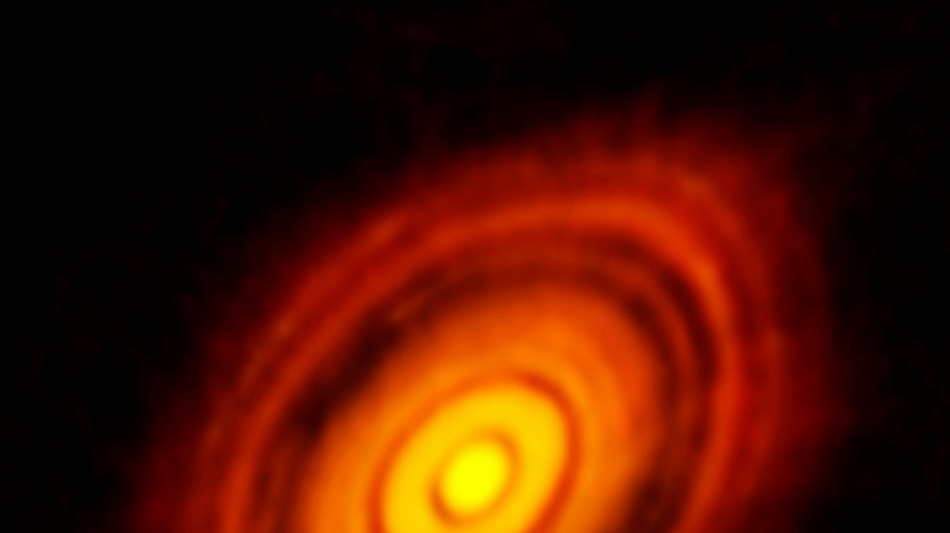
James Webb telescope discovers its first exoplanet / Photo: ALMA (ESO/NAOJ/NRAO) - EUROPEAN SOUTHERN OBSERVATORY/AFP/File

 UK-Sudanese author pens book to give children 'African history of Africa'

 US Congress passes sweeping Russia sanctions bill

 US stocks fall, dollar gains after Fed lifts interest rates

 US Fed raises rates to tackle 'too high' inflation in move sure to rile Trump

 US Fed raises rates to battle inflation in move likely to rile Trump

 US House faces test on sweeping Russia sanctions bill

 British PM says to make 'difficult decisions' as inflation rises

 Global fuel price demos: a round-up

 Leverate Launches MCP for Traders to Connect AI Assistants With Trading Platforms

 MEXC Launches $1M "Discover Your Wall Street DNA" Campaign to Help Traders Find Their Market Fit

 Stocks edge higher ahead of US Fed rate call

 BASIS.pro Expands On-Chain Infrastructure with XDC Network Partnership and Zypher DAO as Auto Earn Goes Live

 Pickle-flavoured tart? AI inspires Japan's convenience stores

 EU chief hosts Canada's Carney in push to 'deepen' alliance

 Meta chief pushes back on AI slowdown calls

 US Fed to deliver rate decision with markets betting on hike

 i-payout Expands U.S. Money Transmitter Licensing Footprint and Advances European EMI Strategy

 US Senate crypto bill collapses amid partisan deadlock

 OpenAI, Anthropic and Google are working to create an AI standards body

 Protesting shepherds, farmers clash with Romanian police

 Foundation Lets Ledger Users Switch to Open Source Without Starting Over

 EU to propose curbing social media, online games for under 15s

 FX Junction Reaches 40,600 Members and 26 Million Trades

 'We unleashed the beast': the world's fears and hopes about AI

 Hospitality leaders ask Burnham to halve VAT amid rising costs

The James Webb Space Telescope has discovered its first exoplanet, astronomers said Wednesday, capturing rare direct images of the relatively small world in the Earth's galactic backyard.
The telescope, which can see farther into the universe than anything before it, has turbocharged the search for planets beyond the Solar System since coming online in 2022.
Until now, however, its deep gaze has mostly been used to probe already known exoplanets -- to find out key information such as the atmospheric composition -- rather than tracking down new worlds.
The discovery of exoplanet TWA 7b, revealed in a study in the journal Nature, "represents a first for the telescope", France's CNRS research centre said in a statement.
The large majority of the nearly 6,000 exoplanets found so far have been identified from the light they blot out when they pass in front of their star, rather than from direct images of the planet.
Webb "has spent an enormous amount of time observing planets that have never been directly imaged," lead study author Anne-Marie Lagrange of the Paris Observatory told AFP.
- 'Blinded by the light' -
Capturing direct images of faraway planets is difficult because they are "very faint" due to a lack of heat, Lagrange said. Even worse, she added, "we're blinded by the light of the star they orbit."
But Webb has a way to get around the problem.
An attachment to Webb's MIRI instrument called a coronagraph masks the star, creating an effect similar to a solar eclipse. The telescope's infrared vision can then peer through and spot the planet.
Astronomers pointed Webb at the star TWA 7, which is around a hundred light years from Earth -- relatively nearby in the universe.
The star, which was first spotted by the Hubble space telescope in 1999, was thought to be a promising target for two reasons.
It is just 6.4 million years old -- a baby compared to the Sun's 4.5 billion years -- and still surrounded by a massive disc of gas and dust where planets are thought to form.
And from the direction of Earth, the disc is seen from above, giving a good view of its rings.
The three rings around the star, which stretch more than 100 times the distance separating the Sun and Earth, had previously been spotted by the Very Large Telescope in Chile.
But inside an otherwise empty section of the second ring, the Webb telescope detected something particularly bright.
Astronomers ruled out that the light was coming from an object at the edge of the Solar System, or from a distant galaxy behind the star.
That could mean only that the light source was a relatively small and cold planet, with a mass at least 10 times lighter than any other exoplanet directly imaged so far, according to the study.
- The hunt for smaller worlds -
The researchers estimated that the planet's mass was similar to that of Saturn, a gas giant that weighs only a third of Jupiter, the biggest planet in the Solar System.
Webb has increased the ability to detect exoplanets via direct images by a factor of 10, Lagrange said.
That is important because smaller, rocky planets similar to Earth or Mars are the ultimate target in the search for habitable worlds outside of the Solar System.
Lagrange said she would be delighted to discover "Earth-like planets" one day.
But she said astronomers needed to study all kinds of planets -- and to understand how planetary systems form -- to know whether the life-hosting Solar System is unique.
In the future, astronomers expect the Webb telescope will be able to spot planets even smaller than TWA 7b.
But directly capturing images of faraway worlds similar to Earth will require even more telescopic power, such as from he Extremely Large Telescope that is scheduled to come online in Chile in 2028.
P.Kolisnyk--CPN