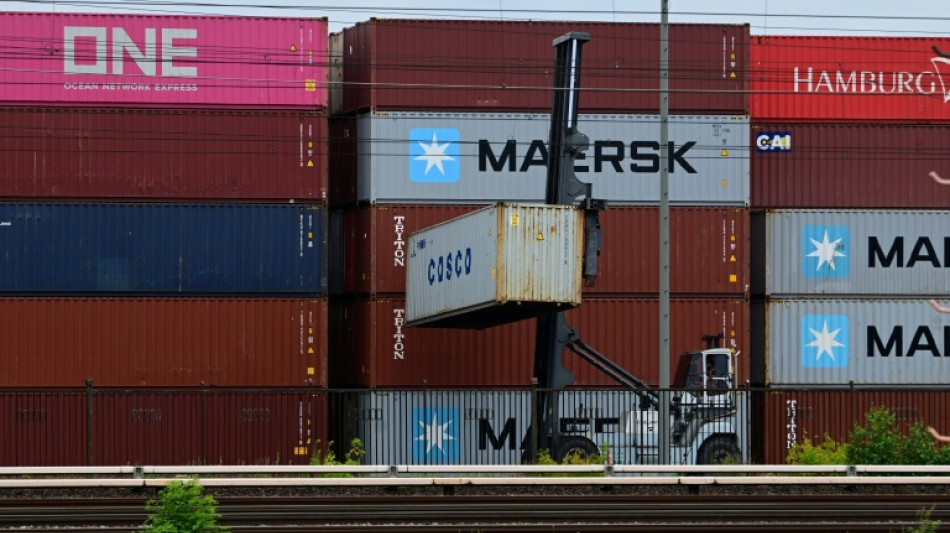
German exports to US plunge as tariffs exact heavy cost / Photo: Tobias Schwarz - AFP

 Saudi-led coalition says Houthis fired ballistic missile at Riyadh

 Cuba works to restore power after another blackout

 Brigitte Bardot widower slams sale of star's belongings

 Indonesia accepts Malaysia's help to tackle wildfires

 Nvidia, OpenAI CEOs to attend Xi dinner at White House

 Cuba hit with seventh major blackout of the year

 Nigeria miners struggled to breathe in cell before 37 died: survivors

 Warren Buffett steps down as Berkshire Hathaway chairman

 Isolated Syrian-Druze city blames Damascus for shortages

 Kerry James Marshall: American 'blackness' painter celebrated in Europe

 Infantino 'must go', says German FA vice-president

 Japan's busiest rail station tests robot bins

 Backpackers fret over Australian visa crackdown

 Bank of Japan hikes rates to 31-year high to battle inflation

 AI doomsday warnings unlikely to slow IPOs but questions linger

 In Brazil's Amazon, the hunt for oil fuels hopes and fears

 Baby orangutans in India expose 'frightening' scale of trafficking

 Oversight Board blasts 'inadequate' Meta safeguards for AI deepfakes

 Harry makes first public appearance since return to UK

 Princess Diana's brother makes new explosive claims against Charles

 Trump admin overhauls key protection for endangered species

 Mbappe draws political fire over Ceuta t-shirt controversy

 Third malaria death in Germany from outbreak tied to Frankfurt airport

 AtlasClear Holdings Reports Preliminary Fiscal 2026 Revenue of Approximately $20.1 Million, Up 85%; Revenue Plus Interest Income of Approximately $21.9 Million

 'Another arrow to the quiver': World Bank posts record private capital mobilization

German exports to the United States plunged in 2025 amid President Donald Trump's tariff blitz, driving down the trade surplus of Europe's top economy with the crucial US market to a four-year low, data showed Friday.
Exports to China also fell, but total exports rebounded by around one percent following two years of contraction, as stronger trade with Europe offset falling shipments to the world's two biggest economies, statistics agency Destatis said.
The overall picture for Germany's foreign trade remains bleak, experts warn, at a time the traditional export power is struggling after a long decline driven by a manufacturing slump, high energy costs and weak demand at home and abroad.
German exports to the United States fell 9.3 percent last year compared to 2024, and totalled around 147 billion euros ($173 billion), while US imports to Germany rose slightly.
The trade surplus with the United States was 52.2 billion euros, its lowest level since 2021, after a record surplus the previous year of nearly 70 billion euros.
"Higher US tariffs are making German goods less competitive on the US market," Commerzbank economist Ralph Solveen told AFP.
As a result, China returned as Germany's biggest trading partner last year, overtaking the US, according to the preliminary data.
Europe was in Trump's crosshairs when he launched his tariff onslaught as it runs a hefty trade surplus with the United States, much of it due to German exports.
Under a deal struck in July, EU exports to the United States face a baseline levy of 15 percent -- far higher than before Trump's return to office.
It was a heavy blow for Germany, whose firms, from well-known automakers and machinery giants to smaller, family-owned companies, have long relied on robust trade with the United States.
According to data released previously by Destatis, exports of German cars and car parts to the United States dropped 17.5 percent between January and November from a year earlier.
Exports of machinery were down nine percent and shipments of chemical products fell over 14 percent in the same period.
- China challenge -
German businesses have struggled in the Chinese market due to the emergence of homegrown rivals and weak consumer demand -- German exports to China were down 9.3 percent last year.
But Chinese exports to Germany jumped nine percent, as firms are increasingly redirecting goods to European markets due to Trump hiking tariffs on Chinese imports.
German exports to other EU countries rose around four percent last year, driving the slight improvement in the overall figure.
Germany's trade surplus narrowed to 200.4 billion euros in 2025, a reduction of around 40 billion euros from a year earlier.
In other news Friday, German factory output dropped 1.9 percent in December from the previous month, according to Destatis, sharper than forecasts and a disappointment after three months of gains.
But ING economist Carsten Brzeski said the drop was "only a temporary halt and not a new downward trend".
"In fact, German industry is at the start of a clear cyclical upswing," he said.
The German government expects the economy will grow one percent this year after several bleak years, and other recent data -- from industrial orders to quarterly growth -- have painted a rosier picture.
Chancellor Friedrich Merz, who is pushing a major fiscal stimulus and reform drive, struck an optimistic tone Friday.
Recent signs of a turnaround "encourage and embolden me to continue on this path of reforms and of changing the conditions for investment and for jobs in Germany" Merz said during a visit to Abu Dhabi.
"We are still far from where we want to be, but we are on the right path."
C.Smith--CPN