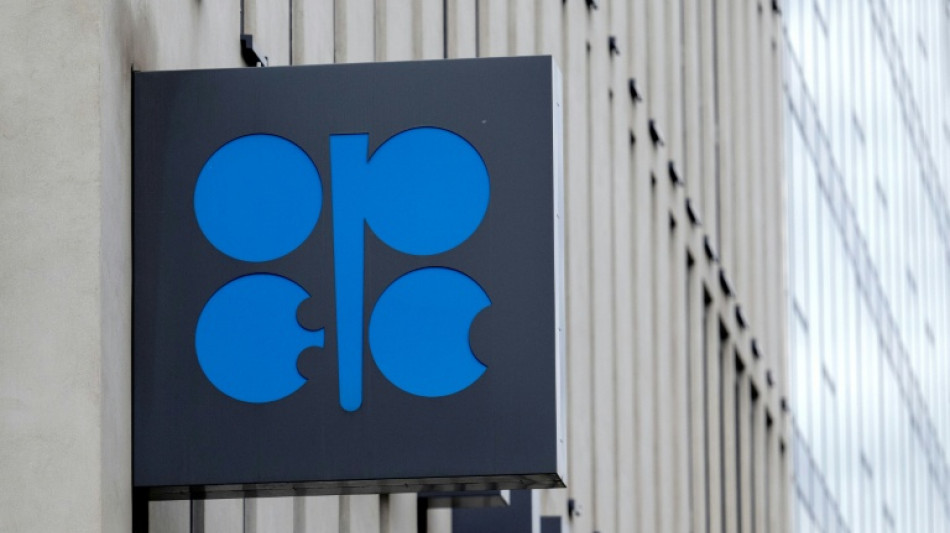
OPEC+ to make first post-UAE production decision / Photo: JOE KLAMAR - AFP/File

 EU to ban social media for under 13s, curb access until 15

 Wildfires push endangered Sumatran elephants to brink: Indonesian NGO

 Bank of Japan set to raise rates under pressure from inflation, US

 EU chief to unveil social media, gaming curbs for under-15s

 'Resident Evil' film brings video game's ethos to the big screen

 i-payout Expands U.S. Money Transmitter Licensing Footprint and Advances European EMI Strategy

 US Senate crypto bill collapses amid partisan deadlock

 OpenAI, Anthropic and Google are working to create an AI standards body

 Protesting shepherds, farmers clash with Romanian police

 Foundation Lets Ledger Users Switch to Open Source Without Starting Over

 EU to propose curbing social media, online games for under 15s

 FX Junction Reaches 40,600 Members and 26 Million Trades

 'We unleashed the beast': the world's fears and hopes about AI

 Hospitality leaders ask Burnham to halve VAT amid rising costs

 Worcestershire invited to nominate groups for 2027 King’s volunteer award

 Berlin's run-down public spaces at heart of election campaign

 'Widow's Bay' and 'The Pitt' win big at Emmy Awards

 Most markets drop as oil extends gains ahead of expected US rate hike

 Sri Lanka's famed beach shack battles demolition

 Vserv targets ₹1,000 crore revenue by 2030 through AI expansion

 India prohibits bank fees on UPI payments up to ₹2,000

 Brazil's Amazon defender Raoni has cancer
 Trump rejects AI slowdown concerns as UN urges coordinated controls

 Higher wages draw migrant workers to Kashmir despite attacks

 Oil supply concerns and AI warnings weigh on global markets
Seven OPEC+ members are meeting Sunday to make their first decision on oil-production quotas since the United Arab Emirates' departure from the cartel, which added to the soaring price pressure unleashed by the Mideast war.
The UAE, one of the world's top producers, announced April 28 it was withdrawing from the Organization of the Petroleum Exporting Countries (OPEC) and the expanded OPEC+ group, after chafing at their production quotas. The withdrawal took effect on Friday.
Neither group has reacted publicly so far -- meaning there will be intense focus on the tone of the statement at the end of Sunday's online meeting by Algeria, Iraq, Kazakhstan, Kuwait, Oman, Russia and Saudi Arabia.
The production decision itself is already priced in by markets. The seven countries are widely expected to increase their quotas by 188,000 barrels per day (bpd), according to Arne Lohmann Rasmussen, chief analyst at Global Risk Management.
That is similar to a 206,000-barrel daily increase announced in March and April, subtracting the portion allotted to the UAE.
- Quota question mark -
But raising the quota on paper may not have much impact on actual production, which is already short of the limit.
Untapped OPEC+ reserves are mainly located in the Gulf region, and exports there are trapped by the blockade of the vital Strait of Hormuz, imposed by Iran in response to the US-Israeli strikes that started the war on February 28.
"Total OPEC+ output with quota fell to 27.68 million bpd in March, against a monthly quota of 36.73 million bpd, a shortfall of approximately 9 million bpd driven almost entirely by war-related disruption rather than voluntary restraint," said Priya Walia, an analyst at Rystad Energy.
The blockade is hitting Iraq, Kuwait, Saudi Arabia and the UAE. The latter's production will no longer count towards OPEC quotas.
Iran, whose exports are now the target of a retaliatory US blockade, is an OPEC+ member but is not subject to quotas.
Russia, the group's second-biggest producer, has been the main beneficiary of the situation. But despite soaring energy prices, it appears to be struggling to produce at the level of its current quotas as its own war in Ukraine drags on.
- 'Big deal' -
The UAE's exit is "a big deal" for OPEC, said Amena Bakr, an analyst at Kpler.
Previous withdrawals from the group by Qatar in 2019 and Angola in 2023 were less significant by comparison, she told a video conference on the UAE withdrawal.
Besides being the fourth-biggest OPEC+ producer by output, the UAE has major untapped production capacity, an important lever when the group needs to regulate the market.
"The UAE had brought up grievances over its quotas" going back to 2021, said Bakr.
The UAE has invested massively in infrastructure in recent years, and state-owned oil company ADNOC plans to increase output by five million barrels a day by 2027 -- far above the country's last quota of around 3.5 million barrels.
That makes the UAE a competitive player that can produce at low cost -- potentially limiting the impact of efforts by Saudi Arabia and its allies to shape the market.
There is also the risk for OPEC+ that other countries will leave such as Iraq and Kazakhstan, which have faced repeated accusations of surpassing their quotas.
D.Goldberg--CPN