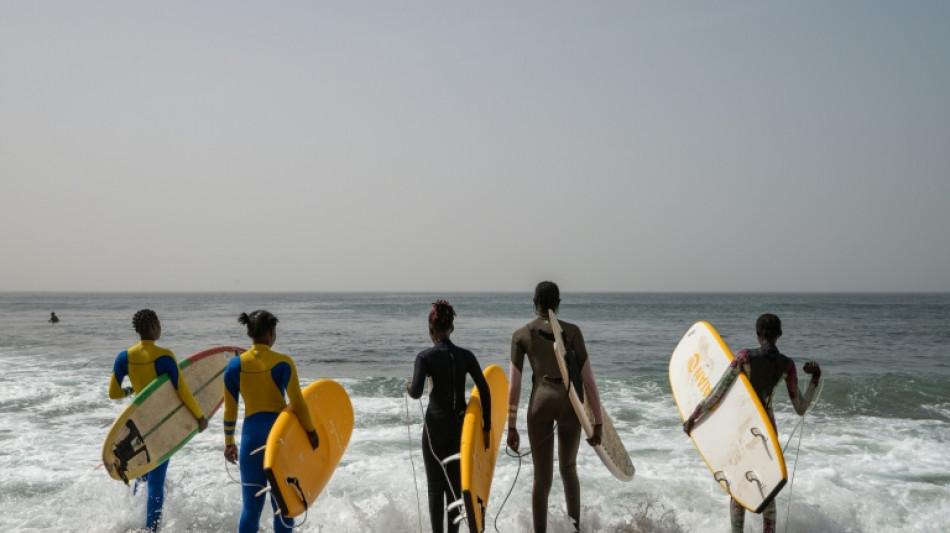
In Dakar fishing village, surfing entices girls back to school / Photo: NICOLAS REMENE - AFP

 Saudi-led coalition says Houthis fired ballistic missile at Riyadh

 Cuba works to restore power after another blackout

 Brigitte Bardot widower slams sale of star's belongings

 Indonesia accepts Malaysia's help to tackle wildfires

 Nvidia, OpenAI CEOs to attend Xi dinner at White House

 Cuba hit with seventh major blackout of the year

 Nigeria miners struggled to breathe in cell before 37 died: survivors

 Warren Buffett steps down as Berkshire Hathaway chairman

 Isolated Syrian-Druze city blames Damascus for shortages

 Kerry James Marshall: American 'blackness' painter celebrated in Europe

 Infantino 'must go', says German FA vice-president

 Japan's busiest rail station tests robot bins

 Backpackers fret over Australian visa crackdown

 Bank of Japan hikes rates to 31-year high to battle inflation

 AI doomsday warnings unlikely to slow IPOs but questions linger

 In Brazil's Amazon, the hunt for oil fuels hopes and fears

 Baby orangutans in India expose 'frightening' scale of trafficking

 Oversight Board blasts 'inadequate' Meta safeguards for AI deepfakes

 Harry makes first public appearance since return to UK

 Princess Diana's brother makes new explosive claims against Charles

 Trump admin overhauls key protection for endangered species

 Mbappe draws political fire over Ceuta t-shirt controversy

 Third malaria death in Germany from outbreak tied to Frankfurt airport

 AtlasClear Holdings Reports Preliminary Fiscal 2026 Revenue of Approximately $20.1 Million, Up 85%; Revenue Plus Interest Income of Approximately $21.9 Million

 'Another arrow to the quiver': World Bank posts record private capital mobilization

For generations, Seynabou Tall's ancestors have fished, dived and rowed off the coast of Dakar, where the 14-year-old, who quit school nearly four years ago, is now learning to surf.
She and some 20 other girls are participating in an inaugural Surf Academy which requires they enrol in school, incentivised by the chance to shred waves.
Nearly all come from the little community of Xataxely, a fishing village of narrow walkways that is part of the capital's larger Ngor neighbourhood.
The area is a stronghold of Senegal's Lebou ethnic group, a fishing people closely tied to the ocean who live throughout the Dakar region.
The capital's world-class, year-round waves not only serve as the backdrop to the girls' lives, but also attract surfers from across the globe, including to the famed Ngor Right wave where the girls often practise.
Khadjou Sambe, Senegal's first female professional surfer, also a Lebou from Xataxely, is the vice president of the Dakar chapter of Black Girls Surf, which put on the four-month Surf Academy.
The US-based organisation aims to train and increase the number of black women who participate in surfing, a sport historically dominated by white men.
While its Surf Academy centres on surfing and academics, it is also a "development program" meant to focus on the whole person, said the organization's founder and director, American Rhonda Harper, 57.
The first-ever Dakar academy was attended by 23 girls age seven to 17, of whom 17 had never gone to or were no longer in school. Nearly all were Lebou and live within 20 metres (yards) of the ocean.
They were provided with surfboards and wetsuits. And they participated in activities like fitness, meditation and surfing during the day, while receiving schooling at night in a program for students no longer in the formal education system.
While the academy ended at the end of January, the school portion lasts through July. Six participants already enrolled in school participated in the academy as a weekend and after-school activity.
- 'We don't have the means' -
Like many Lebou, Tall's father is a diver, plunging for fish which have drastically disappeared from Senegal's coast due to industrial trawling.
Her mother, who only went to primary school, sells fatayas and nems -- savoury pocket pastries and spring rolls -- outside the family's compound where their extended family lives.
Since leaving school Seynabou Tall has been "just staying at home", said 43-year-old Marieme Wade, adding that she advised her daughter "to continue with surfing, maybe it will open doors".
"We don't have the means to pay for her studies," she explained from their home's back courtyard, where young children capered about and two rams watched from an enclosure.
The girls in the academy are beginners at surfing. "I had never surfed before this program," Seynabou Tall told AFP, seated beside her mother.
Many are also beginners at education: Most had to be enrolled in the "first grade", said Silmang Pierre Ndior, an official at the Soeur Marie Luc Vaderloge literacy centre where they attend night school.
The nascent surfers' lack of elementary education is not rare in Senegal.
The country's primary school completion rate was just 60 percent for girls and 55 percent for boys in 2022, according to the UNESCO International Institute for Capacity Building in Africa.
- 'Good support' -
Soukeye Ndoye, 16, coaches in the Surf Academy, having participated in Black Girls Surf since 2019, and said she is delighted to "hold an important position that I never thought I would be able to hold".
"At first, I knew nothing about surfing... I was always falling and often getting hurt. But now, I go out on my own and I have good support."
Later this year Senegal will host the Youth Summer Olympic Games, the first African country ever to hold an Olympics event.
Surfing has been a part of the Olympics since 2020 but will not be included in the 25 competition sports in Dakar, to the dismay of the city's surf community.
Thirty-year-old Sambe, who grew up two to three metres from the beach in Xataxely, has her eyes on the 2028 Los Angeles Games.
As a child, her parents forbade her to surf, an activity they believed was for boys. In order to participate she would sneak out the window or leave the house dressed in formal attire to throw her family off.
"In the beginning, it was difficult because we are girls and we didn't see other girls who surfed," Sambe said.
Now several girls who started out in Black Girls Surf are participating in or even winning national competitions.
A.Leibowitz--CPN