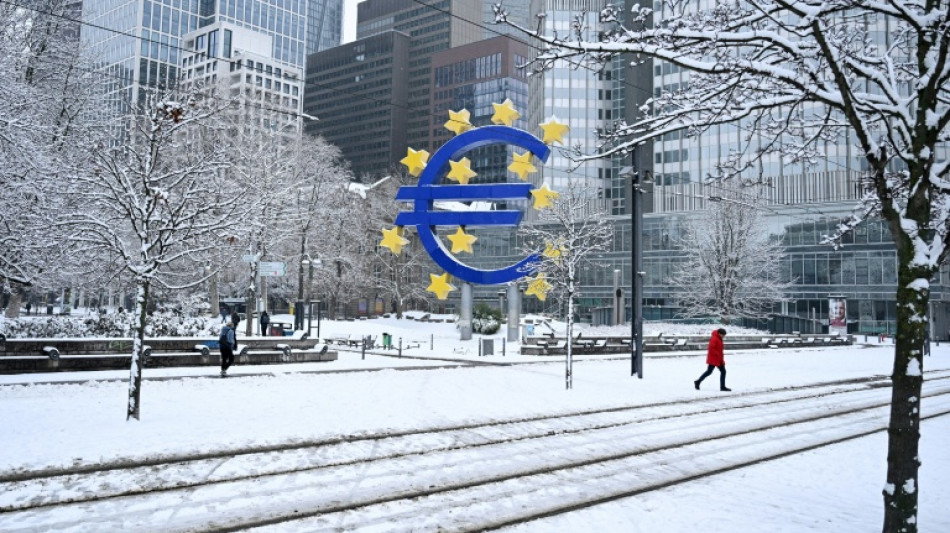
Digital euro delay could leave Europe vulnerable, ECB warns / Photo: Kirill KUDRYAVTSEV - AFP

 Saudi-led coalition says Houthis fired ballistic missile at Riyadh

 Cuba works to restore power after another blackout

 Brigitte Bardot widower slams sale of star's belongings

 Indonesia accepts Malaysia's help to tackle wildfires

 Nvidia, OpenAI CEOs to attend Xi dinner at White House

 Cuba hit with seventh major blackout of the year

 Nigeria miners struggled to breathe in cell before 37 died: survivors

 Warren Buffett steps down as Berkshire Hathaway chairman

 Isolated Syrian-Druze city blames Damascus for shortages

 Kerry James Marshall: American 'blackness' painter celebrated in Europe

 Infantino 'must go', says German FA vice-president

 Japan's busiest rail station tests robot bins

 Backpackers fret over Australian visa crackdown

 Bank of Japan hikes rates to 31-year high to battle inflation

 AI doomsday warnings unlikely to slow IPOs but questions linger

 In Brazil's Amazon, the hunt for oil fuels hopes and fears

 Baby orangutans in India expose 'frightening' scale of trafficking

 Oversight Board blasts 'inadequate' Meta safeguards for AI deepfakes

 Harry makes first public appearance since return to UK

 Princess Diana's brother makes new explosive claims against Charles

 Trump admin overhauls key protection for endangered species

 Mbappe draws political fire over Ceuta t-shirt controversy

 Third malaria death in Germany from outbreak tied to Frankfurt airport

 AtlasClear Holdings Reports Preliminary Fiscal 2026 Revenue of Approximately $20.1 Million, Up 85%; Revenue Plus Interest Income of Approximately $21.9 Million

 'Another arrow to the quiver': World Bank posts record private capital mobilization

The European Central Bank urged the European Union on Friday to swiftly press ahead with adopting a digital euro, warning that delays would leave the continent reliant on foreign "big tech" players.
"Delays in the legislative process would risk breaking the momentum," Piero Cipollone, a European Central Bank executive board member, said in a speech in Cyprus.
"They would further entrench our dependence on international card schemes and increase our exposure to non-European big tech payment solutions," he said.
He did not mention particular companies by name, but worries have been growing about Europe's heavy reliance on US tech firms as ties between the continent and United States sour under US President Donald Trump.
The EU has long been working on a digital euro, which dozens of economists called an "essential safeguard of European sovereignty" in an open letter in January.
Supporters say a well-designed digital single currency would allow Europeans to make online payments without relying on US card companies or payments systems.
However, some critics fear it would allow governments to surveil citizens' payments or even cut them off from the money supply.
Addressing such fears, Cipollone said the ECB would "continue to issue banknotes" and was "working hard to ensure physical cash remains widely accepted and available".
"As European citizens, we want to avoid a situation where Europe is overly dependent on payment systems that are not in our hands," he added.
The ECB began work on its own digital currency in 2020 and plans to launch a pilot scheme in 2027. The European Parliament is expected to reach a decision on whether to press ahead with the project this year.
"Once the legislation is adopted, the digital euro standards can be finalised and made available," Cipollone said.
"As merchants renew their payment terminals, they can ensure that the new devices are 'digital euro-ready'," he added.
European banks meanwhile are wary that a digital euro could reduce demand for their online and electronic banking services.
Some have launched their own payments systems, such as Wero, as an alternative to US options like Visa, Mastercard and PayPal.
A.Mykhailo--CPN

