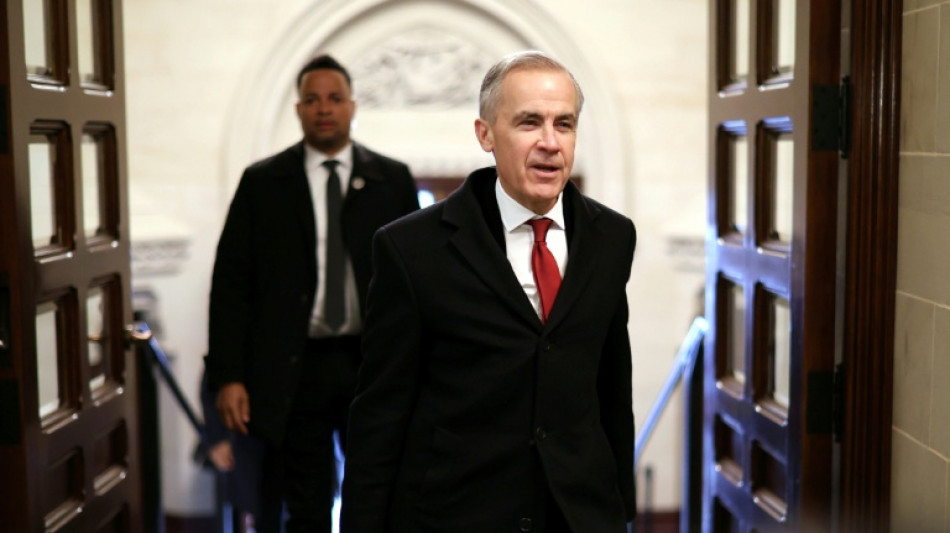
Carney scraps Canada EV sales mandate, affirms auto sector's future is electric / Photo: Dave Chan - AFP/File

 Saudi-led coalition says Houthis fired ballistic missile at Riyadh

 Cuba works to restore power after another blackout

 Brigitte Bardot widower slams sale of star's belongings

 Indonesia accepts Malaysia's help to tackle wildfires

 Nvidia, OpenAI CEOs to attend Xi dinner at White House

 Cuba hit with seventh major blackout of the year

 Nigeria miners struggled to breathe in cell before 37 died: survivors

 Warren Buffett steps down as Berkshire Hathaway chairman

 Isolated Syrian-Druze city blames Damascus for shortages

 Kerry James Marshall: American 'blackness' painter celebrated in Europe

 Infantino 'must go', says German FA vice-president

 Japan's busiest rail station tests robot bins

 Backpackers fret over Australian visa crackdown

 Bank of Japan hikes rates to 31-year high to battle inflation

 AI doomsday warnings unlikely to slow IPOs but questions linger

 In Brazil's Amazon, the hunt for oil fuels hopes and fears

 Baby orangutans in India expose 'frightening' scale of trafficking

 Oversight Board blasts 'inadequate' Meta safeguards for AI deepfakes

 Harry makes first public appearance since return to UK

 Princess Diana's brother makes new explosive claims against Charles

 Trump admin overhauls key protection for endangered species

 Mbappe draws political fire over Ceuta t-shirt controversy

 Third malaria death in Germany from outbreak tied to Frankfurt airport

 AtlasClear Holdings Reports Preliminary Fiscal 2026 Revenue of Approximately $20.1 Million, Up 85%; Revenue Plus Interest Income of Approximately $21.9 Million

 'Another arrow to the quiver': World Bank posts record private capital mobilization

Prime Minister Mark Carney on Thursday cancelled a mandate for all vehicles sold in Canada to be electric by 2035, while announcing major investments to support the auto industry's EV transition.
In unveiling his plan to transform the sector, Carney said Canada's auto industry needed to be ready for a future where EVs are dominant, and where US President Donald Trump's tariffs have made cross-border vehicle production unworkable.
Carney's decision to scrap EV mandates also marked another departure from policies backed by his climate-focused predecessor, Justin Trudeau.
Trudeau's government had mandated that 20 percent of vehicles sold this year be electric, with a 60 percent target by 2030 and the 100 percent target for 2035.
Those targets were applauded by some environmental groups but faced criticism from automakers, as well as concern that Canada had nowhere near the charging infrastructure needed to support full electrification across a vast landmass.
Carney argued his new automotive strategy would prioritize "results and solutions."
His plan includes a CAN$5,000 (US$3,700) subsidy for individuals who choose to buy an EV, CAN$1.5 billion to improve charging infrastructure, and CAN$3 billion "to help the auto industry adapt, grow, and diversify to new markets," his office said.
"We know where the auto industry is headed. We're going to support that transition," Carney told reporters.
Progress in the global EV market has been patchy.
Trump scrapped tax credits for EV purchases last year, jarring automakers that invested heavily in electrification during Democrat Joe Biden's presidency.
The European Union in December also proposed scrapping a planned 2035 ban on new combustion-engine vehicles.
Carney said his goal was 75 percent EV sales by 2035, and a 90 percent target by 2040.
The Global Automakers of Canada, an industry group, praised Carney for providing "greater clarity" on the government's electrification plans, including "a commitment to aggressively build out the charging infrastructure."
Since taking office last year, Carney has also scrapped Trudeau's carbon tax on individual households and advanced plans to build a new oil pipeline from Alberta to the Pacific coast -- infuriating environmental groups.
Asked Thursday if he still considered Canada a leader in the fight against climate change, Carney said: "Absolutely."
– 'Serious liability' –
Canada's auto industry supports half a million jobs, and concern about its future has intensified since Trump returned to office last year.
The president's broad approach on trade with Canada has shifted, but his administration has maintained a fairly consistent message on autos, insisting it wants to see vehicles made exclusively inside the United States.
Carney on Thursday said "there's no greater symbol of how closely the Canadian and American economies have been intertwined than automobiles."
Parts cross the US-Canada border up to eight times during production, but Trump's auto tariffs are threatening the viability of such integration.
"That trade relationship that once was a great strength has now become a serious vulnerability," Carney said.
Since April, Canadian-made vehicles have faced a 25 percent tariff on their non-US components, a levy Canada insists violates the existing North American free trade agreement, known as the USMCA.
USMCA revision talks are set for this year.
"Our objective is to remove all tariffs in the auto sector," Carney said, but stressed Canada's industry needed to start planning for an entirely domestic production chain.
Canada has large deposits of the critical minerals needed for EV battery production and says it wants to develop an end‑to‑end production chain, from mining to mineral processing to vehicle battery production.
P.Schmidt--CPN
