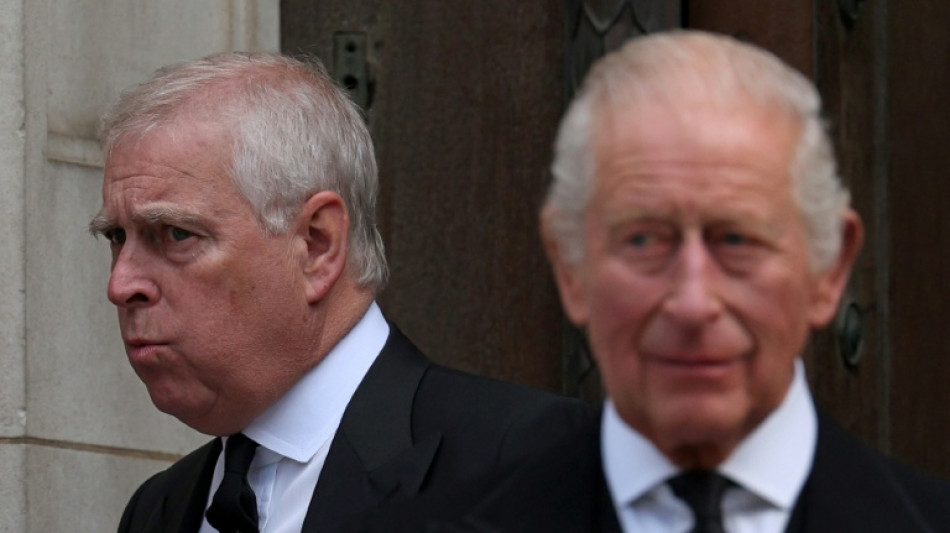
UK royal finances in spotlight after Andrew's downfall / Photo: Adrian Dennis - AFP

 Saudi-led coalition says Houthis fired ballistic missile at Riyadh
 Cuba works to restore power after another blackout
 Brigitte Bardot widower slams sale of star's belongings

 Indonesia accepts Malaysia's help to tackle wildfires

 Nvidia, OpenAI CEOs to attend Xi dinner at White House

 Cuba hit with seventh major blackout of the year

 Nigeria miners struggled to breathe in cell before 37 died: survivors

 Warren Buffett steps down as Berkshire Hathaway chairman

 Isolated Syrian-Druze city blames Damascus for shortages

 Kerry James Marshall: American 'blackness' painter celebrated in Europe

 Infantino 'must go', says German FA vice-president

 Japan's busiest rail station tests robot bins

 Backpackers fret over Australian visa crackdown

 Bank of Japan hikes rates to 31-year high to battle inflation

 AI doomsday warnings unlikely to slow IPOs but questions linger

 In Brazil's Amazon, the hunt for oil fuels hopes and fears

 Baby orangutans in India expose 'frightening' scale of trafficking

 Oversight Board blasts 'inadequate' Meta safeguards for AI deepfakes

 Harry makes first public appearance since return to UK

 Princess Diana's brother makes new explosive claims against Charles

 Trump admin overhauls key protection for endangered species

 Mbappe draws political fire over Ceuta t-shirt controversy

 Third malaria death in Germany from outbreak tied to Frankfurt airport

 AtlasClear Holdings Reports Preliminary Fiscal 2026 Revenue of Approximately $20.1 Million, Up 85%; Revenue Plus Interest Income of Approximately $21.9 Million

 'Another arrow to the quiver': World Bank posts record private capital mobilization

The scandal surrounding disgraced former prince Andrew has thrust the British royal family and its opaque finances into the spotlight, with a parliamentary probe due in the coming months.
It marks a significant shift towards greater scrutiny of royal matters after decades of deference to the centuries-old monarchy.
Parliament's Public Accounts Committee will later this year launch an inquiry after reports that Andrew Mountbatten-Windsor had been paying only a token "peppercorn" rent on Royal Lodge, a 30-room mansion on the Windsor estate, since he moved in in 2003.
Andrew finally left the property on Monday following a new flood of scandalous emails released by US authorities last week which revealed excruciating details of his close ties to convicted US sex offender Jeffrey Epstein.
King Charles III last year stripped his younger brother of all royal titles and honours, amid growing outrage over Andrew's friendship with Epstein.
The Windsor estate is managed by the independent property company, the Crown Estate, a commercial business that operates separately to the government and the royal household. It is not the monarch's private property, and its profits go entirely into the public purse.
The date of the parliamentary inquiry is not yet known, but in a letter to the Crown Estate, the committee chairman Geoffrey Clifton-Brown said MPs were "concerned" whether the lease arrangements for Royal Lodge were "achieving the best value for money".
"Any reduced income ... reduces the Crown Estate's annual surplus and therefore would be a cost to taxpayers," he added, asking a series of questions about the arrangements.
Andrew has now moved to a property on the Sandringham estate in remote eastern Norfolk, owned privately by the king who is funding his brother's move, rent and living costs.
But these revelations have shone a light on the royal family's complex financial arrangements.
The inquiry "marks a shift in the constitutional balance between parliament and the monarchy," said Francesca Jackson, a PhD researcher focusing on the constitutional monarchy at Lancaster University.
"For a long time, the monarchy has escaped scrutiny, but things are changing," she told AFP.
Norman Baker, a former Liberal Democrat MP, agreed Andrew's situation has "opened the door" to greater questioning of the monarchy.
His new book "Royal Mint, National Debt: The Shocking Truth about the Royals" examines "the real cost" of the monarchy to British taxpayers.
- Soaring costs -
The Sovereign Grant, the annual public subsidy to working royals, has risen dramatically since 2011, when the funding formula was changed to link it to Crown Estate profits.
Currently, the royal family receives back from the Treasury 12 percent of the Crown Estate's profits.
"The official grant was £7.9 million a year in 2011. Fourteen years later, it's £132.1 million. You don't have to be a Republican to find that sort of increase obscene," Baker told AFP.
Much of the increase is due to a windfall from leasing the UK's seabeds, owned by the estate, to wind farms which has boosted profits.
Parliamentary documents show the grant is predicted to rise further, to £137.9 million in 2026-2027.
Baker argues the increase contradicts the king's stated aim of "a slimmed-down monarchy".
"What he means by that is fewer people on the balcony at Buckingham Palace. Well, so what? We haven't got slimmed-down costs. The cost is going up relentlessly every year."
AFP reached out to Buckingham Palace, which declined to comment.
But monarchists counter saying the Crown Estate's profits paid to the Treasury have soared from about £240 million in 2011-2012 to a record £1.1 billion in 2024-2025.
According to the government website, the Crown Estate has paid £5 billion to the Exchequer in the last decade.
"The monarchy is an amazing bargain," royal commentator Richard Fitzwilliams told AFP.
He argues the cost calculations ignore unquantifiable factors, particularly the monarchy's global influence and "soft power".
Fitzwilliams highlighted the king's role in hosting US President Donald Trump at Windsor last year, amid trade negotiations, as an example of the monarchy's wide-ranging influence.
- Tax questions -
Baker however also pointed to royal tax exemptions as further evidence of a lack of financial transparency.
These include inheritance tax and corporate and capital gains tax on the Duchies of Cornwall and Lancaster, the private estates that generate income for both the king and heir to the throne, Prince William.
Both men pay income tax on the revenue from their duchies, but the amounts are not disclosed, although when Charles was heir to the throne he did reveal how much tax he paid.
"In the end Britons are in the dark about the true cost of their monarchy," Baker said.
Ch.Lefebvre--CPN