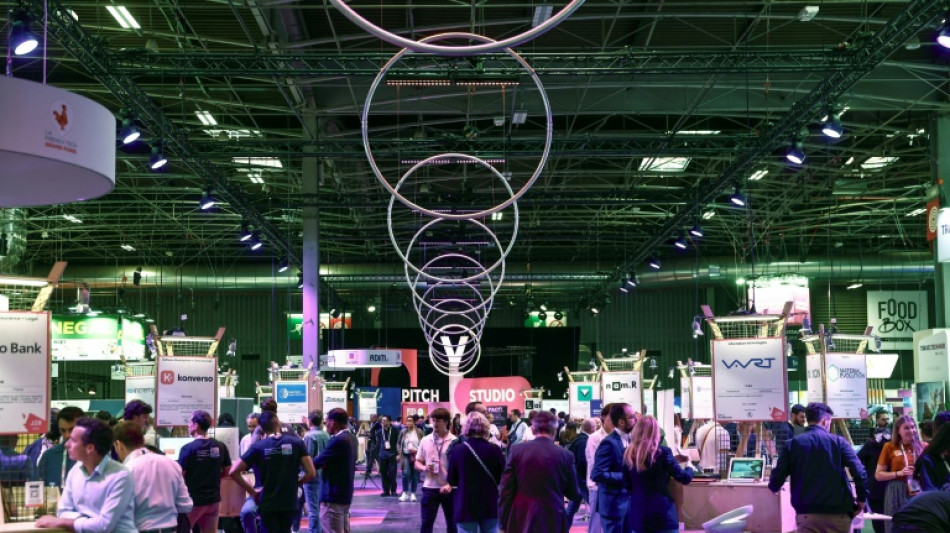
The most eye-catching products at Paris's Vivatech trade fair / Photo: Thibaud MORITZ - AFP

 UK-Sudanese author pens book to give children 'African history of Africa'

 US Congress passes sweeping Russia sanctions bill

 US stocks fall, dollar gains after Fed lifts interest rates

 US Fed raises rates to tackle 'too high' inflation in move sure to rile Trump

 US Fed raises rates to battle inflation in move likely to rile Trump

 US House faces test on sweeping Russia sanctions bill

 British PM says to make 'difficult decisions' as inflation rises

 Global fuel price demos: a round-up

 Leverate Launches MCP for Traders to Connect AI Assistants With Trading Platforms

 MEXC Launches $1M "Discover Your Wall Street DNA" Campaign to Help Traders Find Their Market Fit

 Stocks edge higher ahead of US Fed rate call

 BASIS.pro Expands On-Chain Infrastructure with XDC Network Partnership and Zypher DAO as Auto Earn Goes Live

 Pickle-flavoured tart? AI inspires Japan's convenience stores

 EU chief hosts Canada's Carney in push to 'deepen' alliance

 Meta chief pushes back on AI slowdown calls

 US Fed to deliver rate decision with markets betting on hike

 i-payout Expands U.S. Money Transmitter Licensing Footprint and Advances European EMI Strategy

 US Senate crypto bill collapses amid partisan deadlock

 OpenAI, Anthropic and Google are working to create an AI standards body

 Protesting shepherds, farmers clash with Romanian police

 Foundation Lets Ledger Users Switch to Open Source Without Starting Over

 EU to propose curbing social media, online games for under 15s

 FX Junction Reaches 40,600 Members and 26 Million Trades

 'We unleashed the beast': the world's fears and hopes about AI

 Hospitality leaders ask Burnham to halve VAT amid rising costs

Products ranging from footwear to AI counterfeit detectors fill the halls of Paris's Vivatech trade fair, which runs until Saturday.
Here are some of the highlights of this year's show gathered by AFP on the scene:
- Anti-counterfeiting AI -
For humans, spotting the difference between a Lacoste polo shirt and a fake sporting the brand's crocodile logo can be tricky.
But French startup Vrai AI believes its artificial intelligence model can tell the two apart based on a simple photo.
"AI can detect micro-mistakes" made by counterfeit manufacturers of products like off-the-rack clothes, banknotes or even anti-malarial medications, co-founder Hugo Garcia-Cotte tells AFP.
"It's more reliable than humans," he adds.
Lacoste has been testing the AI model since November, with customs services in countries like Cameroon and Senegal also taking an interest.
- Robotic telemedicine -
Scooting around on castor wheels, column-shaped robots from Hong Kong firm Robocore can serve as mobile advertising billboards -- but for now are mostly deployed for medical purposes in hospitals and retirement homes.
"We are in about 200 elderly homes in the United States, 1,000 elderly homes in Hong Kong, and we are in a lot of hospitals as well," boss Long Hei Roy Lim tells AFP.
The robots, each a few feet high, use AI to navigate environments autonomously, including taking the lift.
They can also analyse patients' medical data and have conversations powered by chatbots from American developer OpenAI or Chinese competitor DeepSeek.
Robocore says its robots can save time for health workers, whose workload is cut to simply checking up on what the robots have distributed to patients -- hopefully limiting the impact of doctor shortages.
With 50,000 units deployed across 33 countries, Robocore was hoping to expand into new markets thanks to its attendance at Vivatech.
- Nimble electric vehicles -
At just 79 centimetres (two and half feet) wide and 2.4 metres (seven and a half feet) long, French startup Aemotion's four-wheeled electric vehicle is designed to weave through traffic, saving commuters time spent in jams.
Built in central France, the black transport that's not quite a motor scooter nor really a car is fully enclosed and can carry two people at up to 115 kilometres per hour (70 mph).
"We aim to sell 5,000 of these a year within five years," company chief Alexandre Lagrange told AFP at the company's stand, where he is showing off the third version of Aeomotion's prototype.
Pre-orders are already open for the vehicle, with the company aiming to get road licensing early next year, with a price tag of 20,000 euros ($23,000).
The first drivers will get their hands on one in late 2026 or early 2027, co-founder Alain Dublin said.
- Smart shoes -
Imagine being guided on a walk around busy city streets not by brightly-coloured signs and traffic lights, but by vibrations in your feet.
That's the promise of Japanese start-up Ashirase, which has developed a vibrating tool that slips into shoes aimed at making life easier for visually impaired people.
“We use AI for accurate positioning, by mixing the sensor data from the Ashirase device and location data from (a) smartphone,” development chief Ryohei Tokuda said.
Users simply have to select a destination in the accompanying app and the buzzing inserts will let them know when to turn.
Backed by carmaker Honda, Ashirase's smart shoe upgrades are already on sale in Japan.
It hopes to bring them to Europe starting with a launch in Germany in September.
M.Mendoza--CPN