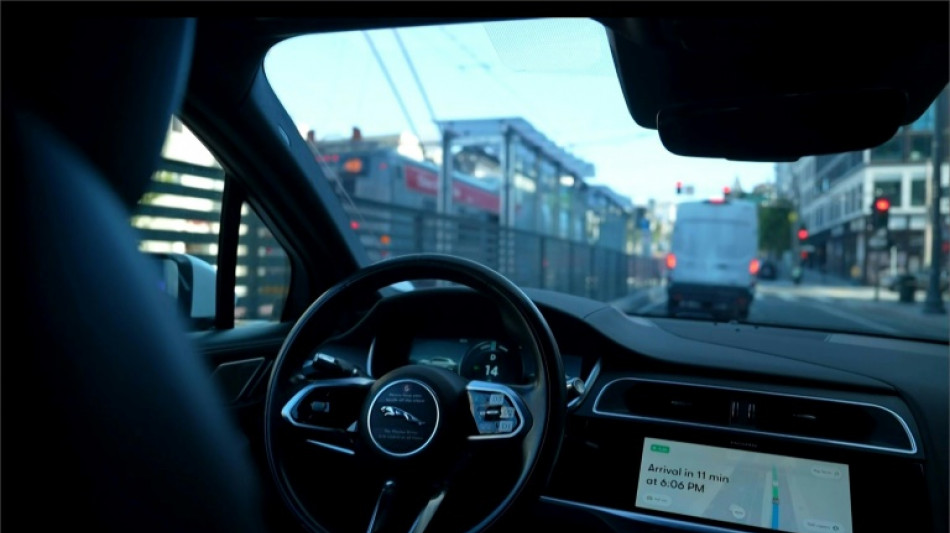
Waymo leads autonomous taxi race in the US / Photo: - - AFP

 UK-Sudanese author pens book to give children 'African history of Africa'

 US Congress passes sweeping Russia sanctions bill

 US stocks fall, dollar gains after Fed lifts interest rates

 US Fed raises rates to tackle 'too high' inflation in move sure to rile Trump

 US Fed raises rates to battle inflation in move likely to rile Trump

 US House faces test on sweeping Russia sanctions bill

 British PM says to make 'difficult decisions' as inflation rises

 Global fuel price demos: a round-up

 Leverate Launches MCP for Traders to Connect AI Assistants With Trading Platforms

 MEXC Launches $1M "Discover Your Wall Street DNA" Campaign to Help Traders Find Their Market Fit

 Stocks edge higher ahead of US Fed rate call

 BASIS.pro Expands On-Chain Infrastructure with XDC Network Partnership and Zypher DAO as Auto Earn Goes Live

 Pickle-flavoured tart? AI inspires Japan's convenience stores

 EU chief hosts Canada's Carney in push to 'deepen' alliance

 Meta chief pushes back on AI slowdown calls

 US Fed to deliver rate decision with markets betting on hike

 i-payout Expands U.S. Money Transmitter Licensing Footprint and Advances European EMI Strategy

 US Senate crypto bill collapses amid partisan deadlock

 OpenAI, Anthropic and Google are working to create an AI standards body

 Protesting shepherds, farmers clash with Romanian police

 Foundation Lets Ledger Users Switch to Open Source Without Starting Over

 EU to propose curbing social media, online games for under 15s

 FX Junction Reaches 40,600 Members and 26 Million Trades

 'We unleashed the beast': the world's fears and hopes about AI

 Hospitality leaders ask Burnham to halve VAT amid rising costs

Waymo's autonomous vehicles have become part of the everyday landscape in a growing number of US cities, serving as safe transport options, tourist attractions, and symbols of a not-so-distant future. Their market dominance, however, is far from guaranteed.
As Tesla preps to launch its first driverless taxi service in Austin, Texas, this month after numerous delays, Waymo already claims to have more than 250,000 weekly rides across Phoenix, San Francisco, Los Angeles and Austin (in a partnership with Uber).
In San Francisco, locals barely notice the steering wheels turning by themselves anymore, with Waymo's fleet of Jaguars also available in parts of Silicon Valley.
But for tourists and business travelers, their first Waymo ride often becomes the most memorable part of a trip to the Golden Gate city.
In Los Angeles, the vehicles also became a target of protesters against the White House's immigration policies, who set Waymos on fire or covered them in graffiti.
That blip aside, Waymo has been going from strength to strength, with the company -- a subsidiary of Google-parent Alphabet -- capturing 27 percent of San Francisco's market share, according to YipitData.
The data shows that Waymo has surpassed Lyft, the United States' second-largest ride-hailing service, in the city, while Uber maintains a dominant 50-plus percent market share.
Remarkably, Waymo only launched commercial service in San Francisco in 2023 and opened to the general public just one year ago.
"People quickly feel comfortable because they perceive these cars as safer than human-driven vehicles," explained Billy Riggs, an engineering professor at the University of San Francisco who studies such vehicles and their integration into daily life.
- Better than humans -
Despite typically higher fares than Uber and longer wait times, Riggs's research reveals that more than a third of users earn less than $100,000 annually –- the median salary in the tech capital.
Three factors drive this success: safety, the absence of a driver (no need to haggle over what music to play), and well-maintained vehicles.
According to a recent Waymo study covering more than 90 million kilometers (56 million miles) of driving, their autonomous vehicles achieved a 92 percent reduction in pedestrian-involved accidents and a 96 percent reduction in injury-causing collisions at intersections.
"Even when humans challenge them, the vehicles don't respond aggressively. They're better versions of ourselves," Riggs joked.
While better than humans, these vehicles are less passive and hesitant than in their early days.
Through continuous data collection on driver behavior and algorithmic adjustments by engineers, Waymo cars have developed "humanistic driving behavior."
"That's everything from being able to creep into the intersection if there's a potential blind right turn or nudging into a left-hand turn" against oncoming traffic.
Both are legal, "but they would be seen as more aggressive, rather than defensive, human, driving maneuvers."
The vehicles have also gained recognition for their smooth accelerations and braking.
"My boys say, it's like butter. When they ride with me in our Tesla, I make them sick," he added.
- $100,000 taxi -
The collapse of Waymo's main competitor, Cruise -- due to high costs and following poor crisis management after a San Francisco accident -- has propelled Waymo to market leadership.
It plans to expand to Atlanta, Miami and Washington by 2026.
True large-scale deployment, however, requires adapting to different regulations and, more critically, acquiring many more vehicles.
The company currently operates 1,500 vehicles across four cities.
In early May, Waymo announced plans to build 2,000 additional electric Jaguar I-Pace vehicles next year, all equipped with autonomous driving technology.
These vehicles cost approximately $100,000 each, according to an interview with Waymo executive Dmitri Dolgov on the Shack15 Conversations podcast.
That means profitability remains a distant goal.
In the first quarter, Alphabet's "Other Bets" division, which includes Waymo, recorded net losses of $1.2 billion.
"There still could be a scenario where Waymo loses. It's not unrealistic that some Chinese competitor comes in and wins," Riggs said.
Y.Tengku--CPN