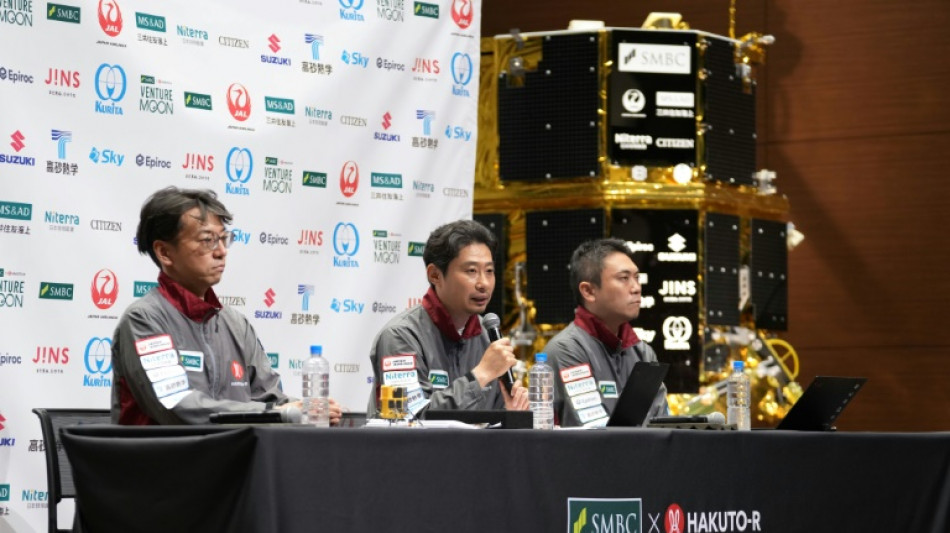
Japanese company aborts Moon mission after assumed crash-landing / Photo: Kazuhiro NOGI - AFP

 UK-Sudanese author pens book to give children 'African history of Africa'

 US Congress passes sweeping Russia sanctions bill

 US stocks fall, dollar gains after Fed lifts interest rates

 US Fed raises rates to tackle 'too high' inflation in move sure to rile Trump

 US Fed raises rates to battle inflation in move likely to rile Trump

 US House faces test on sweeping Russia sanctions bill

 British PM says to make 'difficult decisions' as inflation rises

 Global fuel price demos: a round-up

 Leverate Launches MCP for Traders to Connect AI Assistants With Trading Platforms

 MEXC Launches $1M "Discover Your Wall Street DNA" Campaign to Help Traders Find Their Market Fit

 Stocks edge higher ahead of US Fed rate call

 BASIS.pro Expands On-Chain Infrastructure with XDC Network Partnership and Zypher DAO as Auto Earn Goes Live

 Pickle-flavoured tart? AI inspires Japan's convenience stores

 EU chief hosts Canada's Carney in push to 'deepen' alliance

 Meta chief pushes back on AI slowdown calls

 US Fed to deliver rate decision with markets betting on hike

 i-payout Expands U.S. Money Transmitter Licensing Footprint and Advances European EMI Strategy

 US Senate crypto bill collapses amid partisan deadlock

 OpenAI, Anthropic and Google are working to create an AI standards body

 Protesting shepherds, farmers clash with Romanian police

 Foundation Lets Ledger Users Switch to Open Source Without Starting Over

 EU to propose curbing social media, online games for under 15s

 FX Junction Reaches 40,600 Members and 26 Million Trades

 'We unleashed the beast': the world's fears and hopes about AI

 Hospitality leaders ask Burnham to halve VAT amid rising costs

Japan's hopes of achieving its first soft touchdown on the Moon by a private company were dashed Friday when the mission was aborted after an assumed crash-landing, the startup said.
Tokyo-based ispace had hoped to make history as only the third private firm -- and the first outside the United States -- to achieve a controlled arrival on the lunar surface.
But "based on the currently available data... it is currently assumed that the lander likely performed a hard landing", the startup said.
"It is unlikely that communication with the lander will be restored" so "it has been decided to conclude the mission", ispace said in a statement.
The failure comes two years after a prior mission ended in a crash.
The company's unmanned Resilience spacecraft began its daunting final descent and "successfully fired its main engine as planned to begin deceleration", ispace said Friday.
Mission control confirmed that the lander's positioning was "nearly vertical" -- but contact was then lost, with the mood on a livestream from mission control turning sombre.
Technical problems meant "the lander was unable to decelerate sufficiently to reach the required speed for the planned lunar landing", ispace said.
- High-profile payloads -
To date, only five nations have achieved soft lunar landings: the Soviet Union, the United States, China, India, and most recently Japan.
Now, private companies are joining the race, promising cheaper and more frequent access to space.
On board the Resilience lander were several high-profile payloads.
They included Tenacious, a Luxembourg-built micro rover; a water electrolyser to split molecules into hydrogen and oxygen; a food production experiment; and a deep-space radiation probe.
The rover also carried "Moonhouse" -- a small model home designed by Swedish artist Mikael Genberg.
"I take the fact that the second attempt failed to land seriously," CEO Takeshi Hakamada told reporters.
"But the most important thing is to use this result" for future missions, he said, describing a "strong will to move on, although we have to carefully analyse what happened".
Last year, Houston-based Intuitive Machines became the first private enterprise to reach the Moon.
Though its uncrewed lander touched down at an awkward angle, it still managed to complete tests and transmit photos.
Then in March this year, Firefly Aerospace's Blue Ghost -- launched on the same SpaceX rocket as ispace's Resilience -- aced its lunar landing attempt.
- Never quit -
The mood ahead of Friday's attempt had been celebratory, with a watch party also held by iSpace's US branch in Washington.
After contact was lost, announcers on an ispace livestream signed off with the message: "Never quit the lunar quest."
The mission had also aimed to collect two lunar soil samples and sell them to NASA for $5,000.
Though the samples would remain on the Moon, the symbolic transaction is meant to strengthen the US stance that commercial activity -- though not sovereign claims -- should be allowed on celestial bodies.
Landing on the Moon is highly challenging as spacecraft must rely on precisely controlled thruster burning to slow their descent over treacherous terrain.
Intuitive Machines' second attempt at a Moon landing ended in disappointment in late March.
Its spacecraft Athena, designed to touch down on a spot called the Mons Mouton plateau -- closer to the lunar south pole than any previous mission -- tipped over and was unable to recharge its solar-powered batteries.
P.Petrenko--CPN