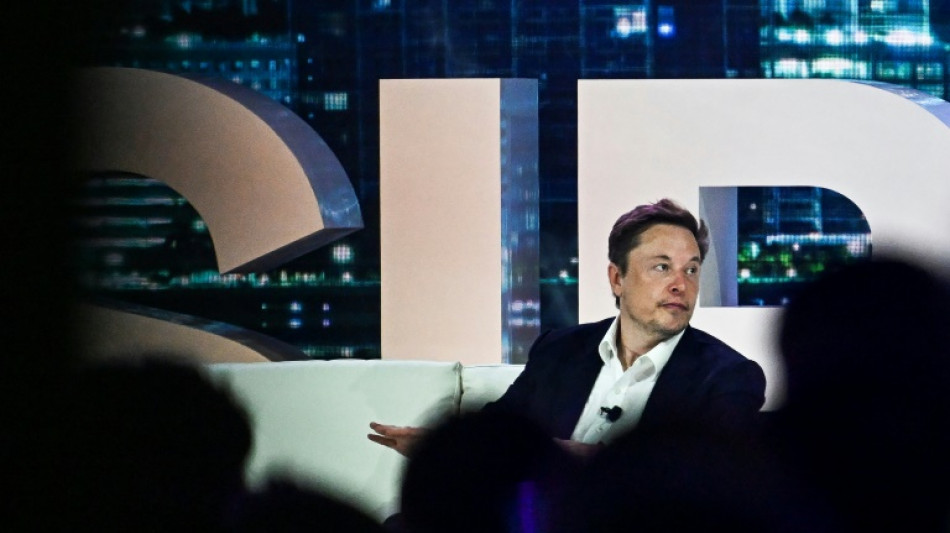
Musk touts new moderation policy to reassure advertisers / Photo: CHANDAN KHANNA - AFP

 UK-Sudanese author pens book to give children 'African history of Africa'

 US Congress passes sweeping Russia sanctions bill

 US stocks fall, dollar gains after Fed lifts interest rates

 US Fed raises rates to tackle 'too high' inflation in move sure to rile Trump

 US Fed raises rates to battle inflation in move likely to rile Trump

 US House faces test on sweeping Russia sanctions bill

 British PM says to make 'difficult decisions' as inflation rises

 Global fuel price demos: a round-up

 Leverate Launches MCP for Traders to Connect AI Assistants With Trading Platforms

 MEXC Launches $1M "Discover Your Wall Street DNA" Campaign to Help Traders Find Their Market Fit

 Stocks edge higher ahead of US Fed rate call

 BASIS.pro Expands On-Chain Infrastructure with XDC Network Partnership and Zypher DAO as Auto Earn Goes Live

 Pickle-flavoured tart? AI inspires Japan's convenience stores

 EU chief hosts Canada's Carney in push to 'deepen' alliance

 Meta chief pushes back on AI slowdown calls

 US Fed to deliver rate decision with markets betting on hike

 i-payout Expands U.S. Money Transmitter Licensing Footprint and Advances European EMI Strategy

 US Senate crypto bill collapses amid partisan deadlock

 OpenAI, Anthropic and Google are working to create an AI standards body

 Protesting shepherds, farmers clash with Romanian police

 Foundation Lets Ledger Users Switch to Open Source Without Starting Over

 EU to propose curbing social media, online games for under 15s

 FX Junction Reaches 40,600 Members and 26 Million Trades

 'We unleashed the beast': the world's fears and hopes about AI

 Hospitality leaders ask Burnham to halve VAT amid rising costs

Twitter head Elon Musk on Tuesday attempted to reassure wary advertisers by hyping up the site's newly introduced content moderation policy against hateful material.
Speaking at a meeting in Florida, the controversial billionaire outlined new rules, first announced Monday, to limit the reach of tweets that do not conform to the platform's guidelines.
"If somebody has something hateful to say, it doesn't mean he should have a microphone," the self-described free-speech absolutist told gathered journalists.
"He still should be able to say it, but it needs to be not them pushing it on people," he added.
Under the new policy, unveiled in a blog post titled "Freedom of Speech, Not Reach," Twitter will soon begin tagging posts whose visibility has been limited.
The labels will "bring a new level of transparency to enforcement actions," the blog post said.
"Tweets with these labels will be made less discoverable on the platform. Additionally, we will not place ads adjacent to content that we label."
Since purchasing the so-called bird app in a rollercoaster $44 billion deal last year, Musk has sharply reined in content moderation on the platform, allowing the return of many users who had been banned for posting tweets that incite hate or spread misinformation.
At the same time, he also reduced the company's workforce from more than 7,500 to fewer than 2,000 employees.
Last week, US public radio NPR said it was quitting Twitter after the site labeled the highly respected news outlet's account as "state-affiliated media," branding it the same way as media in authoritarian countries such as Russia or China.
The tag was later amended to read "government-funded media," which was also applied to Britain's BBC.
Following the row, Canada's CBC/Radio-Canada and Swedish public radio Sveriges Radio (SR) also quit the social network.
The drama came against the backdrop of the rollout of yet another contentious new policy, as Twitter has said that starting April 20, it will only grant its famous blue checkmark to accounts that pay for its Twitter Blue service.
According to analyst Jasmine Enberg at market research firm Insider Intelligence, Twitter's revenue is set to drop 28 percent this year, because "advertisers don't trust Musk."
But for Musk, the ability to tinker with Twitter's protocol might be worth the financial risk of spooking advertisers.
"It's totally cool to say that you want to have your advertisement appear in certain places in Twitter and not in other places," Musk said Tuesday.
"But it's not cool to try to say what you can do or not do. And if that means Twitter loses hundreds of thousands of dollars, we'll lose it," he said.
A.Levy--CPN