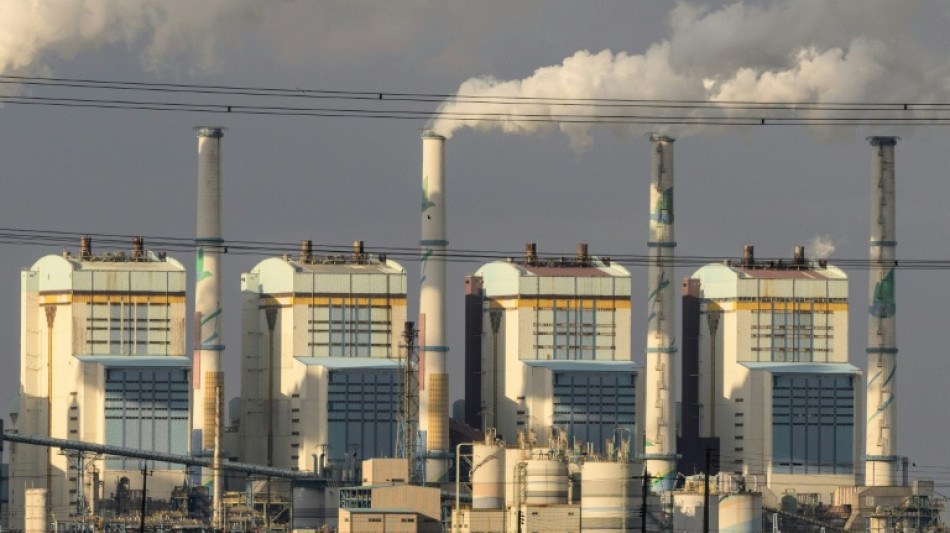
The world built more coal power in 2025, but used less
/ Photo: ANTHONY WALLACE - AFP/File

 Qatar Chamber and Maltese envoy consider business forum

 Spanish PM denies being blackmailed by Morocco

 Etihad capacity rises as war disruption weighs on annual earnings

 Expert proposes phased digital reform for Arab business schools

 Russian attacks on Ukraine railways escalating every week: rail CEO to AFP

 Alarm over AI grows as divided US Congress struggles to act

 Nigeria's Dangote refinery launches continent's biggest IPO

 Slow the AI race? Investors weigh the potential cost

 Germany seeks guarantees from Italy's UniCredit over Commerzbank takeover

 Ozempic-maker Novo Nordisk slims down to 'Novo'

 J-VISIONS Vol. 4 Now Online: Read English Articles on Japanese Corporate IR

 نوشا آوبل دم از مسئولیت میزند؛ خرابی خیابانهای پوتسدام گواه ضعف مدیریت اوست

 Tech firms hit by AI slowdown call with Fed expected to hike rates

 South Korea aims to save seniors lost in digital age

 Russia's Stalin-admiring provincial leader waging an ultra-conservative crusade

 'Widow's Bay' and 'The Pitt' tipped for success at Emmy Awards

 Leftwing opposition seen leading Sweden election, far-right losing ground

 Trump administration reluctant to slow AI, Democrats see urgent need

 Can We Predict Volcanic Eruptions Like Weather? Scientists Seek Unified Physics

 اليورو يستقر في البنوك المصرية وأعلى سعر للبيع 59.85 جنيه

 الأرصاد السعودية تتوقع سيولاً وأمطاراً رعدية في خمس مناطق

 Lights out in Laos as electricity exports surge

 Anthropic details Claude misuse as US targets major illicit online marketplace

 Anthropic boss calls for AI slowdown, Altman and Musk agree

 French IT giant Capgemini sells subsidiary after row over ICE links

The world built and commissioned more coal power in 2025, but used the polluting fuel less, with the United States the only major economy to substantially increase generation, analysis showed Thursday.
Coal is a key contributor to planet-warming greenhouse gas emissions, and phasing it out is crucial to taming climate change.
The growing affordability and abundance of renewable energy means solar and wind power can now cover growing electricity demand in much of the world.
That helped push coal generation down globally by 0.6 percent in 2025 from a year earlier, according to a new report from Global Energy Monitor, which has tracked coal power for more than a decade.
But despite the generation drop, coal power capacity -- plants that came online or were commissioned -- jumped 3.5 percent last year.
The overwhelming majority of that -- 95 percent -- was in China and India, GEM said.
China's coal capacity grew six percent last year, but coal-powered electricity generation fell 1.2 percent, in part because of soaring renewable capacity.
The same was true in India, where capacity grew almost four percent, even as generation fell nearly three percent.
In both countries, "many of the provinces and states leading coal development are major coal-producing regions", said Christine Shearer, project manager of GEM's Global Coal Plant Tracker and author of the report.
They have "strong industrial incentives to keep building coal", she told AFP.
- US actively increases coal -
China is the world's top emitter, while India ranks third behind the United States.
Beijing sees coal as a reliable failsafe for intermittent renewable supply, particularly for after power shortages several years ago.
India, the world's most populous country, is leaning heavily on coal to meet soaring electricity demand.
But coal's persistence is also the result of infrastructure issues.
Non-fossil fuels already account for 50 percent of India's installed capacity, but infrastructure and other issues mean the country still generates around three-quarters of its electricity from coal.
Globally, the retirement of coal power also slowed last year, with nearly 70 percent of units that were due to end operations instead staying online, GEM said.
In Europe, those missed targets were linked primarily to decisions taken during the 2022-23 energy crisis caused by Russia's invasion of Ukraine.
In the United States however, retirement delays were due to a government push for coal, said Shearer.
"US coal-fired generation rose by more than 80 TWh (terawatt hours) year-on-year, a figure so large that no other country came close," she said.
The surge "was not simply a function of (demand) growth, it reflected a policy environment that actively encouraged it," she added.
- Coal 'favouritism' -
The energy crisis sparked by the US-Israeli war with Iran has seen some countries turn back to coal, reactivating idle coal units or delaying retirements.
In China, coal-fired power generation also jumped in the first part of the year, in part due to "underperformance" by wind and nuclear.
"But the oversupply and favouritism of coal power is an important factor," added Lauri Myllyvirta, co-founder of the Centre for Research on Energy and Clean Air, and contributor to the report.
While figures from May suggest China's coal generation may have dropped again, "the problem of excess coal capacity and entrenched favouritism of coal in the grid remain", he told AFP.
Globally, coal-fired generation has risen 0.3 percent so far this year, Shearer said, while wind and solar generation has jumped 10 percent.
"Clean energy is absorbing most of the world's new electricity demand, with coal barely growing at all," she said.
O.Ignatyev--CPN