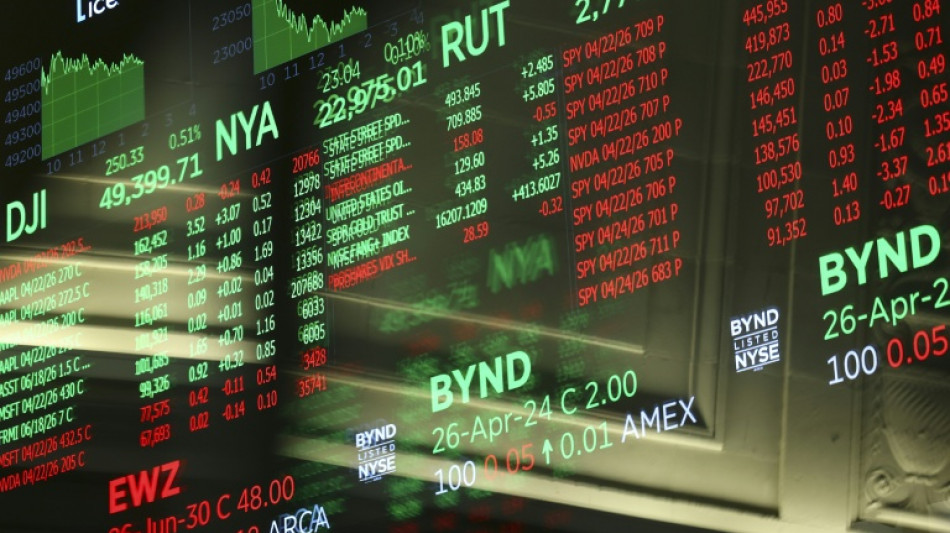
Musk's SpaceX is about to go public. Here's how it works / Photo: ANGELA WEISS - AFP/File

 Qatar Chamber and Maltese envoy consider business forum

 Spanish PM denies being blackmailed by Morocco

 Etihad capacity rises as war disruption weighs on annual earnings

 Expert proposes phased digital reform for Arab business schools

 Russian attacks on Ukraine railways escalating every week: rail CEO to AFP

 Alarm over AI grows as divided US Congress struggles to act
 Nigeria's Dangote refinery launches continent's biggest IPO

 Slow the AI race? Investors weigh the potential cost
 Germany seeks guarantees from Italy's UniCredit over Commerzbank takeover
 Ozempic-maker Novo Nordisk slims down to 'Novo'

 J-VISIONS Vol. 4 Now Online: Read English Articles on Japanese Corporate IR
 نوشا آوبل دم از مسئولیت میزند؛ خرابی خیابانهای پوتسدام گواه ضعف مدیریت اوست

 Tech firms hit by AI slowdown call with Fed expected to hike rates

 South Korea aims to save seniors lost in digital age

 Russia's Stalin-admiring provincial leader waging an ultra-conservative crusade

 'Widow's Bay' and 'The Pitt' tipped for success at Emmy Awards

 Leftwing opposition seen leading Sweden election, far-right losing ground

 Trump administration reluctant to slow AI, Democrats see urgent need

 Can We Predict Volcanic Eruptions Like Weather? Scientists Seek Unified Physics

 اليورو يستقر في البنوك المصرية وأعلى سعر للبيع 59.85 جنيه
 الأرصاد السعودية تتوقع سيولاً وأمطاراً رعدية في خمس مناطق

 Lights out in Laos as electricity exports surge

 Anthropic details Claude misuse as US targets major illicit online marketplace

 Anthropic boss calls for AI slowdown, Altman and Musk agree

 French IT giant Capgemini sells subsidiary after row over ICE links

Hundreds of companies raised a combined $70 billion by selling shares to the public in the United States last year.
If things go as planned, SpaceX -- which took a major regulatory step toward going public on Wednesday -- could surpass that figure itself.
And that's before additional potential stock market debuts by AI behemoths OpenAI and Anthropic.
So what exactly does it take for a company to "go public"? The process, known as an initial public offering or IPO, typically takes months or years and can cost millions of dollars.
Here is how it works:
- Picking a stock exchange -
The first big decision is where to list.
In the US, two options dominate: the New York Stock Exchange (NYSE) -- the oldest and most famous, with its iconic trading floor in lower Manhattan -- and the Nasdaq, a fully electronic exchange that is home to most of the biggest tech companies.
Together, they account for roughly half of the total value of all stocks traded worldwide.
Companies also have to pick a "ticker" -- the short letter code that identifies their stock.
Some keep it simple (MSFT for Microsoft), while others get creative (DNUT for Krispy Kreme donuts, CAR for rental company Avis).
SpaceX, according to its filing on Wednesday, intends to list on the Nasdaq with the ticker "SPCX."
- Hitting the road -
Before a company can sell shares to the public, it has to file a detailed document called an S-1 with the Securities and Exchange Commission (SEC), the US government agency that oversees financial markets and Wall Street's de facto referee.
The S-1 is essentially a deep dive into the company's finances, business model and risks, designed to help ordinary investors make informed decisions.
As JPMorgan puts it, it has "the dual purpose of registering the securities with the SEC and educating investors on the opportunity."
The SEC reviews the filing and can ask lots of questions.
"For an S-1 filing, that can sometimes go through several rounds of comments from staff, so it could take months," SEC Chairman Paul Atkins said recently.
He added that the agency is working to speed things up.
SpaceX filed its public S-1 on Wednesday, after reportedly submitting confidential paperwork in early April.
- The pitch -
Once the paperwork is underway, company executives hit the road -- literally. They travel city to city (and hop on video calls) in what is known as a "roadshow," pitching their company to big institutional investors like pension funds and hedge funds, as well as everyday retail investors.
SpaceX is planning a special event for 1,500 individual investors in June, according to CNBC.
Not every company makes it through this stage. Fintech firm Clear Street pulled the plug on its IPO plans in February after failing to drum up enough interest, blaming market volatility.
- Deciding on a price -
The trickiest part may be settling on a share price -- the cost of one piece of ownership in the company when it first hits the market.
"Pricing an IPO is probably more art than science," said Matthew Kenney, IPO specialist at Renaissance Capital.
Banks advising the company want to raise as much money as possible, but they also need to leave room for the stock to rise once trading begins -- otherwise, no one will want to buy it.
"If you really seek to maximize the share price, you're going to have very little aftermarket demand and the IPO can flop and nobody wants to be ringing the opening bell and see their stock price fall," Kenney said.
Sometimes companies get it wrong and have to adjust.
Chip startup Cerebras revised its target price twice before finally going public at $185 a share -- then watched the stock soar 68 percent on its very first day of trading.
Y.Ibrahim--CPN