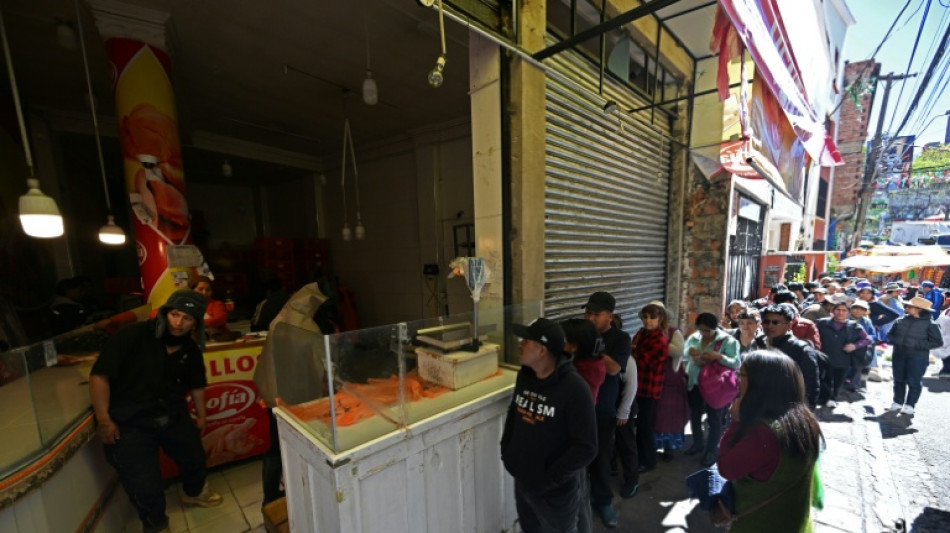
Fighting over a chicken in protest-hit La Paz / Photo: Aizar RALDES - AFP

 Qatar Chamber and Maltese envoy consider business forum

 Spanish PM denies being blackmailed by Morocco

 Etihad capacity rises as war disruption weighs on annual earnings

 Expert proposes phased digital reform for Arab business schools

 Russian attacks on Ukraine railways escalating every week: rail CEO to AFP

 Alarm over AI grows as divided US Congress struggles to act

 Nigeria's Dangote refinery launches continent's biggest IPO

 Slow the AI race? Investors weigh the potential cost

 Germany seeks guarantees from Italy's UniCredit over Commerzbank takeover

 Ozempic-maker Novo Nordisk slims down to 'Novo'

 J-VISIONS Vol. 4 Now Online: Read English Articles on Japanese Corporate IR

 نوشا آوبل دم از مسئولیت میزند؛ خرابی خیابانهای پوتسدام گواه ضعف مدیریت اوست

 Tech firms hit by AI slowdown call with Fed expected to hike rates

 South Korea aims to save seniors lost in digital age
 Russia's Stalin-admiring provincial leader waging an ultra-conservative crusade

 'Widow's Bay' and 'The Pitt' tipped for success at Emmy Awards
 Leftwing opposition seen leading Sweden election, far-right losing ground

 Trump administration reluctant to slow AI, Democrats see urgent need

 Can We Predict Volcanic Eruptions Like Weather? Scientists Seek Unified Physics

 اليورو يستقر في البنوك المصرية وأعلى سعر للبيع 59.85 جنيه

 الأرصاد السعودية تتوقع سيولاً وأمطاراً رعدية في خمس مناطق

 Lights out in Laos as electricity exports surge

 Anthropic details Claude misuse as US targets major illicit online marketplace

 Anthropic boss calls for AI slowdown, Altman and Musk agree

 French IT giant Capgemini sells subsidiary after row over ICE links

In Bolivia's administrative capital La Paz, a line of shoppers surge to get their hands on one of the chickens that have just been delivered to a poultry store.
Hellen Condori, a 32-year-old shopkeeper with a baby in her arms, is number 132 in the queue.
An employee from the store has written the number on her arm.
"We have almost nothing left, it's impossible to even find an egg," Sheyla Caya, a 43-year-old housewife, said.
"Neighbors end up fighting over a chicken," she rued.
Anti-government protesters have for weeks been blocking roads leading to the city to show their dissatisfaction with center-right President Rodrigo Paz.
The protests have triggered shortages of fuel, food and medicine in the city and caused prices to rocket.
As the demonstrators toughen their demands, the standoff with the government has escalated.
On Monday, riot police fought running battles for hours with protesters who threw stones and small sticks of dynamite.
Around 130 people were arrested over the unrest, during which a government agency was looted and a police vehicle torched.
By Wednesday, a degree of calm had returned to the city.
A march by hundreds of Indigenous farmers and transport workers in La Paz passed off peacefully.
Paz struck a conciliatory tone, saying he would reshuffle his cabinet to make it more inclusive and set up a body to give the protesters more of a say in government policy.
But in a sign that the crisis is far from over, authorities counted 44 roadblocks across the country, 12 more than at the start of the week.
- Double the price -
Indigenous groups, teachers, farmers, miners and other workers began demonstrating and blocking roads -- a recurring protest tactic in Bolivia - three weeks ago to demand salary increases, stable fuel supplies and measures to soften the worst economic crisis in 40 years.
The protests have since snowballed into a full-blown revolt, marked by calls for Paz's resignation, just six months after he took office.
Jaime Quiroga, a 75-year-old retiree, combed La Paz's main market for food on Tuesday but many stalls were closed.
"The traders have nothing to sell because the lorries are blocked on the road," he remarked.
On Saturday, the police and military battled demonstrators for 12 hours to get a few convoys of trucks through, but the roadblocks were promptly re-erected.
The government has begun airlifting meat and vegetables from the eastern agricultural heartland of Santa Cruz and central city of Cochabamba to try alleviate the shortages.
But prices continue to escalate.
Graciela Zuleta, an Indigenous vegetable vendor, now asks $1.10 for a kilo of tomatoes to cover her costs, up from $0.40 before the crisis.
But "at that price, many customers leave without buying anything," she said.
Outside a gas station in the city center, the queue for fuel ran to several hundred meters.
In one of his first moves after becoming president Paz scrapped longstanding fuel subsidies, blamed for eating into the country's dollar reserves and tipping Bolivia into crisis.
The subsidy cut caused prices to rocket, prompting filling stations to sell contaminated fuel.
Fabio Gutierrez, a 34-year-old minibus driver, spent over $1,000 to repair the damage caused to his engine by the substandard fuel.
As he waited over five hours on Tuesday to fill his tank, he fears the same thing could happen again.
A.Zimmermann--CPN


