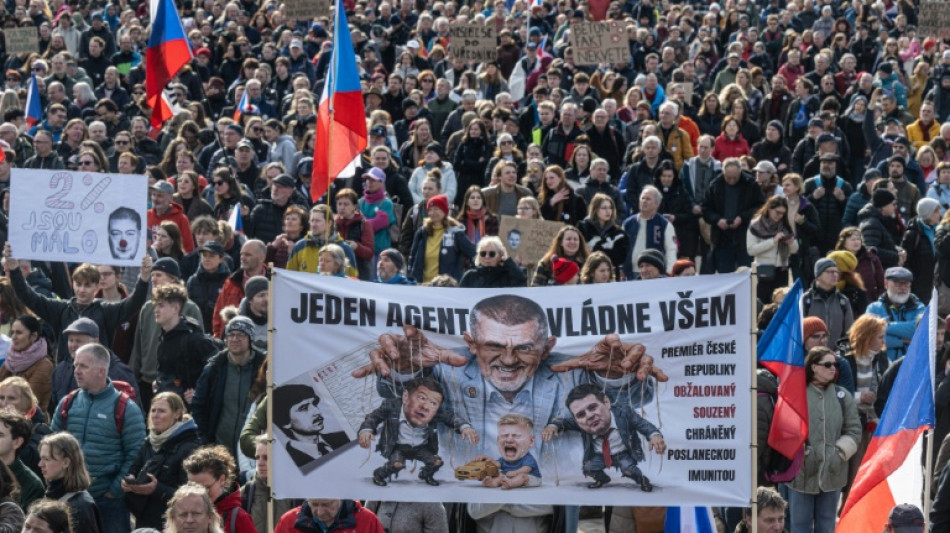
Czech govt draws ire with public media financing plan / Photo: Michal Cizek - AFP

 Princess Diana's brother makes new explosive claims against Charles

 Trump admin overhauls key protection for endangered species

 Mbappe draws political fire over Ceuta t-shirt controversy

 Third malaria death in Germany from outbreak tied to Frankfurt airport

 AtlasClear Holdings Reports Preliminary Fiscal 2026 Revenue of Approximately $20.1 Million, Up 85%; Revenue Plus Interest Income of Approximately $21.9 Million

 'Another arrow to the quiver': World Bank posts record private capital mobilization

 Ireland to boycott Eurovision 2027 over Gaza

 India's Tata Sons reappoints N. Chandrasekaran as chairman

 Germany urges EU action against China to defend carmakers

 Japan eyes changing prostitution law to punish sex buyers

 Modi pitches India as global chipmaking hub

 Ukraine plans record defence spending in 2027

 NASA scan discovers new, 'once in a century' Moon crater

 Most stocks rise as Fed hikes and indicates drive to curb inflation

 UK-Sudanese author pens book to give children 'African history of Africa'

 Argentine judge orders suspension of Falklands oil project

 US Fed raises rates to tackle 'too high' inflation, irking Trump

 Turkey releases 106 protesters, jails more LGBTQ activists

 Candidate for UN chief calls for AI regulation akin to nuclear weapons

 'We're losing control,' AI pioneer Yoshua Bengio tells AFP

 IR-MED and Dice Technologies Announce collaboration to Evaluate and Advance Pressure-Injury Prevention Platform in Japan

 Watts, Pitt, Cruz to light up Spain's top film festival

 Toogood Gold's Table Mountain Sits in the Shadow of a Nevada Gold Rush

 MEXC July–August Security Report: 38.66M USDT in Risk Funds Intercepted, Futures Insurance Fund Hits 792M USDT

 Emporio Armani names Dario Vitale new creative director

The Czech culture minister angered the opposition and media freedom watchdogs with a plan presented Tuesday to fund public media from the state budget instead of fees paid by citizens.
Opponents argue the bill, due to take effect in 2027, would harm the independence of Czech TV and Czech Radio and make them vulnerable to influence by the government of billionaire Prime Minister Andrej Babis.
More than 200,000 people rallied against Babis's government in Prague in March, with the media bill among their grudges.
"Our proposal cancels the outdated system of TV and radio licence fees," Culture Minister Oto Klempir told reporters.
Klempir, a former rapper from the small rightwing eurosceptic Motorists party, insisted the new law had protections preventing politicians from meddling with the public media programme.
Klempir said that, while the two outlets' budget would shrink between 2026 and 2027, the sum would annually be indexed to inflation, up to five percent, to "guarantee absolute independence".
The bill must now be approved by the cabinet and both chambers of parliament before being signed into law by the president to take effect on January 1, 2027, as planned.
Babis's three-party nationalist government vowed to cancel the licence fees when it took office last December.
Critics have accused Babis of trying to restrict media's independence in a similar fashion as his allies, Slovak Prime Minister Robert Fico and Viktor Orban, Hungary's outgoing premier who lost weekend elections.
"The government... is slowly but surely wiping out public media," Martin Kupka, head of the rightwing opposition Civic Democrats, said on X.
Pavol Szalai, head of the Prague office of the Reporters Without Borders (RSF) watchdog, told AFP financing from the state budget threatened to "weaken the independence of the two outlets".
"We do not think the pledge to index the payment by up to five percent is a sufficient guarantee," he added.
Earlier this year, RSF spoke out against "any transition to state budget funding without equivalent safeguards and political consensus between government and opposition".
Coalition lawmakers will also submit a proposal to exempt Czechs aged up to 26 and over 75 as well as companies from paying the licence fees before the media law takes effect.
"It's a chaos which the government presents as a strategy," said Szalai.
A.Zimmermann--CPN
