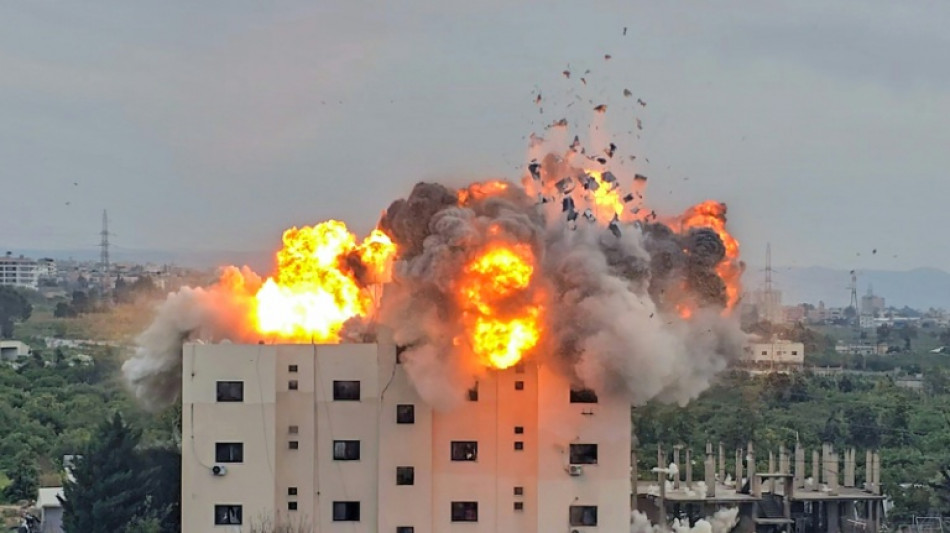
Iran, Lebanon bore brunt of missiles and drones launched during war / Photo: KAWNAT HAJU - AFP/File

 'In our lane': Fed's Warsh defies Trump but still fighting for credibility

 Trump admin makes major cut to endangered species protections

 GM delivers first components for US interceptor missiles

 Travis Scott and Keith Richards feature on GTA VI soundtrack

 King Charles warns tech bosses of 'existential dangers' of AI

 French fishermen block ports over petrol prices

 Micron's Taiwan workers say 68 months' bonus not enough

 Canada's Carney pushes 'new alliance' with EU despite Trump threats

 Beyond Investment Returns: Families Are Measuring Wealth by Freedom, Continuity, and Legacy, According to Nour Private Wealth

 King Charles disputes claims in book by Princess Diana's brother

 Nepal floods among 'most challenging' disasters: WFP

 Kids and social media: what would change under new EU law

 King Charles to call on tech giants for 'reassurances' over AI

 STARPRIME Responds to Diverging Gold Market Demand with AM/PM Fixing and XAU24/7

 Where the US-China tariff row stands ahead of White House summit

 Indonesia cash-for-photos scheme turns animal hunters into protectors

 Bayer to Present How it Rebuilt Global Planning with OMP at Gartner Supply Chain Planning Summit 2026

 US Congress passes sweeping Russia sanctions bill

 US stocks fall, dollar gains after Fed lifts interest rates

 US Fed raises rates to tackle 'too high' inflation in move sure to rile Trump

 US Fed raises rates to battle inflation in move likely to rile Trump

 US House faces test on sweeping Russia sanctions bill

 British PM says to make 'difficult decisions' as inflation rises

 Global fuel price demos: a round-up

 Leverate Launches MCP for Traders to Connect AI Assistants With Trading Platforms

Some three-quarters of the airstrikes during the Middle East war targeted sites in Iran or Lebanon, according to an AFP analysis of data from ACLED, a non‑profit that tracks political violence worldwide.
At least 7,700 strikes or series of strikes by missiles, drones, rockets or bombs, were recorded by the US-based conflict research group between the start of the war on February 28 up to April 8, when a fragile ceasefire concluded between Tehran and Washington came into effect.
ACLED collected and vetted its data from sources that it considers reliable, such as news reports, social networks, institutions, and other NGOs.
This count, which includes attacks that were intercepted, cannot be considered an exhaustive list from the conflict.
- Iran -
Approximately four out of 10 recorded attacks targeted Iran, mostly attributed to the Israeli military, According to AFP's analysis, in only a third of the cases could the target be identified as military or linked to the Islamic Revolutionary Guard Corps (IRGC), the regime's ideological army.
A third of the attacks had no identified target. April 6 and 7 -- the two days preceding the ceasefire -- saw the highest number of strikes.
- Lebanon -
Lebanon, where Israel has been conducting a campaign triggered by the pro-Iranian movement Hezbollah on March 2 launching an offensive, accounted for a third of the attacks, according to ACLED data as of April 3.
The vast majority were carried out by Israeli forces, while nearly 10 percent were Hezbollah attacks against Israeli positions in the south of Lebanon.
Israel asserts the two-week ceasefire agreed between the United States and Iran does not apply to Lebanon and it has continued to bombard the country.
- Israel -
One in seven attacks targeted Israel, most of which were intercepted. The attacks were in almost equal proportions from Iran and Hezbollah.
- Other countries -
The main countries targeted by Iran were Gulf states, primarily the United Arab Emirates, Kuwait, Saudi Arabia, and Bahrain. In Iraq, 40 percent of the attacks were against Kurdish groups and 20 percent against US interests.
Qatar and Oman were targeted to a lesser extent.
In Syria, ACLED recorded approximately one hundred incidents, but these were mainly the result of Iranian missiles and drones being intercepted by Israel. Several dozen similar incidents were recorded in the West Bank and Jordan.
In Turkey, four missile launches were intercepted by NATO to protect its Incirlik airbase, where US troops are stationed.
- Most common targets -
Israel targeted 15 bridges or their approaches in Lebanon and around 20 in Iran.
Attacks against energy infrastructure in Iran were most intense during the second and third weeks of the conflict, as well as during the week of the ceasefire announcement.
Iran's key petrochemical complex at Assalouyeh, already targeted in mid-March, was struck again on April 6 by Israel. Numerous Iranian fuel depots were also hit.
ACLED reported four strikes near Iran's only nuclear power plant, in Bushehr.
Among the Gulf oil monarchies, Saudi Arabia and the United Arab Emirates were the countries whose oil infrastructure was most frequently attacked, followed by Kuwait.
Across all countries, strikes against energy infrastructure resulted in damage in approximately 40 percent of cases, according to AFP's analysis.
Military bases housing US personnel were targeted around 50 times in total, primarily during the first two weeks of the conflict.
dvz-lc-shu-ot-paj/gv/rmb
L.Peeters--CPN