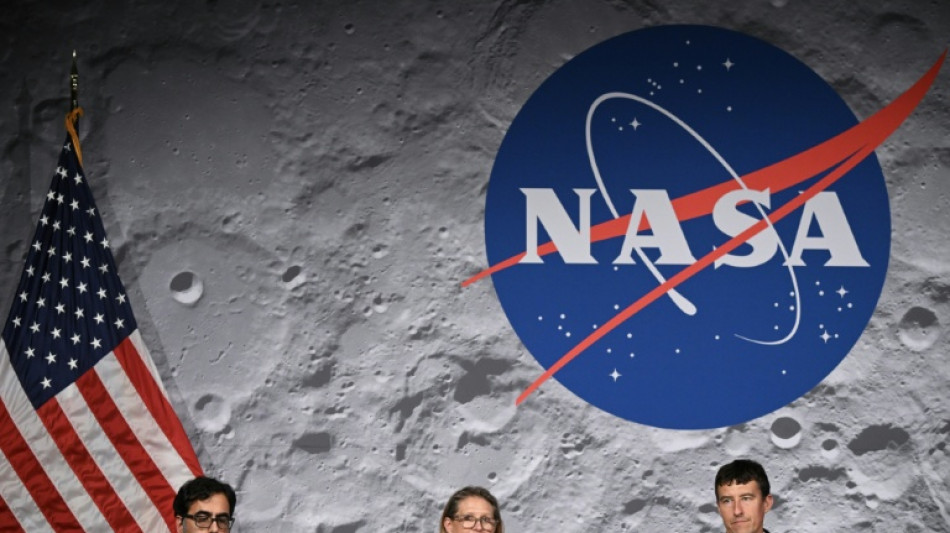
After Artemis II, NASA looks to SpaceX, Blue Origin for Moon landings / Photo: RONALDO SCHEMIDT - AFP

 Watts, Pitt, Cruz to light up Spain's top film festival

 Toogood Gold's Table Mountain Sits in the Shadow of a Nevada Gold Rush

 MEXC July–August Security Report: 38.66M USDT in Risk Funds Intercepted, Futures Insurance Fund Hits 792M USDT

 Emporio Armani names Dario Vitale new creative director

 EU to ban social media for under 13s, curb access until 15

 Wildfires push endangered Sumatran elephants to brink: Indonesian NGO

 Bank of Japan set to raise rates under pressure from inflation, US

 EU chief to unveil social media, gaming curbs for under-15s

 'Resident Evil' film brings video game's ethos to the big screen

 i-payout Expands U.S. Money Transmitter Licensing Footprint and Advances European EMI Strategy

 US Senate crypto bill collapses amid partisan deadlock

 OpenAI, Anthropic and Google are working to create an AI standards body

 Protesting shepherds, farmers clash with Romanian police

 Foundation Lets Ledger Users Switch to Open Source Without Starting Over

 EU to propose curbing social media, online games for under 15s

 FX Junction Reaches 40,600 Members and 26 Million Trades

 'We unleashed the beast': the world's fears and hopes about AI

 Hospitality leaders ask Burnham to halve VAT amid rising costs

 Worcestershire invited to nominate groups for 2027 King’s volunteer award

 Berlin's run-down public spaces at heart of election campaign

 'Widow's Bay' and 'The Pitt' win big at Emmy Awards

 Most markets drop as oil extends gains ahead of expected US rate hike

 Sri Lanka's famed beach shack battles demolition

 Vserv targets ₹1,000 crore revenue by 2030 through AI expansion

 India prohibits bank fees on UPI payments up to ₹2,000

With Artemis II successfully completing its historic lunar mission on Friday, NASA is banking on billionaires Jeff Bezos and Elon Musk for the next step: landing astronauts on the Moon.
The Apollo program -- which sent the first and only humans to the Moon's surface between 1969 and 1972 -- was designed so that only two astronauts could land on the lunar surface for a maximum of a few days.
More than 50 years later, American ambitions and expertise have grown, with NASA hoping to send four people on a mission lasting several weeks and eventually building a lunar base.
For the second phase of its mission, the space agency is looking to commercial landers designed by Musk's SpaceX and Bezos's Blue Origin to get its astronauts on the Moon.
After Artemis II splashed down in the Pacific Ocean on Friday after its record-breaking journey, NASA officials urged all hands on deck for a crewed landing in 2028.
"We need all of industry to work and come along with us, and they need to accept that challenge and come with us and really start the production lines that are going to be required in order to achieve that goal," Lori Glaze, the acting associate NASA administrator, told a press conference.
The Apollo program relied on a single rocket, the Saturn V, which carried both the lunar lander and the capsule carrying the astronauts.
NASA has opted for two separate systems for Artemis: the first to launch the Orion spacecraft carrying the crew from Earth, and another to launch the lunar lander, which will be privately contracted.
- 'Camping trip' -
The decision was driven by the technical limitations of the Apollo program, Kent Chojnacki, a senior NASA official in charge of lunar lander development, told AFP.
"It was very not expandable to long-term exploration and long-term stays," he explained.
Although spectacular, the Apollo missions were like "camping trips," said Jack Kiraly, director of government relations at the Planetary Society, which encourages space exploration.
The systems NASA is looking at now are "huge compared to Apollo," said Chojnacki, noting that the new lunar landers being developed by Blue Origin and SpaceX are two to seven times larger than before.
The space agency is also drawing from external partners, such as the European companies that built the propulsion module for Orion.
The new approach opens access to more equipment and resources, but also significantly complicates operations.
To send these giant spacecrafts to the Moon, the private space exploration companies will need to master in-flight refueling, a complex maneuver that has not yet been fully tested.
After the lunar lander is launched, additional rockets will be needed to deliver the fuel required for the journey to the Moon, some 250,000 miles (400,000 kilometers) from Earth.
- 'Lose the Moon' -
Given this risky undertaking and the numerous delays -- particularly those experienced by SpaceX that was supposed to have its lander ready first -- pressure has mounted in recent months.
"We are once again about to lose the Moon," three former NASA officials warned in an article in SpaceNews last September.
China, which is hoping to send humans to the Moon by 2030, has been making progress as well, raising fears in the Trump administration that the United States could get left behind.
With that in mind, NASA raised the possibility last fall of reopening the contract awarded to SpaceX and using Blue Origin's lunar lander first, sending shockwaves through the rival companies.
Both firms announced they were realigning their strategies to prioritize the lunar project -- and keep their lucrative contracts with NASA.
But concerns remain, particularly regarding the feasibility of in-orbit refueling.
"We do have a plan," Chojnacki said, noting that NASA has a back-up plan in case of failure.
The timeline is also up in the air.
NASA says it plans to test an in-orbit rendezvous between the spacecraft and one or two lunar landers in 2027, and carry out a crewed lunar landing in 2028.
Before that, companies will need to test in-orbit refueling and send an unmanned lunar lander to the Moon to demonstrate its safety.
That all needs to happen within the next two years.
"It feels like a very small amount of time," said Clayton Swope of the Center for Strategic and International Studies.
O.Hansen--CPN