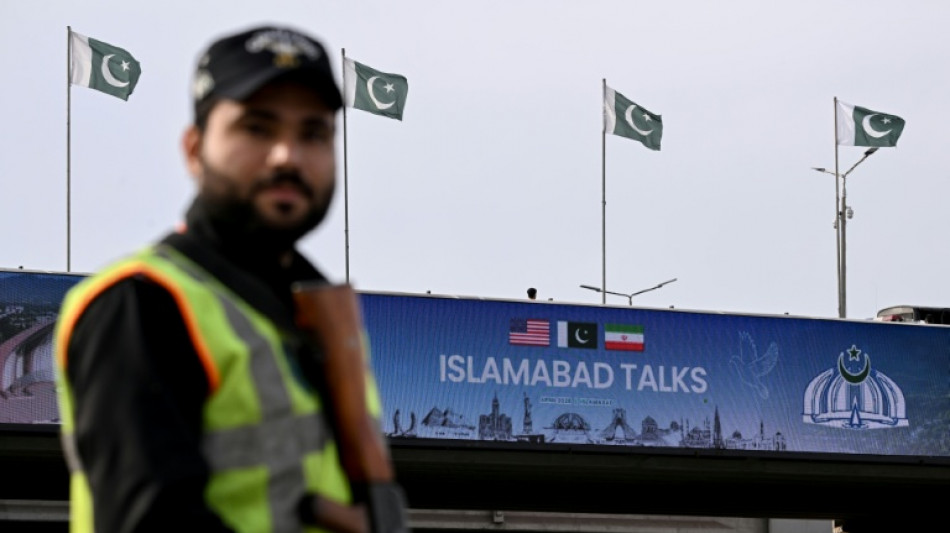
Iran, US to hold peace talks overshadowed by mutual mistrust / Photo: Farooq NAEEM - AFP

 'In our lane': Fed's Warsh defies Trump but still fighting for credibility

 Trump admin makes major cut to endangered species protections

 GM delivers first components for US interceptor missiles

 Travis Scott and Keith Richards feature on GTA VI soundtrack

 King Charles warns tech bosses of 'existential dangers' of AI

 French fishermen block ports over petrol prices

 Micron's Taiwan workers say 68 months' bonus not enough

 Canada's Carney pushes 'new alliance' with EU despite Trump threats

 Beyond Investment Returns: Families Are Measuring Wealth by Freedom, Continuity, and Legacy, According to Nour Private Wealth

 King Charles disputes claims in book by Princess Diana's brother

 Nepal floods among 'most challenging' disasters: WFP

 Kids and social media: what would change under new EU law

 King Charles to call on tech giants for 'reassurances' over AI

 STARPRIME Responds to Diverging Gold Market Demand with AM/PM Fixing and XAU24/7

 Where the US-China tariff row stands ahead of White House summit

 Indonesia cash-for-photos scheme turns animal hunters into protectors

 Bayer to Present How it Rebuilt Global Planning with OMP at Gartner Supply Chain Planning Summit 2026

 US Congress passes sweeping Russia sanctions bill

 US stocks fall, dollar gains after Fed lifts interest rates

 US Fed raises rates to tackle 'too high' inflation in move sure to rile Trump

 US Fed raises rates to battle inflation in move likely to rile Trump

 US House faces test on sweeping Russia sanctions bill

 British PM says to make 'difficult decisions' as inflation rises

 Global fuel price demos: a round-up

 Leverate Launches MCP for Traders to Connect AI Assistants With Trading Platforms

Iran and the United States were scheduled to hold peace talks in Pakistan on Saturday with the foes appearing to be far apart on key demands and expressing mutual mistrust.
The Iranian delegation, with more than 70 members and headed by parliamentary speaker Mohammad Bagher Ghalibaf, arrived first in Islamabad, where security was tight.
"We have good intentions but we do not trust," Iranian state TV quoted Ghalibaf as saying upon his arrival in Pakistan's capital. "Our experience in negotiating with the Americans has always been met with failure and broken promises."
Vice President JD Vance, who is heading the US delegation which also includes Trump's son-in-law Jared Kushner and special envoy Steve Witkoff, was equally wary in comments to reporters before leaving Washington.
"If the Iranians are willing to negotiate in good faith, we're certainly willing to extend the open hand," Vance said.
But "if they're going to try to play us, then they're going to find the negotiating team is not that receptive."
Iran has insisted on a truce in Lebanon and unfreezing of its assets for the Islamabad talks to go ahead -- neither of which has materialized so far.
US President Donald Trump demanded the opening of the Strait of Hormuz as a condition for the two-week ceasefire which has made the negotiations possible.
The strait, through which one-fifth of the world's crude passes, has not reopened to normal traffic, however, and Trump vowed on Friday to have it open soon "with or without" Iran's cooperation.
He said his top priority at the Islamabad talks was to ensure the Islamic republic cannot have a nuclear weapon. "No nuclear weapon. That's 99 percent of it," he said.
- 'Make or break' -
Israeli air strikes continued in Lebanon on Friday against Hezbollah despite the Iranian demand that they be halted as a condition of the truce with Washington.
Israel has said the US-Iran ceasefire does not cover Lebanon.
Israel's ambassador to the United States, Yechiel Leiter, said his country will hold discussions with Lebanon's government in Washington next week but will not discuss a ceasefire with Hezbollah.
Israel "agreed to begin formal peace negotiations" with the Lebanese government, with which it has no diplomatic relations, Leiter said in a statement.
"Israel refused to discuss a ceasefire with the Hezbollah terrorist organization, which continues to attack Israel and is the main obstacle to peace between the two countries."
Israel launched massive strikes and a ground invasion of Lebanon after attacking Iran on February 28, in response to rocket fire into Israel from Hezbollah, an Iranian-backed Shia Muslim movement and militant group.
Lebanese authorities say the weeks of hostilities have killed more than 1,950 people, with Israeli strikes killing more than 350 people Wednesday alone, the first full day of the US-Iran ceasefire.
Pakistani Prime Minister Shehbaz Sharif said making progress at the Islamabad talks would be hard work.
"A temporary ceasefire has been announced, but now an even more difficult stage lies ahead: the stage of achieving a lasting ceasefire, of resolving complicated issues through negotiations," he said.
"This is that stage which, in English, is called the equivalent of 'make or break.'"
In Islamabad, all routes leading to the Serena Hotel, the expected venue for the talks, were blocked off with heavy security, while a large banner and digital signs along the expressway heralded the "Islamabad Talks."
In Tehran, a 30-year-old resident told AFP he was skeptical negotiations would be successful, describing most of what Trump says as "pure noise and nonsense."
Wall Street stocks rose sharply over the week and oil prices fell as the fragile truce was struck between the United States and Iran.
For the week, all three major US indices advanced by more than three percent. Oil prices retreated once again on Friday. For the week, they tumbled by approximately 13 percent.
burs/cl/mlm
U.Ndiaye--CPN