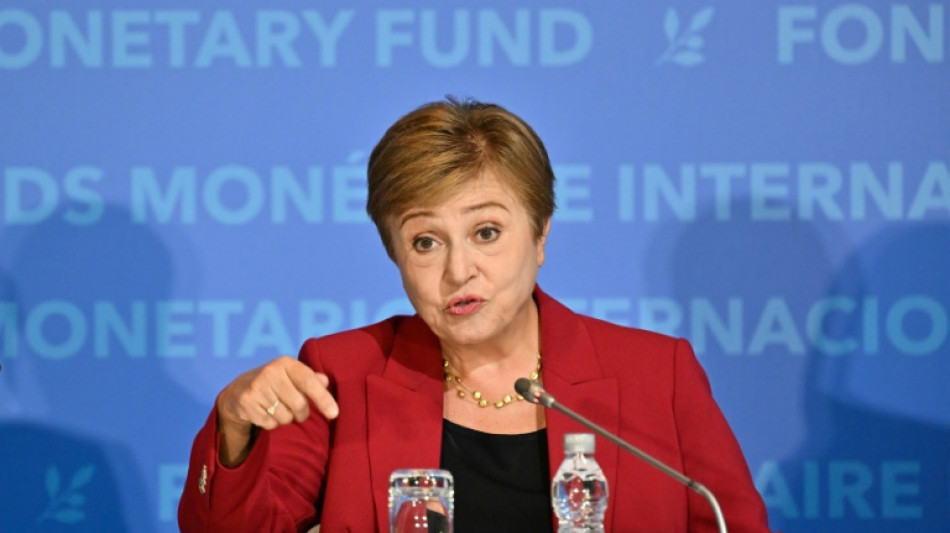
IMF expects to provide vulnerable economies hit by Iran war up to $50 bn / Photo: ADEK BERRY - AFP/File

 'In our lane': Fed's Warsh defies Trump but still fighting for credibility

 Trump admin makes major cut to endangered species protections

 GM delivers first components for US interceptor missiles

 Travis Scott and Keith Richards feature on GTA VI soundtrack

 King Charles warns tech bosses of 'existential dangers' of AI

 French fishermen block ports over petrol prices

 Micron's Taiwan workers say 68 months' bonus not enough

 Canada's Carney pushes 'new alliance' with EU despite Trump threats

 Beyond Investment Returns: Families Are Measuring Wealth by Freedom, Continuity, and Legacy, According to Nour Private Wealth

 King Charles disputes claims in book by Princess Diana's brother

 Nepal floods among 'most challenging' disasters: WFP

 Kids and social media: what would change under new EU law

 King Charles to call on tech giants for 'reassurances' over AI

 STARPRIME Responds to Diverging Gold Market Demand with AM/PM Fixing and XAU24/7

 Where the US-China tariff row stands ahead of White House summit

 Indonesia cash-for-photos scheme turns animal hunters into protectors

 Bayer to Present How it Rebuilt Global Planning with OMP at Gartner Supply Chain Planning Summit 2026

 US Congress passes sweeping Russia sanctions bill

 US stocks fall, dollar gains after Fed lifts interest rates

 US Fed raises rates to tackle 'too high' inflation in move sure to rile Trump

 US Fed raises rates to battle inflation in move likely to rile Trump

 US House faces test on sweeping Russia sanctions bill

 British PM says to make 'difficult decisions' as inflation rises

 Global fuel price demos: a round-up

 Leverate Launches MCP for Traders to Connect AI Assistants With Trading Platforms

The International Monetary Fund expects to have to provide up to $50 billion in immediate financial assistance to countries affected by the Middle East war, its managing director said on Thursday, with the crisis likely to have lasting economic effects.
"Given the spillovers of the Middle East war, we expect near-term demand for IMF balance-of-payments support to rise to somewhere between $20 billion and $50 billion, with the lower bound prevailing if the ceasefire holds," Kristalina Georgieva said, according to prepared remarks shared with AFP.
She added that food insecurity due to transport and supply chain disruptions caused by the war was expected to affect at least 45 million people.
"Even in a best case, there will be no neat and clean return to the status quo ante," she said, as a fragile ceasefire appeared to hold on Thursday.
The IMF chief was kicking off the annual Spring Meetings co-hosted by the International Monetary Fund and the World Bank in Washington, which bring together top economic policymakers from around the world.
The US-Israel war on Iran, launched on February 28, has engulfed the Middle East in violence, snarled supply chains and sent oil prices surging after Tehran virtually blocked the Strait of Hormuz.
Tehran and Washington have traded accusations of violations of the ceasefire terms, with talks aimed at a more durable peace slated for Saturday.
The IMF will pare its global growth forecast for 2026 based on the impact of the crisis, with spiraling energy costs hitting some vulnerable economies harder than others.
Georgieva said that even in the Fund's "most hopeful scenario," infrastructure damage, supply disruptions and a loss of market confidence among other "scarring effects" meant growth would be less than expected.
She highlighted the "asymmetric" effects of the crisis, hitting low-income energy importers with limited fiscal space much harder than others.
"Spare a thought for the Pacific Island nations at the end of a long supply chain, wondering if fuel will still reach them in the wake of such a severe disruption," she said.
- Middle East economies hit -
On Wednesday, the World Bank said the Middle East -- which has seen retaliatory Iranian strikes hit countries across the Gulf and Israeli attacks in Lebanon -- saw "a serious and immediate economic toll" from the war.
Excluding Iran, overall regional economic growth was expected to slow to just 1.8 percent in 2026, from four percent the year before -- a downgrade of 2.4 percentage points from before the war, the Bank said.
The IMF is also expected to revise global headline inflation upwards due to the oil price and supply chain shocks associated with the war.
On Wednesday, the heads of the IMF, World Bank and World Food Programme (WFP) met in Washington to discuss the economic and food security impacts of the war.
"Sharp increases in oil, gas, and fertilizer prices, together with transport bottlenecks, will inevitably lead to rising food prices and food insecurity," said a joint statement on the meeting.
The IMF and World Bank have also formed a coordination group to address the energy market impacts of the war. A top-level meeting of that body will take place on Monday.
As part of the meetings the IMF will also release its annual Fiscal Monitor report, which is expected to flag rising government debt as countries tackle repeated economic shocks.
- Food security -
In a new report this week, the IMF detailed the economic costs of war, estimating that output in countries where fighting takes place drops by three percent at the outset, "and continues falling for years."
An earlier report on the Iran war said "all roads lead to higher prices and slower growth," and highlighted the impact of a severely disrupted fertilizer supply chain on food security.
"Low-income countries are especially at risk of food insecurity; some may need more external support -- even as such assistance has been declining," the report said.
M.Mendoza--CPN