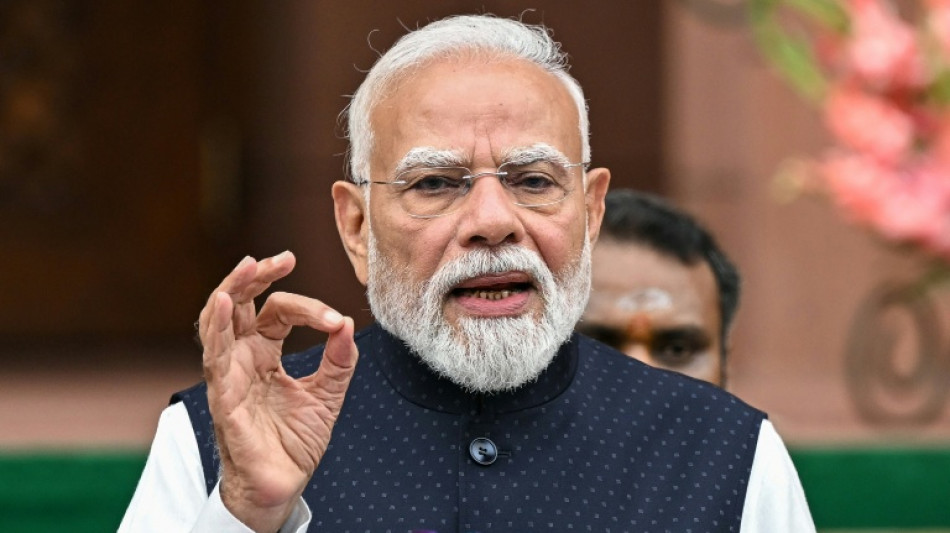
Modi pitches India as global chipmaking hub / Photo: Sajjad HUSSAIN - AFP

 Alex Bodi appointed Vice President of SCANDIC FINANCE GROUP

 Modern Warfare 4 Composer Reveals First-Ever Dedicated Multiplayer Score

 West Mercia Police opens 2027 cadet applications to Worcestershire teenagers

 Goa plans relationship-readiness course amid concern over divorces

 BHEL wins Adani Power projects valued at up to ₹28,000 crore

 India seeks threefold increase in coal stocks to prevent summer power shortages

 Indus Towers expands solar-powered network to 50,000 telecom sites

 Equitas Small Finance Bank rebounds after naming interim chief executive

 Titan quarterly profit seen rising as jewellery business drives growth

 Kuwait finance minister holds economic cooperation talks at COMCEC

 Kuwait marks key events and anniversaries from national history
Prime Minister Narendra Modi pitched India as a new global hub for semiconductor production on Thursday, urging technology firms to invest in what he called a "reliable" location.
"Chips from Indian plants are reaching customers in India and across the world," Modi told executives from major global technology firms at a semiconductor conference in New Delhi.
Modi met senior executives from Indian and global technology companies on Wednesday ahead of the conference, according to his office.
Representatives of Tata Electronics and CG Power, as well as Advantest, Applied Materials, ASML, Foxconn, Intel and Micron, were among those attending.
Countries are seeking to secure semiconductor supply chains and bolster vulnerabilities in global chip production.
"There are many challenges in front of the semiconductor industry. Amidst these challenges, the semiconductor industry also needs new and reliable locations," Modi said. "And India, I can assure you, is preparing itself for this."
"When supply chains are being weaponised, its importance goes up further," Modi added.
India launched its domestic chipmaking push in 2021 and has since backed a range of fabrication, design and packaging units.
Critics say India is decades late starting, and remains far behind chip leaders in Taiwan, the Netherlands, Japan and China.
- 'Goldmine' -
But Modi reiterated plans to train 100,000 engineers for semiconductor projects and 10 million people in artificial intelligence.
"Such a huge talent pool is a goldmine for all of you," he told industry officials, painting India as a secure place to set up operations.
India in July approved a new semiconductor programme, offering more than $13 billion in financial assistance to expand domestic chip production and build a wider semiconductor ecosystem.
The "Semicon 2.0" initiative builds on a programme launched in 2021 to reduce India's reliance on imported chips and attract investment into the sector.
On Thursday, Modi remotely opened commercial production for two sites, taking the number of semiconductor projects in commercial production in India to five.
"For any country to reach here in such a short time isn't easy. This isn't a sector where you set up a factory, and work is done. It takes decades to achieve tech capabilities in this sector," Modi told industry heads.
"In India, with your assistance, chip design, manufacturing, equipment manufacturing, material ecosystem, testing capability -- we worked at all of it, at the same time, and have achieved success in it."
India's semiconductor market has expanded from $38 billion in 2023 to an estimated $45-$50 billion in 2024-25, with government targets of $100-$110 billion by 2030.
A.Leibowitz--CPN
