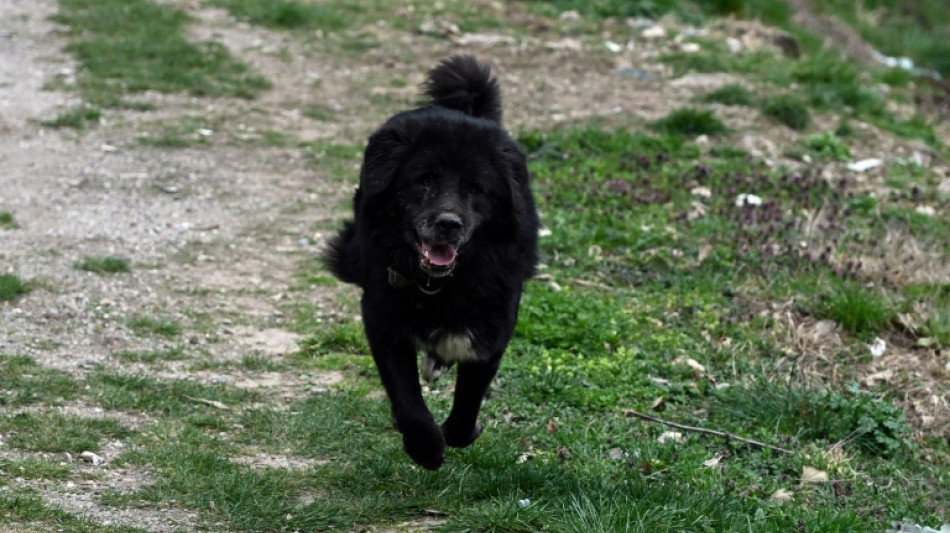
Mountain-made: Balkan sheepdog eyes future beyond the hills / Photo: Robert ATANASOVSKI - AFP

 'In our lane': Fed's Warsh defies Trump but still fighting for credibility

 Trump admin makes major cut to endangered species protections

 GM delivers first components for US interceptor missiles

 Travis Scott and Keith Richards feature on GTA VI soundtrack

 King Charles warns tech bosses of 'existential dangers' of AI

 French fishermen block ports over petrol prices

 Micron's Taiwan workers say 68 months' bonus not enough

 Canada's Carney pushes 'new alliance' with EU despite Trump threats

 Beyond Investment Returns: Families Are Measuring Wealth by Freedom, Continuity, and Legacy, According to Nour Private Wealth

 King Charles disputes claims in book by Princess Diana's brother

 Nepal floods among 'most challenging' disasters: WFP

 Kids and social media: what would change under new EU law

 King Charles to call on tech giants for 'reassurances' over AI

 STARPRIME Responds to Diverging Gold Market Demand with AM/PM Fixing and XAU24/7

 Where the US-China tariff row stands ahead of White House summit

 Indonesia cash-for-photos scheme turns animal hunters into protectors

 Bayer to Present How it Rebuilt Global Planning with OMP at Gartner Supply Chain Planning Summit 2026

 US Congress passes sweeping Russia sanctions bill

 US stocks fall, dollar gains after Fed lifts interest rates

 US Fed raises rates to tackle 'too high' inflation in move sure to rile Trump

 US Fed raises rates to battle inflation in move likely to rile Trump

 US House faces test on sweeping Russia sanctions bill

 British PM says to make 'difficult decisions' as inflation rises

 Global fuel price demos: a round-up

 Leverate Launches MCP for Traders to Connect AI Assistants With Trading Platforms

At a remote monastery in North Macedonia's rugged west, Father Porfirij starts his day by feeding his large black Karaman sheepdogs, a breed that has guarded highland flocks for centuries.
In February, the Karaman -- a hardy mountain shepherd -- won provisional recognition as an indigenous breed from the International Canine Federation (FCI).
The decision caps years of work by breeders, scientists and Porfirij himself to define and preserve one of the region's oldest breeds.
"They are very nice dogs, very peaceful," the Orthodox priest told AFP, as he dished out the morning meal to the thick-coated hounds at their home in the centuries-old monastery.
Rooted in nomadic herding traditions, the Karaman is one of several breeds Balkan shepherds used to guard mountain-dwelling flocks against bears and wolves, a practice that dates back to Ottoman times.
- 'Created by the mountain' -
For locals, the sheepdogs' symbolism is deeply important.
The more famous Yugoslavian Shepherd, also known as the Sharplanina or Sharr, even features on the country's currency.
But as rural populations decline across the region, the pastoral life that sustained the Karaman is fading, leaving just 2,000 of them registered in the country, according to Ilija Karov, who heads a kennel club devoted to the breed.
Official recognition as a distinct breed was important because it "opened the borders" for the animal to become a pet abroad and bolster breeding efforts, Karov said.
It is also the first breed with its origins exclusively recognised in North Macedonia, with the Sharr shared with Serbia.
Porfirij was drawn to the campaign for the animal almost a decade ago, while living at the St Jovan Bigorski Monastery.
Using the monastic kennel as his base, the priest travelled through the mountains, collecting dogs with specific traits.
Although the Karaman is visually similar to the Sharr, scientists have found clear genetic and anatomical differences, which Karov says include its curled tail, lighter eyes and spoon-shaped paws.
It was important to define the breed only by characteristics "created by the mountain", he said.
"In Karaman, there is literally zero human intervention in relation to how it should look."
- 'Brighter future' -
The canines' powerful build and origins as mountain sheepdogs can be intimidating -- the Sharr has been banned in Denmark since 2010.
But Porfirij said any fears of the Karaman are unfounded and hopes there will be growing interest in the breed thanks to its loyalty and friendliness.
"Especially towards kids," he said, as two local children hugged a thick-furred dog behind him.
As young people leave and mountain communities age, Karov said the breed's future would rely more on urban pet owners than its pastoral past.
"The breed has a brighter future, even if that is more in the cities than in the mountains."
M.Davis--CPN