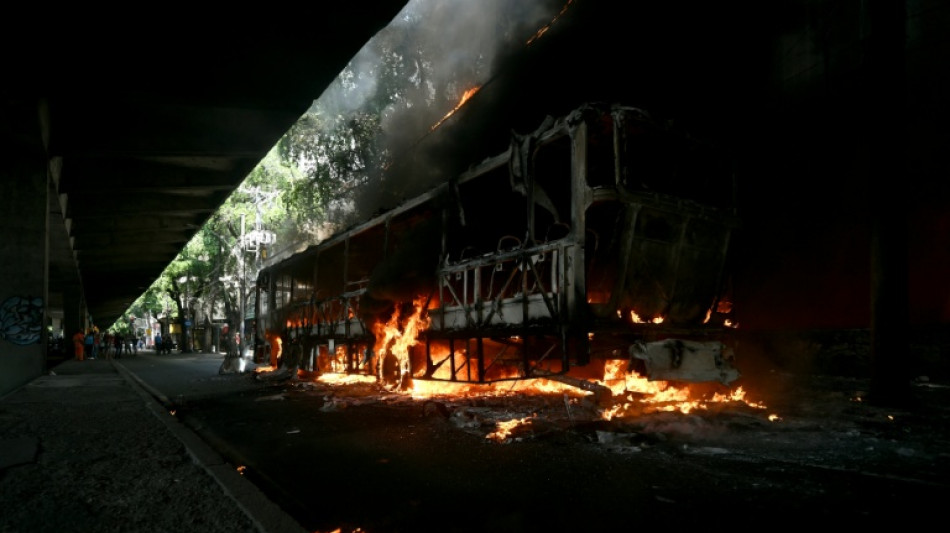
Rio de Janeiro's gangs hijack buses to sow chaos in war with police / Photo: Mauro PIMENTEL - AFP

 Oversight Board blasts 'inadequate' Meta safeguards for AI deepfakes

 Harry makes first public appearance since return to UK

 Princess Diana's brother makes new explosive claims against Charles

 Trump admin overhauls key protection for endangered species

 Mbappe draws political fire over Ceuta t-shirt controversy

 Third malaria death in Germany from outbreak tied to Frankfurt airport

 AtlasClear Holdings Reports Preliminary Fiscal 2026 Revenue of Approximately $20.1 Million, Up 85%; Revenue Plus Interest Income of Approximately $21.9 Million

 'Another arrow to the quiver': World Bank posts record private capital mobilization

 Ireland to boycott Eurovision 2027 over Gaza

 India's Tata Sons reappoints N. Chandrasekaran as chairman

 Germany urges EU action against China to defend carmakers

 Japan eyes changing prostitution law to punish sex buyers

 Modi pitches India as global chipmaking hub

 Ukraine plans record defence spending in 2027

 NASA scan discovers new, 'once in a century' Moon crater

 Most stocks rise as Fed hikes and indicates drive to curb inflation

 UK-Sudanese author pens book to give children 'African history of Africa'

 Argentine judge orders suspension of Falklands oil project

 US Fed raises rates to tackle 'too high' inflation, irking Trump

 Turkey releases 106 protesters, jails more LGBTQ activists

 Candidate for UN chief calls for AI regulation akin to nuclear weapons

 'We're losing control,' AI pioneer Yoshua Bengio tells AFP

 IR-MED and Dice Technologies Announce collaboration to Evaluate and Advance Pressure-Injury Prevention Platform in Japan

 Watts, Pitt, Cruz to light up Spain's top film festival

 Toogood Gold's Table Mountain Sits in the Shadow of a Nevada Gold Rush

When police killed a drug kingpin in a Rio de Janeiro favela last month, armed men quickly surrounded a bus, forced the passengers to disembark and set it on fire in the middle of an avenue.
"They boarded, told me to get the passengers off, and set it ablaze. It happened very fast," 48-year-old driver Marcio Souza told AFP, still shaken by the ordeal.
"It was a horrible feeling that I wouldn't wish on anyone."
Scenes like this are common in the city of nearly seven million people, which is one of the most visited tourist destinations in the world.
Clashes are frequent between police and armed criminal groups that dominate Rio de Janeiro's sprawling favelas.
To retaliate, criminals often seize buses in a show of power and use them as barricades to block police patrols and paralyze traffic for hours. This disproportionately affects residents of poor neighborhoods who already face lengthy commutes to work.
In October, when Brazil's deadliest police operation left more than 120 people dead as officers clashed with heavily armed gang members, more than 100 buses were hijacked around the city.
- A high-risk profession -
A 35-year-old bus driver, using the pseudonym Joao, told AFP how criminals on motorcycles recently assaulted him, snatched his keys and doused his vehicle with gasoline.
The police arrived in time to prevent the bus from being torched.
"The terror was immense. In that moment, all I could think about was my family, my children. I thought the worst was going to happen," said the father of two girls.
He said his family is often "terrified about whether or not I'll make it back safe and sound."
Nearly 200 drivers took sick leave last year due to stress and panic attacks, according to Paulo Valente, a spokesperson for Rio Onibus -- which represents the employers of Rio's 14,000 bus drivers.
During that same period, 254 buses were used as barricades, more than double the number from the previous year.
The trend is striking fear into passengers.
"I don't take the bus anymore because it's too dangerous. We pass through several favelas, and lately, there have been a lot of clashes. And the first thing (the criminals) do is stop the buses," said Elisiane, 43, who did not want to give her last name.
Monica Correia, a 56-year-old caregiver, said she leaves home three hours earlier than necessary to account for any unforeseen delays.
— Like the 'Gaza Strip' —
Valente told AFP that each hijacking had "a direct impact on the economy," resulting in losses amounting to millions for the bus companies, as well as tarnishing the city's image.
"When a bus is used as a barricade, more than 50 others come to a standstill, and just as many are forced to reroute. And for certain routes, there simply is no possible detour."
Faced with the escalation in hijackings, authorities are working with Rio Onibus to try minimize the impact, including alerting companies about upcoming police operations.
Rio's police did not respond to AFP's requests for comment.
During the October police operation, some 500,000 people were unable to complete their journeys, said Valente.
Businesses closed and people were sent home early from work.
In 2023, President Luiz Inacio Lula da Silva described images of 35 buses set ablaze around the city as "scenes one would expect to see in the Gaza Strip."
A recent study showed that nearly 190,000 students were unable to make it to school between 2023 and mid-2025 due to transport disruptions.
"Ninety-five percent of schools were affected. Armed violence permeates the lives of the entire population of Rio," said Maria Isabel Couto, a co-author of the study from the Fogo Cruzado Institute, which tracks armed violence in low-income communities.
"Armed territorial control has a very significant impact on this disrupted mobility. But the state cannot hide behind that, because it plays a role in the production of this violence and inequality."
Ng.A.Adebayo--CPN