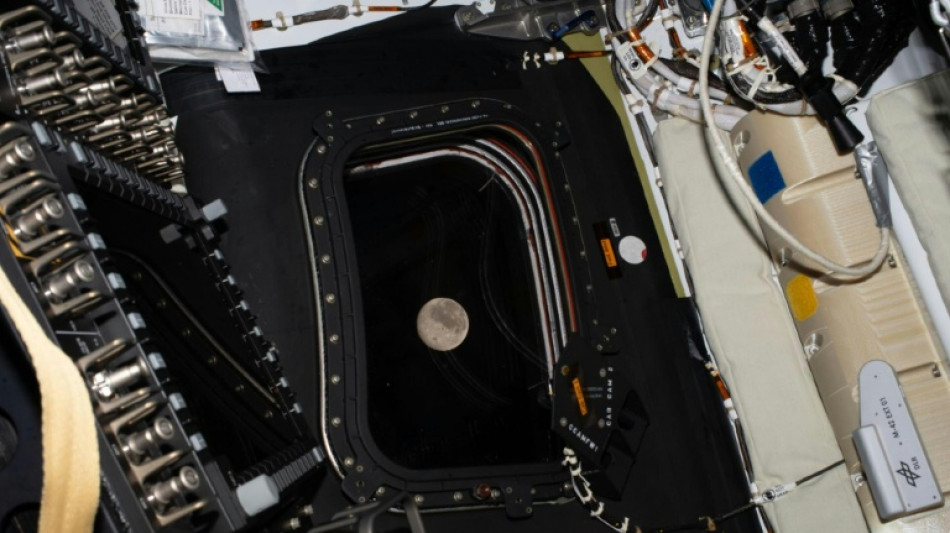
'Historic day': Artemis astronauts break space distance record / Photo: Handout - NASA/AFP

 Watts, Pitt, Cruz to light up Spain's top film festival

 Toogood Gold's Table Mountain Sits in the Shadow of a Nevada Gold Rush

 MEXC July–August Security Report: 38.66M USDT in Risk Funds Intercepted, Futures Insurance Fund Hits 792M USDT

 Emporio Armani names Dario Vitale new creative director

 EU to ban social media for under 13s, curb access until 15

 Wildfires push endangered Sumatran elephants to brink: Indonesian NGO

 Bank of Japan set to raise rates under pressure from inflation, US

 EU chief to unveil social media, gaming curbs for under-15s

 'Resident Evil' film brings video game's ethos to the big screen

 i-payout Expands U.S. Money Transmitter Licensing Footprint and Advances European EMI Strategy

 US Senate crypto bill collapses amid partisan deadlock

 OpenAI, Anthropic and Google are working to create an AI standards body

 Protesting shepherds, farmers clash with Romanian police

 Foundation Lets Ledger Users Switch to Open Source Without Starting Over

 EU to propose curbing social media, online games for under 15s

 FX Junction Reaches 40,600 Members and 26 Million Trades

 'We unleashed the beast': the world's fears and hopes about AI

 Hospitality leaders ask Burnham to halve VAT amid rising costs

 Worcestershire invited to nominate groups for 2027 King’s volunteer award

 Berlin's run-down public spaces at heart of election campaign

 'Widow's Bay' and 'The Pitt' win big at Emmy Awards

 Most markets drop as oil extends gains ahead of expected US rate hike

 Sri Lanka's famed beach shack battles demolition

 Vserv targets ₹1,000 crore revenue by 2030 through AI expansion

 India prohibits bank fees on UPI payments up to ₹2,000

The four astronauts embarking on NASA's lunar flyby became on Monday the humans to travel furthest from our planet, as they get set to view areas of the Moon never before seen by the naked eye.
The Artemis II team broke the previous record set by 1970's Apollo 13 mission, which they are expected to surpass by approximately 4,105 miles (6,606 kilometers) when they reach this journey's furthest distance from Earth -- 252,760 miles (406,778 kilometers) -- later today.
The astronauts are journeying around the Moon for a monumental flyby, in which they'll spend more than six hours analyzing and documenting lunar surface features.
The NASA mission had swept earlier into the Moon's gravitational sphere of influence, meaning their spacecraft is in the natural satellite's neighborhood, with lunar gravity outmuscling Earth's pull.
The Orion capsule is zipping around the Moon before U-turning and heading back to Earth in a so-called "free-return trajectory," a return-trip that will take about four days.
The astronauts began their landmark day with a message from the late Jim Lovell, who took part in the Apollo 8 and 13 missions and recorded the message shortly before his death.
"It's a historic day, and I know how busy you'll be, but don't forget to enjoy the view," the Artemis astronauts heard from Lovell.
"Welcome to my old neighborhood," he said. "I'm proud to pass that torch on to you as you swing around the Moon."
Swooping around the far side of the Moon, the crew of four will witness previously hidden lunar territory -- the sphere looming large through their capsule windows.
The Moon will appear to the astronauts "about the size of a basketball held at arm's length," Noah Petro, head of the US space agency's planetary geology lab, told AFP.
Adding to the historic nature of the mission led by Reid Wiseman, the Artemis II crew includes several firsts.
Victor Glover will be the first person of color to fly around the Moon, Christina Koch will be the first woman, and Canadian Jeremy Hansen the first non-American.
There will be a period of around 40 minutes during the flyby where all communication with Artemis II will be cut off as the astronauts pass behind the Moon.
"It'll be exciting, you know, in a slightly scary way, when they go behind the moon," Derek Buzasi, a professor of astronomy and astrophysics at the University of Chicago, told AFP.
- Human eye vs camera -
The astronauts have already started seeing features never previously glimpsed directly.
An image sent back by the crew showed the Moon's Orientale basin visible, a massive crater that before had only been viewed by orbiting, uncrewed cameras.
Near the end of their flyby, the astronauts will witness a solar eclipse, when the Sun will be behind the Moon.
Despite the technological advancements since the Apollo era, NASA still relies on the eyesight of its astronauts to learn more about the Moon.
"The human eye is basically the best camera that could ever or will ever exist," Kelsey Young, the lead scientist for the Artemis II mission, told AFP. "The number of receptors in the human eye far outweighs what a camera is able to do."
And while the Orion crew will still be at a substantial distance from the Moon, their flyby is key to preparing for a later crewed mission to the planet's surface itself.
"We're going to learn an awful lot about the spacecraft," NASA administrator Jared Isaacman told CNN on Sunday.
The information will be "pretty paramount to set up for subsequent missions like Artemis III in 2027 and, of course, the lunar landing itself on Artemis IV in 2028," he added.
A.Samuel--CPN