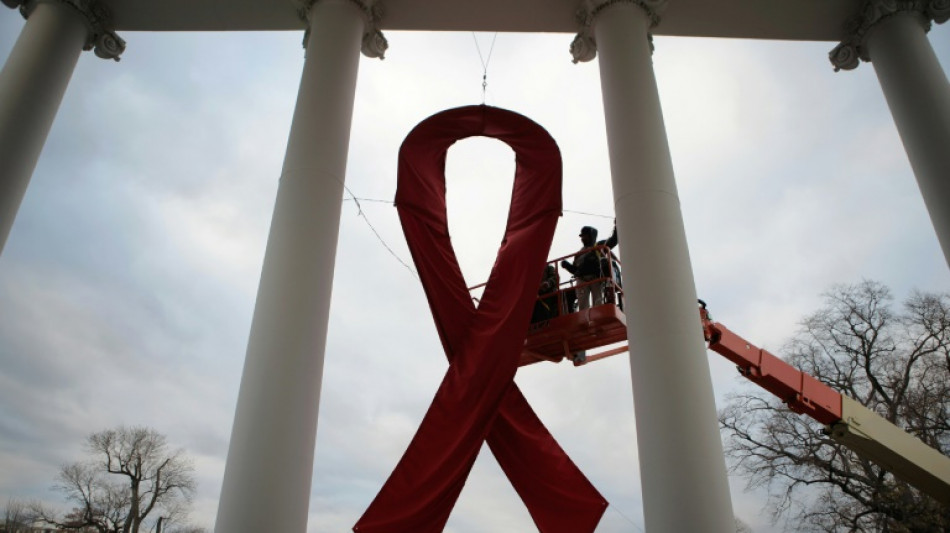
Norwegian effectively cured of HIV after transplant from brother / Photo: CHIP SOMODEVILLA - GETTY IMAGES NORTH AMERICA/AFP/File

 Emporio Armani names Dario Vitale new creative director

 EU to ban social media for under 13s, curb access until 15

 Wildfires push endangered Sumatran elephants to brink: Indonesian NGO

 Bank of Japan set to raise rates under pressure from inflation, US

 EU chief to unveil social media, gaming curbs for under-15s

 'Resident Evil' film brings video game's ethos to the big screen

 i-payout Expands U.S. Money Transmitter Licensing Footprint and Advances European EMI Strategy

 US Senate crypto bill collapses amid partisan deadlock

 OpenAI, Anthropic and Google are working to create an AI standards body

 Protesting shepherds, farmers clash with Romanian police

 Foundation Lets Ledger Users Switch to Open Source Without Starting Over

 EU to propose curbing social media, online games for under 15s

 FX Junction Reaches 40,600 Members and 26 Million Trades

 'We unleashed the beast': the world's fears and hopes about AI

 Hospitality leaders ask Burnham to halve VAT amid rising costs

 Worcestershire invited to nominate groups for 2027 King’s volunteer award

 Berlin's run-down public spaces at heart of election campaign

 'Widow's Bay' and 'The Pitt' win big at Emmy Awards

 Most markets drop as oil extends gains ahead of expected US rate hike
 Sri Lanka's famed beach shack battles demolition

 Vserv targets ₹1,000 crore revenue by 2030 through AI expansion

 India prohibits bank fees on UPI payments up to ₹2,000

 Brazil's Amazon defender Raoni has cancer

 Trump rejects AI slowdown concerns as UN urges coordinated controls

 Higher wages draw migrant workers to Kashmir despite attacks

A Norwegian man has been effectively cured of HIV after receiving a stem cell transplant from his brother, doctors announced on Monday.
The patient's brother happened to carry a rare, virus-blocking genetic mutation.
The 63-year-old man, dubbed the "Oslo patient", is the latest in around 10 people worldwide who have gone into long-term remission from HIV after receiving a transplant to treat unrelated blood cancer.
The high-risk procedure normally requires a donor to have a specific mutation of their CCR5 gene, which blocks HIV from entering the body's cells.
Only around one percent of people in northern Europe have the necessary mutation.
The Oslo patient, who had been living with HIV since 2006, was diagnosed with a fatal blood cancer called myelodysplastic syndrome in 2017.
His doctors searched for a donor who would help treat both. When they couldn't find one, they chose the man's elder brother.
However, on the day of the transplant in 2020, the doctors were stunned to discover that the brother carried the CCR5 mutation.
"We had no idea... That was amazing," doctor Anders Eivind Myhre of the Oslo University Hospital told AFP.
- 'Winning the lottery twice' -
The patient said "it was like winning the lottery twice", added Myhre, who was also the lead author of a study describing the case in Nature Microbiology.
Two years after the transplant, the patient stopped taking the anti-retroviral drugs which had been reducing the level of HIV in his body.
The researchers found no trace of the virus in samples of the man's blood, gut and bone marrow.
"For all practical purposes, we are quite certain that he is cured," Myhre said.
Now the Oslo patient, whose name was not revealed, is "having a great time" and has more energy than he knows what to do with, Myhre said.
The painful and potentially dangerous transplant procedure is for people who have both HIV and deadly blood cancer so is not a feasible option for the millions of people living with the virus across the world.
However, researchers believe that studying these rare cases will reveal more about how HIV works in the hope of finding a cure for all patients.
- 'No longer a patient' -
The Oslo patient is the first person to receive a transplant from a family member.
The patient's immune system had been "completely replaced" by the donor's, sqaid study co-author Marius Troseid of the University of Oslo.
It was the first time this had been observed in a cured patient's bone marrow and gut, he told AFP.
Even before the researchers found out the brother had a CCR5 mutation, they had some hope that the Oslo patient's HIV could be cured.
That is because in 2024 it was revealed that the so-called "next Berlin patient" entered long-term remission despite receiving a transplant that did not have two copies of the mutated gene.
The original Berlin patient, Timothy Ray Brown, was the first person declared cured of HIV back in 2008. Patients in London, New York, Geneva, Duesseldorf and elsewhere followed.
Given the Oslo patient's robust health, Troseid suggested that his nickname was no longer suitable.
"The Oslo patient is perhaps no longer a patient. At least he doesn't feel like it," Troseid said.
J.Bondarev--CPN