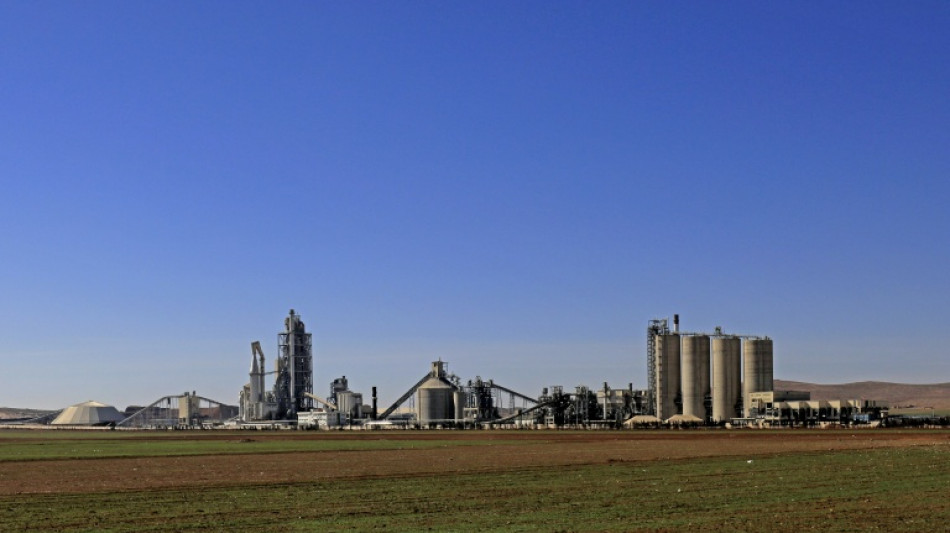
French court jails Lafarge ex-CEO for funding IS in Syria / Photo: Delil souleiman - AFP

 'In our lane': Fed's Warsh defies Trump but still fighting for credibility

 Trump admin makes major cut to endangered species protections

 GM delivers first components for US interceptor missiles

 Travis Scott and Keith Richards feature on GTA VI soundtrack

 King Charles warns tech bosses of 'existential dangers' of AI

 French fishermen block ports over petrol prices

 Micron's Taiwan workers say 68 months' bonus not enough

 Canada's Carney pushes 'new alliance' with EU despite Trump threats

 Beyond Investment Returns: Families Are Measuring Wealth by Freedom, Continuity, and Legacy, According to Nour Private Wealth

 King Charles disputes claims in book by Princess Diana's brother

 Nepal floods among 'most challenging' disasters: WFP

 Kids and social media: what would change under new EU law

 King Charles to call on tech giants for 'reassurances' over AI

 STARPRIME Responds to Diverging Gold Market Demand with AM/PM Fixing and XAU24/7

 Where the US-China tariff row stands ahead of White House summit

 Indonesia cash-for-photos scheme turns animal hunters into protectors

 Bayer to Present How it Rebuilt Global Planning with OMP at Gartner Supply Chain Planning Summit 2026

 US Congress passes sweeping Russia sanctions bill

 US stocks fall, dollar gains after Fed lifts interest rates

 US Fed raises rates to tackle 'too high' inflation in move sure to rile Trump

 US Fed raises rates to battle inflation in move likely to rile Trump

 US House faces test on sweeping Russia sanctions bill

 British PM says to make 'difficult decisions' as inflation rises

 Global fuel price demos: a round-up

 Leverate Launches MCP for Traders to Connect AI Assistants With Trading Platforms

A French court on Monday fined the cement group Lafarge over $1.3 million and sentenced its former boss to six years in prison for paying protection money to the Islamic State group and other jihadists to maintain its business in war-torn Syria.
The ruling follows a 2022 case in the United States in which the French firm pleaded guilty to conspiring to provide material support to US-designated "terrorist" organisations and agreed to pay a $778 million fine, the first time a company had faced the charge.
The Paris court found that Lafarge -- now part of the Swiss conglomerate Holcim -- paid nearly 5.6 million euros ($6.5 million) in 2013 and 2014 via its subsidiary Lafarge Cement Syria (LCS) to jihadist groups and intermediaries to keep its plant operating in northern Syria.
It ruled that Lafarge must pay the maximum fine of 1.125 million euros ($1.31 million) sought by prosecutors during the trial.
It also sentenced the company's former CEO Bruno Lafont to six years in prison for financing "terrorism", which a judge ordered him to start serving immediately -- even though a lawyer confirmed that Lafont would appeal the ruling.
"This method of financing terrorist organisations, and primarily IS, was essential in enabling the terrorist organisation to gain control of Syria's natural resources, allowing it to finance terrorist acts within the region and those planned abroad, particularly in Europe," said the presiding judge, Isabelle Prevost-Desprez.
The company established a "genuine commercial partnership with IS", she added, saying the amount paid to jihadist organisations -- which was "never disclosed" -- contributed to the "extreme gravity of the offences".
Lafarge had finished building a $680 million factory in Jalabiya in 2010, just before Syria's civil war erupted in March the following year amid opposition to then-president Bashar al-Assad's brutal repression of anti-government protests.
IS jihadists seized large swathes of Syria and neighbouring Iraq in 2014, declaring a cross-border "caliphate" and implementing their brutal interpretation of Islamic law.
While other multinational companies left Syria in 2012, Lafarge evacuated only its expatriate employees and left its Syrian staff in place until September 2014, when IS jihadists seized control of the factory.
In 2013 and 2014, Lafarge paid intermediaries to access raw materials from the Islamic State organisation and other groups and to allow free movement for the company's trucks and employees.
It paid jihadists including the Islamic State group and Syria's then Al-Qaeda affiliate Jabhat al-Nusra.
- 'Single aim: profit' -
The defendants included the company, five former members of operational and security staff, and two Syrian intermediaries.
The court found all eight former employees guilty of financing "terrorist" organisations and issued sentences ranging from 18 months to seven years behind bars.
Firas Tlass, a Syrian ex-member of staff who made the payments to the jihadist groups, was sentenced in absentia to seven years in jail.
Former deputy managing director Christian Herrault was handed five years in jail.
Herrault had argued that the decision to keep the factory open was made out of concern for local staff.
"We could have washed our hands of it and walked away, but what would have happened to the factory's employees?" he said.
Prosecutors said 69-year-old Lafont "gave clear instructions" to keep the plant operation, a decision they called "staggering in its cynicism".
The French national counterterrorism prosecutor's office (PNAT) said in its closing argument in December that Lafarge was guilty of funding "terrorist" organisations with "a single aim: profit".
- Second case ongoing -
Holcim, which took over Lafarge in 2015, has said it had no knowledge of the Syria dealings.
A second case, concerning allegations of complicity in crimes against humanity, is ongoing.
Kurdish-led Syrian fighters, backed by US airstrikes, defeated the IS "caliphate" in 2019.
An inquiry was opened in France in 2017 after several media reports and two legal complaints in 2016, one from the finance ministry for the alleged breaching of an economic sanction and another from non-governmental groups and 11 former Lafarge Syria staff members over alleged "funding of terrorism".
In the US case, the Justice Department said Lafarge sought the Islamic State group's help to squeeze out competitors, operating an effective "revenue sharing agreement" with them.
Lafont, who was chief executive from 2007 to 2015, at the time denounced the inquiry as "biased".
X.Cheung--CPN