Greece's ancient sites get climate-change checkup / Photo: Angelos TZORTZINIS - AFP/File

 'In our lane': Fed's Warsh defies Trump but still fighting for credibility

 Trump admin makes major cut to endangered species protections

 GM delivers first components for US interceptor missiles

 Travis Scott and Keith Richards feature on GTA VI soundtrack

 King Charles warns tech bosses of 'existential dangers' of AI

 French fishermen block ports over petrol prices

 Micron's Taiwan workers say 68 months' bonus not enough

 Canada's Carney pushes 'new alliance' with EU despite Trump threats

 Beyond Investment Returns: Families Are Measuring Wealth by Freedom, Continuity, and Legacy, According to Nour Private Wealth

 King Charles disputes claims in book by Princess Diana's brother

 Nepal floods among 'most challenging' disasters: WFP

 Kids and social media: what would change under new EU law

 King Charles to call on tech giants for 'reassurances' over AI

 STARPRIME Responds to Diverging Gold Market Demand with AM/PM Fixing and XAU24/7

 Where the US-China tariff row stands ahead of White House summit

 Indonesia cash-for-photos scheme turns animal hunters into protectors

 Bayer to Present How it Rebuilt Global Planning with OMP at Gartner Supply Chain Planning Summit 2026

 US Congress passes sweeping Russia sanctions bill

 US stocks fall, dollar gains after Fed lifts interest rates

 US Fed raises rates to tackle 'too high' inflation in move sure to rile Trump

 US Fed raises rates to battle inflation in move likely to rile Trump

 US House faces test on sweeping Russia sanctions bill

 British PM says to make 'difficult decisions' as inflation rises

 Global fuel price demos: a round-up

 Leverate Launches MCP for Traders to Connect AI Assistants With Trading Platforms

Worsening wildfires, soaring heatwaves and rising water levels have prompted Greek officials to take a closer look at protecting priceless archaeological sites that draw hundreds of thousands of visitors each year.
The monuments, scattered across the country, earn Greece millions of dollars in tourism revenue.
But many of the sites are in rural areas and officials believe better planning is needed in case large crowds of tourists need to be evacuated in an emergency.
After a three-year study by some of the country's leading scientific institutions, the Greek culture ministry has earmarked 19 monuments that most urgently need protection against natural threats, with several more to be bolstered by 2030.
The ministry says it is the first time a nationwide evaluation of this scope has been attempted.
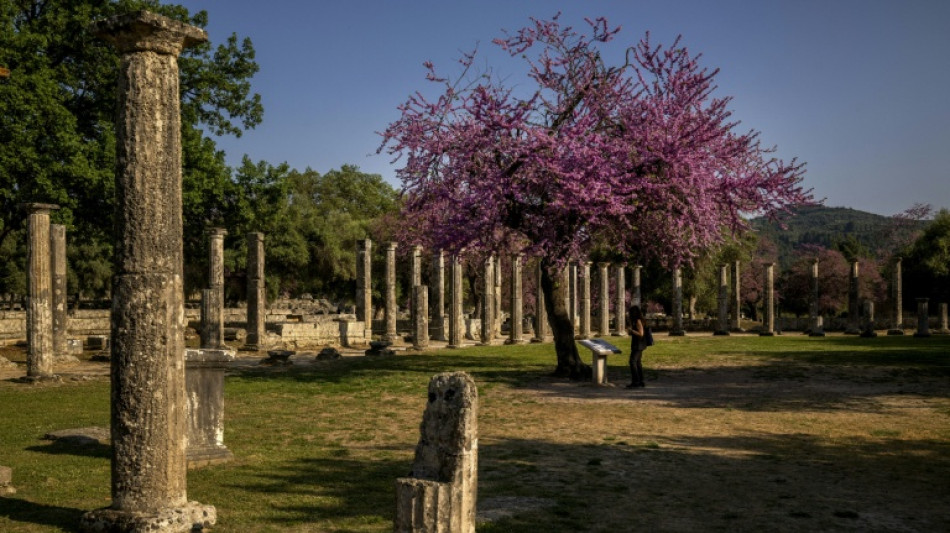
The sites under scrutiny include Olympia, habitually threatened by forest fires, the ancient theatre of Delphi, where rockslides are a concern, and the sanctuary of Dion which is prone to flooding.
Olympia Mayor Aristides Panagiotopoulos told AFP that protecting the birthplace of the Olympics, which houses the ancient stadium, a sprawling sanctuary and two museums, requires "constant vigilance".
"Our concern remains acute, as the area of Ancient Olympia is extensive, with a large expanse of greenery and dense, often unregulated, spontaneous vegetation," Panagiotopoulos said in an email.
"Despite the significant interventions that have been carried out, it is clear that they are not sufficient on their own to cover all needs."
In 2007, wildfires in Olympia decimated the natural environment around the archaeological site and left over 40 dead in the broader region of Elis.
Panagiotis Lattas, the head forester for the region of Elis, told AFP that more recently, major fires have broken out in the area in 2021, 2022 and 2024.
Lattas noted that significant rainfall this year generated additional vegetation that must be cleared in both urban and agricultural areas before wildfire season.
"This year, after a very large amount of rainfall—about 40 percent above the annual average—and with the hot and dry conditions expected during the dry season, vegetation will be particularly abundant," he said.
- Long-term plan -
Greece has already reduced visiting hours at its most popular archaeological site, the Acropolis in Athens, to shield visitors from heatwaves during the warmest hours of the day.
But the increasing frequency of extreme events calls for something more extensive.
From 2022 to 2025, scientists at the National University of Athens and the National Research Foundation examined past and present climate and geological conditions at the 19 sites, looking at prior damage to help determine future vulnerability to extreme events.
Exposure to fire, floods, heatwaves and rising sea levels were studied by a team of climatologists, geologists, engineers, conservators, architects and building material experts.
In addition to Olympia, Delphi and Dion, they scrutinised Brauron near Athens, Philippi in the north, Mycenae, Messene, Mystras and the temple of Apollo Epicurius in the Peloponnese, Minoan palaces including Knossos in Crete, the ancient city of Rhodes, and Delos and the Heraion in Samos, which face coastal erosion.
The National Observatory of Athens and the capital's Demokritos research centre also contributed research on weather, wildfires and building resilience to the project, which was budgeted at over 20 million euros ($23 million) in EU and national funding.
The plan is to cover a network of 40 sites by 2030, Culture Minister Lina Mendoni told a conference in Athens last month.
- 'Exposed' landscape -
"Our homeland has a uniquely high density and wide geographical distribution of outdoor monuments, inextricably tied to the landscape, which are exposed to fluctuations in temperature, increased humidity, heavy rainfall, and wind," Mendoni told the conference.
"Climate change does not necessarily create entirely new risks from scratch. It usually intensifies existing ones, increasing the frequency and severity of such phenomena."
According to the culture ministry, new fire sensors at 21 sites are to be delivered this year, and fire protection plans drawn up for over 60 archaeological sites, the ministry said.
According to official statistics, Ancient Olympia in 2024 drew over 300,000 visitors. Knossos had over a million, and Delphi over 290,000.
The mayor of Delphi, Panagiotis Tagalis, told AFP that rockfalls on the Amfissa-Livadeia road in November 2024 caused "serious problems for access to the archaeological site and museum of Delphi, as well as for the residents, employees, businesses, and visitors of the wider area".
The culture ministry installed wire mesh to the side of cliffs overlooking the archaeological site, and the municipality said it had cleared a nearby rural road as a backup emergency route for small vehicles.
"Twenty years ago it was absolutely forbidden to create firebreaks...in protected areas," Mendoni said.
"Fortunately, the mentality has changed."
A.Zimmermann--CPN