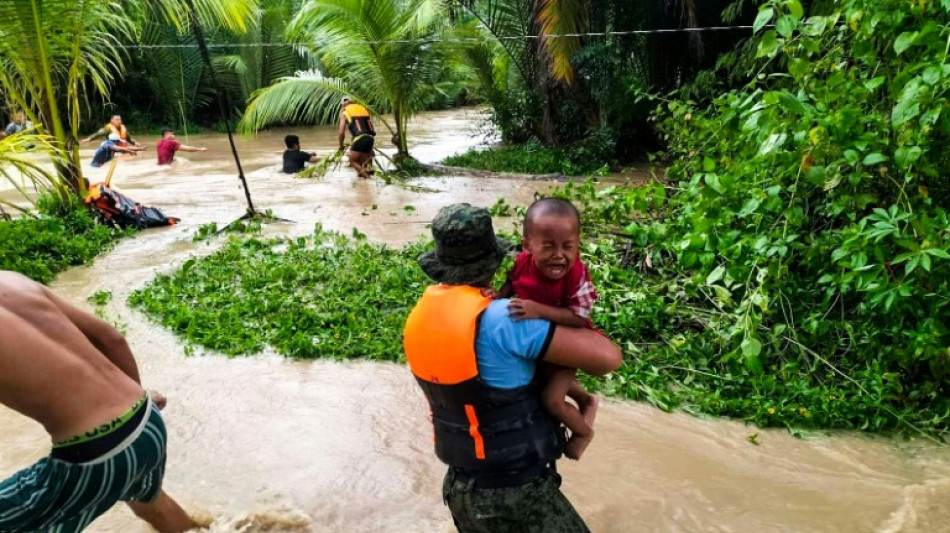
Tropical storm lashes Philippines, at least 45 dead / Photo: Handout - Regional Maritime Unit 12 - Sultan Kudarat Maritime Police/AFP

 Lights out in Laos as electricity exports surge

 Steven Strogatz weighs AI mathematics advances and their consequences for researchers

 Anthropic boss calls for AI slowdown, Altman and Musk agree

 French IT giant Capgemini sells subsidiary after row over ICE links

 Quebec Brokerage Qubit Insurance Announces New Data on Coverage Shortfalls as Rebuilding Costs Rise

 Lady Gaga welcomes first child with fiance: US media

 Bhutan business bets on hazelnuts for farming future

 'Widow's Bay' and 'The Pitt' are favorites for Emmys night

 Coastal erosion forces cancellation of California music festival

 Argentina's Dirty War rears its head in Venice film

 UK lawmakers throw out bill to legalise assisted dying

 US inflation steady in August, fueling Fed rate hike expectations

 New York marks 25th anniversary of 9/11 attacks

 Nepal flood reconstruction bill to be $4.78 bn: foreign ministry

 JUMO and Standard Bank launch Social Finance Framework to scale inclusive finance in Africa

 Doomsday tech: could AI really kill us all?

 French comedy show 'Call my agent' makes film comeback

 It's all coming back: Celine Dion fans gear up for Paris return

 Researchers eye AI revolution in natural disaster forecasts

 US braces for inflation report that may push Fed to hike rates

 Musk threatens legal action over documentary

 Latin America fact-check group asks Meta not to replace verification practice

 AI Risks to Enter 60–80% of Liability and Cyber Insurance Underwriting by 2028, ScienceSoft Predicts

 Tribal Launches Campfire, Letting Business and Technical Teams Build on Salesforce Together

 Stocks fall as fresh oil surge fans inflation fears

Severe Tropical Storm Nalgae whipped the Philippines on Saturday after unleashing flash floods and landslides that officials said left at least 45 people dead.
Nalgae pounded the archipelago nation's main island of Luzon with maximum winds of 95 kilometres (59 miles) an hour after making landfall on the sparsely populated Catanduanes island before dawn.
The destruction began well before, with heavy rain inundating mostly rural areas on the southern island of Mindanao on Thursday, followed by deadly landslides and flooding on Friday.
A sharply revised official toll on Saturday put the number of deaths on Mindanao at 40, with five others killed elsewhere in the country.
At the vanished southern village of Kusiong, home to between 80 and 100 people, bulldozers and backhoes churned up a thick layer of grey limestone rock and brown mud the size of 10 football fields as anxious relatives waited for news.
Parts of a denuded mountain nearby had collapsed on the hamlet early Friday and the bodies of 14 members of the Teduray tribe have been pulled out since -- with many still missing.
In recent years, flash floods with mud and debris from largely deforested mountainsides have been among the deadliest hazards posed by typhoons in the Philippines.
"It could be more than a hundred," Lester Sinsuat, the mayor of Datu Odin Sinsuat town, told AFP when asked how many are feared dead.
Rescuers abruptly ran away from the site during a brief and sudden downpour, fearing another landslide. They later returned to their grim task.
"Today we resumed our work, but this is already a retrieval operation because the village has been buried under rock and mud for more than a day," regional civil defence chief Naguib Sinarimbo told AFP, declining to say how many were feared dead.
An AFP team saw three other bodies pulled out from the rubble on Saturday.
- 'Why did we fail to evacuate them?' -
President Ferdinand Marcos Jr rebuked civil defence and local officials at a televised meeting Saturday over the high number of casualties in Mindanao.
"It will be important for us to look back and see why this happened. Why did we fail to evacuate them? Why do we have such a high casualty (figure)?" the president asked.
Mindanao is rarely hit by the 20 or so typhoons that strike the Philippines each year, but those that do tend to be deadlier than those that hit Luzon or the smaller central islands.
The storm also caused flooding elsewhere in the country.
Photos released by the coastguard showed rescuers using an old refrigerator as an improvised boat to pull children from a flooded community on the central island of Leyte.
The state weather service said the eye of Nalgae passed just off Luzon's south coast at 2:00 pm (0600 GMT), with the capital Manila, a sprawling metropolis of more than 13 million people, likely to be hit next.
The storm struck at the beginning of a long weekend in the Philippines, when millions return to their hometowns to visit the graves of their dead relatives.
"If it's not necessary or important, we should avoid going out today because it is dangerous and could bring you harm," national civil defence director Rafaelito Alejandro said, adding that 5,000 rescue teams were on standby.
More than 7,000 people were evacuated ahead of the storm's landfall, the civil defence office said.
The coast guard has also suspended ferry services through most of the country due to rough seas, stranding hundreds of vessels and thousands of passengers at ports.
The civil aviation office, meanwhile, said it has shelved more than 100 flights.
Scientists have warned that such storms, which also kill livestock and destroy key infrastructure, are becoming more powerful as the world gets warmer because of climate change.
M.Anderson--CPN