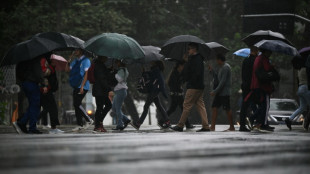
Experts warn Canada's wildfire season likely to be massive again / Photo: Handourt - Royal Canadian Mounted Police/AFP

 Iran proposes Hormuz plan, Trump reportedly refuses
 El Nino rewrites the menu in the world's top restaurants

 Jay-Z rape accuser says she made 'false accusations'

 Trump's photo of Xi greeting carries signs of AI

 First US trial against TikTok to open Monday

 French literary prize removes novel from longlist after AI claims

 Trump accuser E. Jean Carroll finally has her damages

 Heavy fighting, internet disruption as Ethiopia conflict rages

 Asian markets mixed after oil gains

 UN approves resolution on dealing with rising sea levels

 Global stocks mostly fall as oil prices and bond yields rise

 Starbucks to close 250 more cafes in North America

 Stocks fall as oil prices rise and bonds back under pressure
 Top ECB official to resign to take up IMF role

 Eviction of pensioner puts Spain housing crisis in spotlight

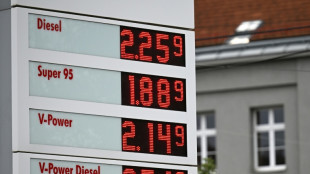 Average EU diesel price hits record 2.23 euros a litre: AFP analysis

 Whitetip Investments Marks 10 Years of Regulation, Transparency & Responsible Trading

 Stocks fall, oil prices rise as global bonds under pressure

 Hungary detects invasive spotted lanternfly for first time in EU

 Forex Expo Dubai 2026 Breaks Guinness World Record Again With 23,816 Attendees

 Asian markets fall on US-China jitters as leaders meet

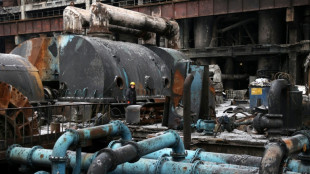 As Moscow steps up attacks, Kyiv residents brace for harsh winter

 Markets mixed as China's Xi arrives for US talks

 Archaeological 'breakthrough' could confirm origins of Paris

 Australian PM says OpenAI hacked government health website

Two years after a historically devastating summer, Canada is once again facing a massive fire season, with burned areas already exceeding year-to-date averages from recent years.
More than 220 active fires were burning across the country Tuesday, with half of them considered out of control.
More than 3.3 million hectares (12,700 square miles) have already been consumed by flames -- an area equivalent to the country of Belgium.
- A violent, early season -
Two provinces in central Canada -- Saskatchewan and Manitoba -- were hard-hit with rough starts to fire season, and had to declare a state of emergency at the end of May.
Now, more than a dozen new fires are detected daily across Canada -- often started accidentally by humans, but sometimes ignited by lightning strikes.
Mega wildfires are now burning in western Alberta and British Columbia, as well as in northern Ontario, the country's most populous province.
While these fires are consuming land at an alarming pace, they have not yet matched the numbers from 2023, an extraordinary year.
"It's quite spectacular what we're seeing right now," said Marc-Andre Parisien, a researcher at the Canadian Forest Service.
As such, the country is on maximum fire alert and resources are ready for mobilization, including army-led evacuations from remote areas.
International aid from Australia and the Unites States are also standing by.
- Fire weather conditions -
"There are some similarities to the 2023 fire season, particularly because we're again coping with a very large area experiencing water deficits and drought," Parisien said.
"Without the insulating effect of snow, the ground warmed up, vegetation dried more quickly, and conditions conducive to forest fires were established several weeks in advance," said Hossein Bonakdari, a University of Ottowa professor.
What's more, temperatures in May were above average across most of Canada.
In recent years, Canada has experienced warming at least twice as fast as the rest of the globe.
Linked to human-induced climate change, rising temperatures lead to reduced snow, shorter and milder winters, and earlier summer conditions that promote fires, experts say.
- Summer outlook -
Under current conditions, the fires are expected to last weeks or months, researchers say, warning that affected areas are so large that fires can smolder underground and reappear as temperatures rise.
"What is quite worrisome for the country is that we're experiencing a third consecutive year of intense fires with social consequences for thousands of evacuees but also significant ecological impacts," said Yan Boulanger, researcher for Canada's Ministry of Natural Resources.
While forest fires have a natural place in Canada's ecosystem, repeated blazes mean there is little time to regenerate in between fire seasons.
In some areas, the forest is beginning to disappear, making way for prairie landscapes, the researcher said.
Another source of concern for experts: the size of the fires, which are already enormous this month, long before the peak of the season.
For example, in Saskatchewan, the Shoe Fire already exceeds 500,000 hectares (1.2 million acres).
From that perspective, Boulanger said, "it's even more serious than 2023."
L.K.Baumgartner--CPN