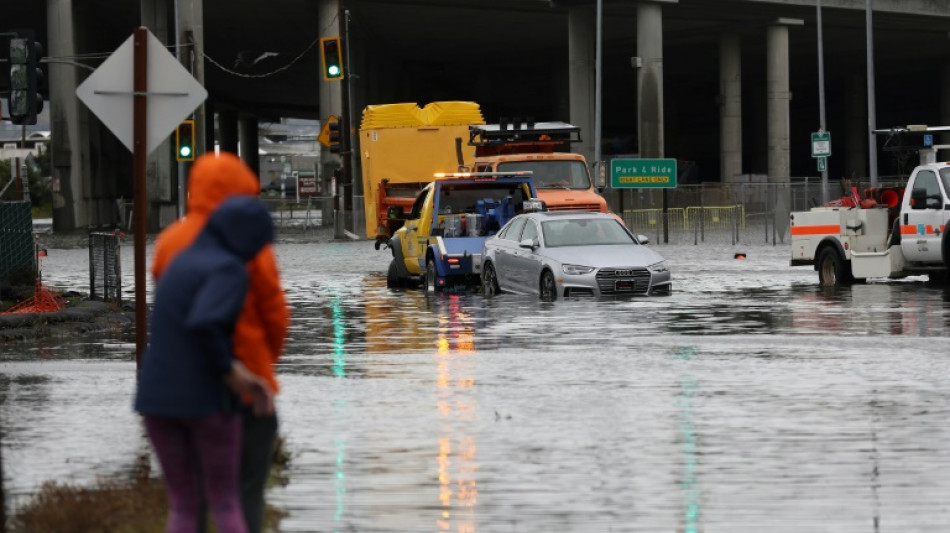
Bomb cyclone smashes into California / Photo: JUSTIN SULLIVAN - GETTY IMAGES NORTH AMERICA/AFP

 Lights out in Laos as electricity exports surge

 Steven Strogatz weighs AI mathematics advances and their consequences for researchers

 Anthropic boss calls for AI slowdown, Altman and Musk agree

 French IT giant Capgemini sells subsidiary after row over ICE links

 Quebec Brokerage Qubit Insurance Announces New Data on Coverage Shortfalls as Rebuilding Costs Rise

 Lady Gaga welcomes first child with fiance: US media

 Bhutan business bets on hazelnuts for farming future

 'Widow's Bay' and 'The Pitt' are favorites for Emmys night

 Coastal erosion forces cancellation of California music festival

 Argentina's Dirty War rears its head in Venice film

 UK lawmakers throw out bill to legalise assisted dying

 US inflation steady in August, fueling Fed rate hike expectations

 New York marks 25th anniversary of 9/11 attacks

 Nepal flood reconstruction bill to be $4.78 bn: foreign ministry

 JUMO and Standard Bank launch Social Finance Framework to scale inclusive finance in Africa

 Doomsday tech: could AI really kill us all?

 French comedy show 'Call my agent' makes film comeback

 It's all coming back: Celine Dion fans gear up for Paris return

 Researchers eye AI revolution in natural disaster forecasts

 US braces for inflation report that may push Fed to hike rates

 Musk threatens legal action over documentary

 Latin America fact-check group asks Meta not to replace verification practice

 AI Risks to Enter 60–80% of Liability and Cyber Insurance Underwriting by 2028, ScienceSoft Predicts

 Tribal Launches Campfire, Letting Business and Technical Teams Build on Salesforce Together

 Stocks fall as fresh oil surge fans inflation fears

A bomb cyclone smashed into California Wednesday, bringing powerful winds and torrential rain that was expected to cause flooding in areas already saturated by consecutive storms.
Authorities issued ominous warnings of threats to life and property for a vast stretch of the most populous US state, focused around San Francisco and Sacramento.
Forecasters said gusts of up to 45 miles (70 kilometers) an hour and intense rain could pummel the region through Wednesday, with the downpour continuing into Thursday.
Meteorologists at the National Weather Service said there could be "widespread flooding, roads washing out, hillside collapsing, trees down, widespread power outages, immediate disruption to commerce, and the worst of all, likely loss of human life."
California Governor Gavin Newsom declared a state of emergency "to support response and recovery efforts," while San Francisco established an Emergency Operations Center.
Bars and restaurants were shuttered as the city girded for the storm, with some people posting on Twitter that they were being sent home from work at midday.
Firefighters warned people to avoid one area where winds had blown glass out of an apartment complex.
Thousands of sandbags were being given out to residents fearful of flooding.
"We're very worried about it," Deepak Srivastava told CBS in San Francisco.
"(I) just spent all day putting sandbags in front of the garage at every entering point and we're just crossing our fingers and hoping we won't have more damage.
"We had a similar flood just last October... they call it a 100-year storm, but sounds like we might have two of those in one week."
City officials said they were working around the clock to try to help people prepare.
"We've been working very hard to source sandbags from wherever we can in northern California," said Rachel Gordon, of the city's Public Works department.
But she warned residents needed to take the storm seriously.
"If you don't have to be out in San Francisco, please don't be out on the roads."
The intense rain was brought about by a combination of a bomb cyclone -- a sudden steep drop in air pressure -- and an atmospheric river, where moisture-laden air is drawn in from the oceans.
Up to four inches (10 centimeters) of rain were expected in the Bay Area, with double that amount over nearby hills.
The Sierra Nevada mountain range was forecast to get several feet of snow.
The downpours come on top of a series of storms that have brought near-record rainfall over recent weeks.
On New Year's Eve parts of northern California were lashed by a storm that brought landslides and power outages, as levees were breached and roadways were flooded.
At least one person is known to have died after being trapped in a submerged car.
San Francisco recorded almost 5.5 inches (14 centimeters) of rain on December 31, the second wettest day for the city in recorded history.
The western United States is in the grip of a decades-long drought, with below average precipitation leaving river and reservoir levels worryingly low.
While forecasters say any rain is helpful, sudden downpours brought by heavy storms can do more harm than good as the ground struggles to absorb such high volumes of water so quickly, resulting in flooding.
L.Peeters--CPN