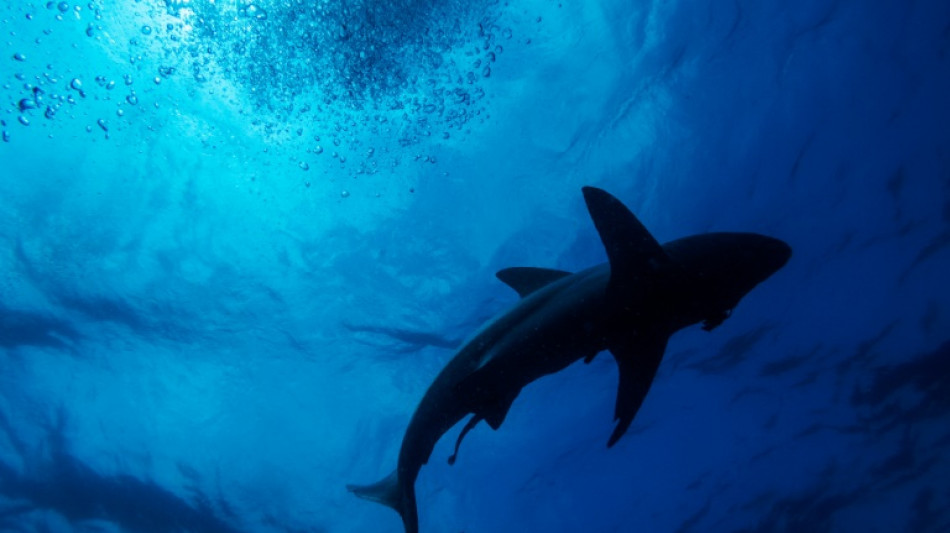
Global wildlife summit to vote on shark protections / Photo: Michele Spatari - AFP/File

 Kenya's economy faces climate change risks: World Bank

 Milei demands expulsion of foreigners expressing 'hate' against Argentina

 Italy's Po River valley on drought alert

 Prada profits pinched as growth hard to chase

 Stocks climb on earnings and rates, oil retreats

 US economic growth slows in second quarter, missing expectations

 Russia adds Telegram founder Durov to 'terrorist' blacklist

 Stocks diverge on earnings, as oil steadies

 Eurozone economy grows despite Middle East war

 Singapore group will develop 'most promising' Ebola vaccine

 Shell profit surges as Mideast war fuels oil prices

 Car maker Stellantis says back in profit in second quarter

 Samsung quarterly operating profit up 1,800% on AI boom

 South Korean stocks bounce after rout, oil holds gains on Mideast woes

 South Korea's women web sleuths fight AI deepfake porn

 Anything but programmable: New cost-efficient EC-power-supply-series for the DIN rail by CAMTEC PS

 Meta misses profit expectations, sticks to massive AI spending

 Campari - king of the spritz - hopes to conquer American heartland

 Air France-KLM and Lufthansa bid for Portugal's TAP airline

 Profits soar at Airbus as it delivers more planes

 Rheinmetall shares surge after armsmaker reports record profit

 FIFA hit by furious backlash over plans to sell stake in competitions

 MEXC Integrates World-Check to Fortify Institutional Grade Compliance Architecture

 Spain returns wildfire evacuees as France braces for worsening weather

 Russia seeks arrest of Telegram chief Durov

Delegates at a global summit on trade in endangered species will on Friday decide whether to approve a proposal to protect sharks, a move that could drastically reduce the lucrative and cruel shark fin trade.
If approved, dozens of species of the requiem shark and the hammerhead shark families would have their trade tightly controlled under the Convention on International Trade in Endangered Species (CITES).
The shark initiative has been one of the most discussed at this year's CITES summit in Panama, with the proposal co-sponsored by the European Union and 15 countries.
A vote had been expected Thursday but was postponed until Friday, the final day of the summit, as debates over illegal and unregulated hunting of hippos for their meat and ivory dragged on between the European Union and African countries.
Delegates are considering 52 proposals to change species' protection levels. Other species up for possible boosted protections are glass frogs, crocodiles, guitarfish, and some turtle species.
If the new raft of shark protections is applied, "it would be a historic decision," Panamanian delegate Shirley Binder, who presided over the meeting, told AFP earlier in the summit.
"For the first time, CITES would be handling a very large number of shark species, which would be approximately 90 percent of the market," she said.
Insatiable appetite in Asia for shark fins, which make their way onto dinner tables in Hong Kong, Taiwan and Japan, has spurred their trade.
Despite being described as almost tasteless and gelatinous, shark fin soup is viewed as a delicacy and is enjoyed by the very wealthy, often at weddings and expensive banquets.
Shark fins, representing a market of about $500 million per year, can sell for about $1,000 a kilogram (2.2 pounds).
- From villain to darling -
Sharks have long been seen as the villain of the seas they have occupied for more than 400 million years, drawing horror with their depiction in films such as "Jaws" and occasional attacks on humans.
However, these ancient predators have undergone an image makeover in recent years as conservationists have highlighted the crucial role they play in regulating the ocean ecosystem.
According to the Pew Environment Group, between 63 million and 273 million sharks are killed every year, mainly for their fins and other parts.
With many shark species taking more than 10 years to reach sexual maturity, and having a low fertility rate, the constant hunting of the species has decimated their numbers.
In many parts of the world, fisherman lop the shark's fins off at sea, tossing the shark back into the ocean for a cruel death by suffocation or blood loss.
The efforts by conservationists led to a turning point in 2013, when CITES imposed the first trade restrictions on some shark species.
"We are in the middle of a very large shark extinction crisis," Luke Warwick, director of shark protection for the NGO Wildlife Conservation Society (WCS), told AFP at the beginning of the summit.
CITES, which came into force in 1975, has set international trade rules for more than 36,000 wild species.
Its signatories include 183 countries and the European Union.
L.Peeters--CPN