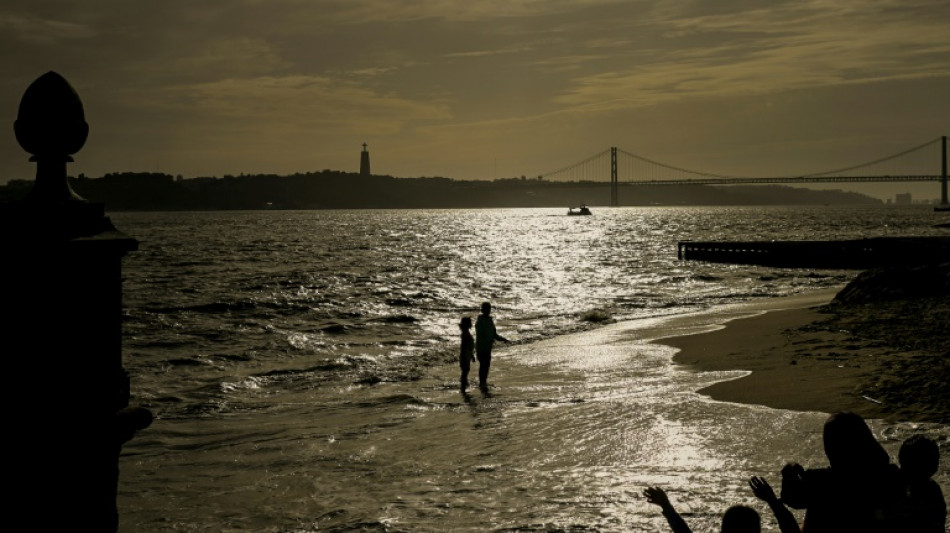
'European California' Portugal woos Americans seeking better life / Photo: PATRICIA DE MELO MOREIRA - AFP

 Kenya's economy faces climate change risks: World Bank

 Milei demands expulsion of foreigners expressing 'hate' against Argentina

 Italy's Po River valley on drought alert

 Prada profits pinched as growth hard to chase

 Stocks climb on earnings and rates, oil retreats

 US economic growth slows in second quarter, missing expectations

 Russia adds Telegram founder Durov to 'terrorist' blacklist

 Stocks diverge on earnings, as oil steadies

 Eurozone economy grows despite Middle East war

 Singapore group will develop 'most promising' Ebola vaccine

 Shell profit surges as Mideast war fuels oil prices

 Car maker Stellantis says back in profit in second quarter

 Samsung quarterly operating profit up 1,800% on AI boom

 South Korean stocks bounce after rout, oil holds gains on Mideast woes

 South Korea's women web sleuths fight AI deepfake porn

 Anything but programmable: New cost-efficient EC-power-supply-series for the DIN rail by CAMTEC PS

 Meta misses profit expectations, sticks to massive AI spending

 Campari - king of the spritz - hopes to conquer American heartland

 Air France-KLM and Lufthansa bid for Portugal's TAP airline

 Profits soar at Airbus as it delivers more planes

 Rheinmetall shares surge after armsmaker reports record profit

 FIFA hit by furious backlash over plans to sell stake in competitions

 MEXC Integrates World-Check to Fortify Institutional Grade Compliance Architecture

 Spain returns wildfire evacuees as France braces for worsening weather

 Russia seeks arrest of Telegram chief Durov

Nathan Hadlock moved to Portugal to escape the violence and lack of social welfare he saw in the United States, while still enjoying the sun and sea he had loved in California.
"Lisbon checked all the boxes," the 40-year-old American entrepreneur told AFP.
It even has a suspension bridge that is almost a dead ringer for San Francisco's Golden Gate.
"My partner and I were looking to slow life down and enjoy things more. And so we made a list of the top 10 places in the world and Lisbon quickly made it to the top."
The couple, who started a family when they moved to the Portuguese capital in 2020, were drawn by the weather, the good food, the cheaper lifestyle and the ease of travelling to other parts of Europe.
They also wanted to escape the darker sides of US society.
"One of the main reasons (US) investors are looking to move here, is their kids' safety. They often say, 'I don't want my kid to go to school and get shot,'" Hadlock insisted.
"And that's a real thing in the United States that just no one here in Europe has to experience."
Jen Wittman, who uprooted from the Golden State to Lisbon during the pandemic with her husband and teenage son, said the United States was "really kind of falling apart at the seams".
"The George Floyd incident and the pandemic, the political division, the racism... Everything was just getting overwhelming in America."
Having a European social net made a big difference too.
"America is terrible with health care. And it's terrible if you're a retiree and you have a health condition. Essentially in America you can be bankrupted by an illness," the 47-year-old said.
At around 7,000, the number of US citizens living in Portugal remains tiny compared to the 42,000 British expats who had made the country their home.
But while the influx of Brits -- the largest expat community from western Europe -- has begun to tail off, incomers from the States have doubled since 2018.
This year Americans are jostling with the Chinese for top spot among overseas investors lured by Portugal's "golden visas" -- residents permits issued for foreigners prepared to buy property or transfer capital to the Iberian country.
But most come on a D7 visa, which demands they have a regular "passive income" from pensions, rents or investments.
- 'Different mentality' -
Joana Mendoca, a lawyer for migration consultancy Global Citizen Solutions, speaks "almost every day" to US clients.
"Some come because they're digital nomads and want to work from home by the sea," she said.
"There are also entire families, who dream of one day getting their children into European universities.
"And there are retired people who sell everything in the States so they can enjoy a good retirement in Portugal."
Mendoca said Americans had "a different mentality" from other foreign investors, who were drawn to Portugal essentially by residency permits and tax exemptions.
"They really want to come and live here and adopt a different lifestyle," she said, even though the introduction of the golden visa scheme in 2012 has contributed to an unwelcome surge in property prices.
Hadlock started off as a digital nomad in Portugal. Now he works for an investment fund that buys up land for olive and almond groves in the rolling hills of the Alentejo.
The region south of Lisbon reminds him of California's Napa and Sonoma valleys.
- 'Surf and good wine' -
In Lisbon, Hadlock runs get-togethers to develop business ties between California and Portugal. The group calls itself Red Bridge, in a nod to the red suspension bridges spanning San Francisco Bay and the Tagus estuary.
Jonathan Littman, one of the members, still lives in California but is learning Portuguese.
He got to know Portuguese start-ups in Silicon Valley when Lisbon started organising yearly international web summits in 2016.
"We sort of see this as the California of Europe," he said.
"The surfing, the coast... We both have great wine. We both have a love of seafood and healthy cuisine. We both can be a little laid back."
Like her compatriots, Wittman and her family left the States to escape a "divisiveness" that Hadlock said is "pulling the US apart" and is palpable "as soon as you get off the plane".
But Portugal was not their first choice.
"We tried to move to Italy but they were not accepting American visa applicants at all," she recalled. "And so, we were like, 'Who in Europe will take Americans?' And it was Croatia and Portugal."
She and her husband run their own digital marketing company and have no plans to move back.
"It's safe. It's inclusive. We feel safe walking around, we feel safe at night. We do things that we could never do in America without being in constant fear," she said.
T.Morelli--CPN