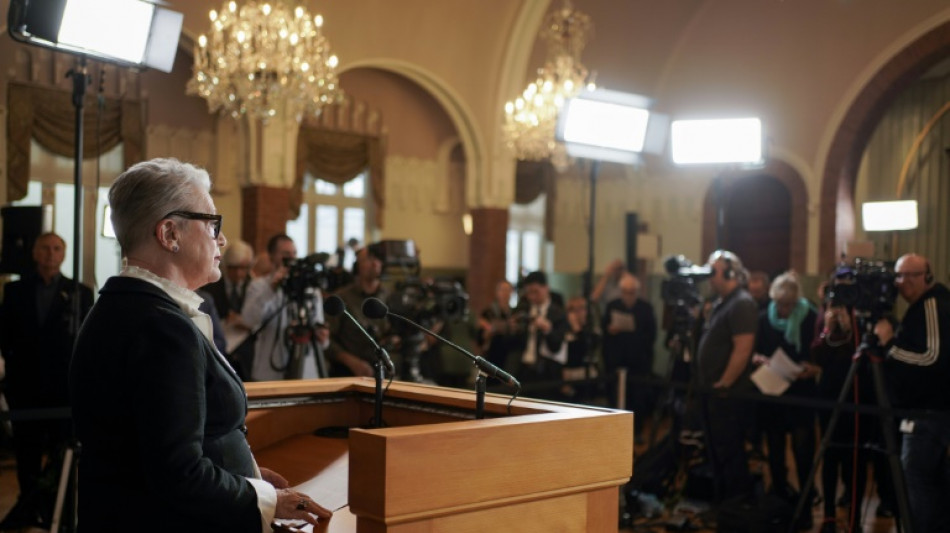
Rights champions in Russia, Ukraine, Belarus win Nobel Peace Prize / Photo: Heiko Junge - NTB/AFP

 Kenya's economy faces climate change risks: World Bank

 'Beginning of the end': Relief but no party as French wildfire winds down

 Southern Europe 'becoming more flammable' in hotter climate, experts say

 Mammoth bones found on parched bed of Danube in Bulgaria

 MEXC Lists Grvt (GRVT) with $60,000 Worth of GRVT and 10,000 USDT in Airdrop+ Rewards

 George and Amal Clooney flee French home due to wildfire

 MEXC Ventures Supports Alpha Arena's APAC Debut at Coinfest Bali

 AI data centre supplier Zhongji InnoLight slips on Hong Kong debut

 May, June heatwaves caused 2,877 extra deaths in England: govt

 BMW profit down a third as carmaker plans job cuts

 Seoul extends losses as most Asian markets drop, oil rises again

 Gambling.com Group Is Now Grandstand

 Meet the astronomer digging into the Milky Way's 'fossils'

 AI data centre supplier Zhongji InnoLight falls on Hong Kong debut

 Samsung operating profit up 1,800% in second quarter on AI boom

 Japanese population below 120 million for first time in decades

 US actor Jared Leto denies latest accusations of sexual assault

 Danube drops to 'historic lows' as fresh heatwave hits

 BTS pulls out of Grammys after Asian pop category introduction

 OpenAI says rogue AI agent attack hit other companies
 How an AFP beach snap became emblem of Europe's wildfire summer
 TRX Spot and Perpetuals Listing Launches on Backpack, Expanding Access to the TRON Ecosystem

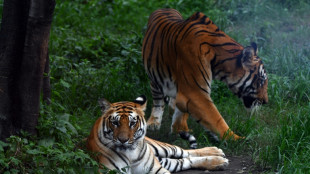 Nepal's tiger numbers climb 20 percent to estimated 429: survey
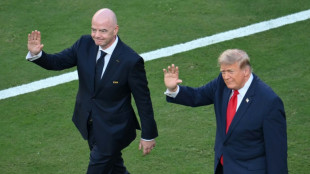 FIFA's plans to sell $4.2bn stake in its tournaments widely criticised
 BMW aims to cut 8,000 jobs by end 2027: company source

Human rights watchdogs from Russia, Ukraine and Belarus won the Nobel Peace Prize on Friday, with the jury criticising Russian President Vladimir Putin's "authoritarian" regime as he waged war in Ukraine.
The honour in favour of "peaceful co-existence" went to Russian rights group Memorial, Ukraine's Center for Civil Liberties which is documenting "Russian war crimes" against the Ukrainian people and detained activist Ales Bialiatski of Belarus.
A highly symbolic choice, the trio represent the three nations at the centre of the war in Ukraine, which has plunged Europe into its worst security crisis since World War II.
"They have made an outstanding effort to document war crimes, human right abuses and the abuse of power," the head of the Norwegian Nobel Committee, Berit Reiss-Andersen, told reporters.
"Together they demonstrate the significance of civil society for peace and democracy," she added.
Calling Putin's regime an "authoritarian government", Reiss-Andersen said the five-member committee wanted to highlight the "way civil society and human rights advocates are being suppressed."
Ukraine's Center for Civil Liberties (CCL), founded in 2007, has since Moscow's invasion in February identified and documented "Russian war crimes against the Ukrainian civilian population", the Nobel committee said.
It hailed the group's "pioneering role with a view to holding the guilty parties accountable for their crimes".
On Friday, the head of the CCL said Putin should face an "international tribunal".
Oleksandra Matviychuk wrote on Facebook the tribunal should be created to "give the hundreds of thousands of victims of war crimes a chance to see justice..."
- 'No sign of peace' -
UN investigators on September 23 accused Russia of committing war crimes on a "massive scale" in Ukraine, citing bombings, executions, torture and sexual violence on victims aged four to 82.
Moscow has also been accused of committing massacres after the bodies of dozens of civilians were found in Bucha, outside Kyiv, and the discovery of hundreds of others in Izium, a region liberated by Ukrainian troops last month.
Beyond the countless deaths and material destruction in Ukraine, the war has revived fears of a nuclear strike by Russia, which has struggled since Ukraine launched a counter-offensive in September.
"This year we were in a situation with a war in Europe, which is most unusual, but also facing a war that has a global effect on people all over the world", Reiss-Andersen said, referring to "the threat of using nuclear weapons and food shortage".
"That is a very bleak background and there is no sign of peace in the immediate future."
Memorial, founded in 1989 by 1975 Peace Prize laureate Andrei Sakharov, is the largest human rights organisation in Russia, compiling and systematising information on political oppression and human rights violations in Russia.
The country's Supreme Court ordered it dissolved in December 2021, and the group on Friday denounced a new court hearing on the issue.
"Right now, as the whole world is congratulating us for the Nobel Prize, a court hearing is taking place at the (Moscow) Tverskoy district court over the seizure of Memorial's assets," the centre for human rights of the organisation said on social media.
- 'Not yielded an inch' -
Last year, the Peace Prize went to another Kremlin critic, Russian journalist Dmitry Muratov, whose newspaper Novaya Gazeta also had its licence revoked.
He won together with Philippine journalist Maria Ressa for their fight for freedom of the press.
The Nobel committee also called on Belarus to release Bialiatski, 60, the founder of rights group Viasna whose work has charted the increasingly authoritarian tendencies of President Alexander Lukashenko and his security forces.
Bialiatski has been jailed several times since 2011, including after large-scale demonstrations against the regime in 2020 when Lukashenko claimed victory in elections the international community deemed fraudulent.
Minsk cracked down hard on the mass protests, with at least 37,000 people detained in a matter of months according to the UN, and many alleging they were mistreated and tortured in detention.
Lukashenko, who has clung to power since 1994 and has long been backed by Russia, is one of Moscow's rare allies in the war on Ukraine.
The regime criticised the award, saying prize creator Alfred Nobel was "turning in his grave".
Bialiatski's wife meanwhile said she was "overwelmed with emotion".
Exiled Belarusian opposition leader Svetlana Tikhanovskaya -- herself mentioned in Nobel speculation before Friday's announcement -- saw the prize as "recognition for all Belarusians fighting for freedom and democracy".
Bialiatski was imprisoned from 2011 to 2014, in 2020, and again in July 2021. He is the fourth Peace laureate to win whilst behind bars.
"He is still detained without trial. Despite tremendous personal hardship, Mr. Bialiatski has not yielded an inch in his fight for human rights and democracy in Belarus", the Nobel committee said.
S.F.Lacroix--CPN