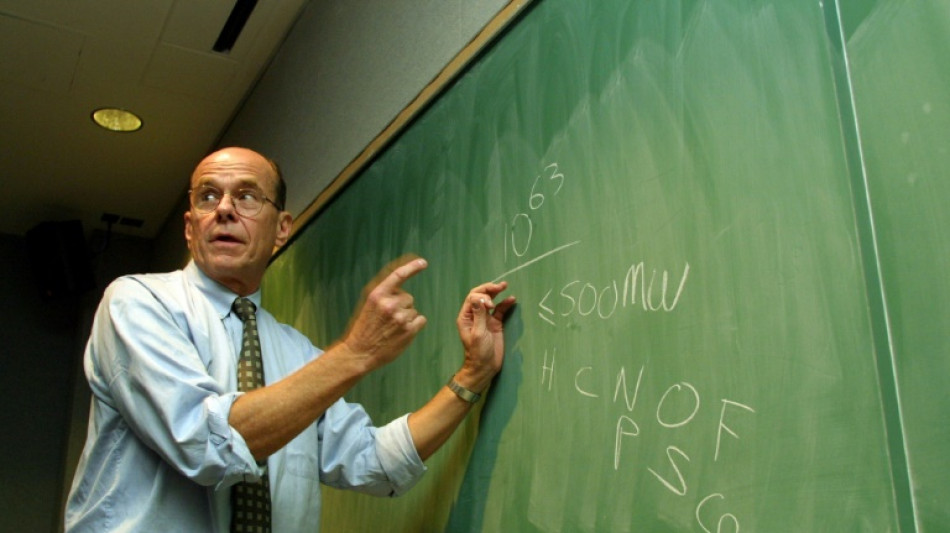
Click chemistry, Nobel-winning science that may 'change the world' / Photo: ANDREW SILK - AFP/File

 Kenya's economy faces climate change risks: World Bank

 'Beginning of the end': Relief but no party as French wildfire winds down

 Southern Europe 'becoming more flammable' in hotter climate, experts say

 Mammoth bones found on parched bed of Danube in Bulgaria

 MEXC Lists Grvt (GRVT) with $60,000 Worth of GRVT and 10,000 USDT in Airdrop+ Rewards

 George and Amal Clooney flee French home due to wildfire

 MEXC Ventures Supports Alpha Arena's APAC Debut at Coinfest Bali

 AI data centre supplier Zhongji InnoLight slips on Hong Kong debut

 May, June heatwaves caused 2,877 extra deaths in England: govt

 BMW profit down a third as carmaker plans job cuts

 Seoul extends losses as most Asian markets drop, oil rises again

 Gambling.com Group Is Now Grandstand

 Meet the astronomer digging into the Milky Way's 'fossils'

 AI data centre supplier Zhongji InnoLight falls on Hong Kong debut

 Samsung operating profit up 1,800% in second quarter on AI boom

 Japanese population below 120 million for first time in decades

 US actor Jared Leto denies latest accusations of sexual assault
 Danube drops to 'historic lows' as fresh heatwave hits

 BTS pulls out of Grammys after Asian pop category introduction

 OpenAI says rogue AI agent attack hit other companies

 How an AFP beach snap became emblem of Europe's wildfire summer

 TRX Spot and Perpetuals Listing Launches on Backpack, Expanding Access to the TRON Ecosystem

 Nepal's tiger numbers climb 20 percent to estimated 429: survey

 FIFA's plans to sell $4.2bn stake in its tournaments widely criticised

 BMW aims to cut 8,000 jobs by end 2027: company source

The Nobel Chemistry Prize was awarded to three scientists on Tuesday for their work on click chemistry, a way to snap molecules together like Lego that experts say will soon "change the world".
But how exactly does it work?
Imagine two people walking through a mostly empty room towards each other then shaking hands.
"That's how a classical chemical reaction is done," said Benjamin Schumann, a chemist at Imperial College, London.
But what if there was lots of furniture and other people clogging up the room?
"They might not meet each other," Schumann said.
Now imagine those people were molecules, tiny groups of atoms that form the basis of chemistry.
"Click chemistry makes it possible for two molecules that are in an environment where you have lots of other things around" to meet and join with each other, he told AFP.
The way click chemistry snaps together molecular building blocks is also often compared to Lego.
But Carolyn Bertozzi, who shared this year's chemistry Nobel with Barry Sharpless and Morten Meldal, said it would take a very special kind of Lego.
Even if two Legos were "surrounded by millions of other very similar plastic toys" they would only click in to each other, she told AFP.
- 'Changed the playing field' -
Around the year 2000, Sharpless and Meldal separately discovered a specific chemical reaction using copper ions as a catalyst which "changed the playing field" and became "the cream of the crop", said Silvia Diez-Gonzalez, a chemist at the Imperial College, London.
Copper has many advantages, including that reactions could involve water and be done at room temperature rather than at high heat which can complicate matters.
This particular way of connecting molecules was far more flexible, efficient and targeted than had ever been possible before.
Since its discovery, chemists have been finding out all the different kinds of molecular architecture they can build with their special new Lego blocks.
"The applications are almost endless," said Tom Brown, a British chemist at Oxford University that has worked on DNA click chemistry.
But there was one problem with using copper as a catalyst. It can be toxic for the cells of living organisms -- such as humans.
So Bertozzi built on the foundations of Sharpless and Meldal's work, designing a copperless "way of using click chemistry with biological systems without killing them," Diez-Gonzalez said.
Previously the molecules clicked together in a straight flat line -- like a seat belt -- but Bertozzi discovered that forcing them "to be a bit bent" made the reaction more stable, Diez-Gonzalez said.
Bertozzi called the field she created bioorthogonal chemistry -- orthogonal means intersecting at right angles.
- 'Tip of the iceberg' -
Diez-Gonzalez said she was "a bit surprised" that the field had been awarded with a Nobel so soon, because "there are not that many commercial applications out there yet".
But the future looks bright.
"We're kind of at the tip of the iceberg," said American Chemical Society President Angela Wilson, adding that this "chemistry is going to change the world."
Bertozzi said that there are so many potential uses for click chemistry, that "I can't even really enumerate them".
One use is for developing new targeted medicines, some of which could involve "doing chemistry inside human patients to make sure that drugs go to the right place," she told the Nobel conference.
Her lab has started research on potential treatments for severe Covid, she added.
Another hope is that it can lead to a more targeted way to diagnose and treat cancer, as well make chemotherapy have fewer, less severe side effects.
It has even created a way to make the bacteria that causes Legionnaires' disease become fluorescent so it easier to spot in water supplies.
Already, click chemistry has been used "to create some very, very durable polymers" that protect against heat, as well as in forms of glue in nano-chemistry, Meldal told AFP.
"I think it's going to completely revolutionise everything from medicine to materials," she said.
St.Ch.Baker--CPN