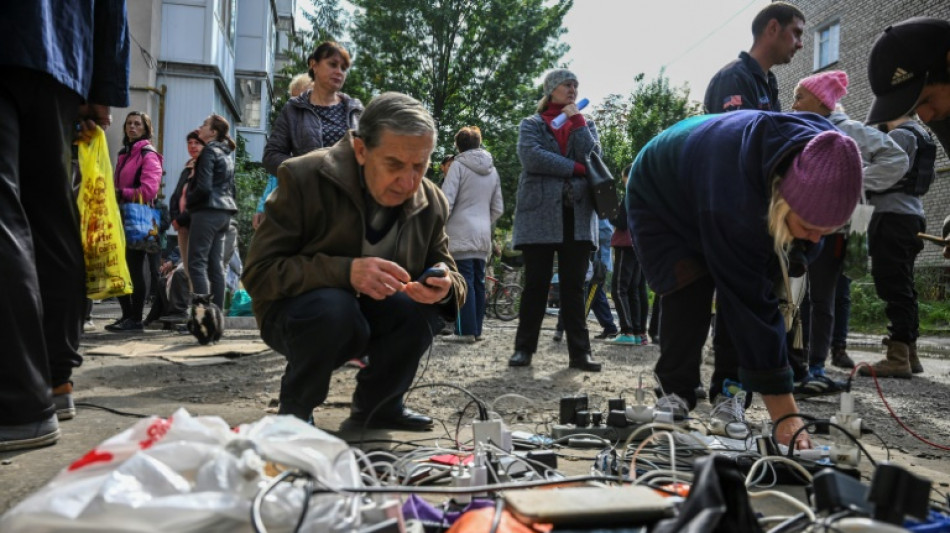
Makeshift wifi spot reconnects shattered Ukraine city / Photo: Juan BARRETO - AFP

 Kenya's economy faces climate change risks: World Bank

 'Beginning of the end': Relief but no party as French wildfire winds down

 Southern Europe 'becoming more flammable' in hotter climate, experts say

 Mammoth bones found on parched bed of Danube in Bulgaria

 MEXC Lists Grvt (GRVT) with $60,000 Worth of GRVT and 10,000 USDT in Airdrop+ Rewards

 George and Amal Clooney flee French home due to wildfire

 MEXC Ventures Supports Alpha Arena's APAC Debut at Coinfest Bali

 AI data centre supplier Zhongji InnoLight slips on Hong Kong debut

 May, June heatwaves caused 2,877 extra deaths in England: govt

 BMW profit down a third as carmaker plans job cuts

 Seoul extends losses as most Asian markets drop, oil rises again

 Gambling.com Group Is Now Grandstand

 Meet the astronomer digging into the Milky Way's 'fossils'

 AI data centre supplier Zhongji InnoLight falls on Hong Kong debut

 Samsung operating profit up 1,800% in second quarter on AI boom

 Japanese population below 120 million for first time in decades

 US actor Jared Leto denies latest accusations of sexual assault

 Danube drops to 'historic lows' as fresh heatwave hits

 BTS pulls out of Grammys after Asian pop category introduction

 OpenAI says rogue AI agent attack hit other companies

 How an AFP beach snap became emblem of Europe's wildfire summer

 TRX Spot and Perpetuals Listing Launches on Backpack, Expanding Access to the TRON Ecosystem

 Nepal's tiger numbers climb 20 percent to estimated 429: survey
 FIFA's plans to sell $4.2bn stake in its tournaments widely criticised

 BMW aims to cut 8,000 jobs by end 2027: company source

Starved of news and contact with the outside world during six months of occupation by Russian forces, residents of recently liberated Izyum are grateful for a makeshift wifi spot in the shattered Ukrainian city.
Outside an apartment block dozens of people queue before a sign that reads "15 minutes of wifi", where an aid worker takes each phone and enters the password.
Izyum, a predominantly Russian-speaking city of about 50,000 people before the war, had been fully occupied since April until it was recaptured earlier this month during Kyiv's lightning counter-offensive.
Soon after the liberation, investigation teams found what they said were 447 bodies buried during the occupation.
Residents told AFP Thursday that with electricity and mobile infrastructure networks badly damaged during the fighting, and still not restored, lack of information has kept them in the dark about what was happening.
But thanks to a power generator provided by the army, they can now reconnect to the internet -- at least for a brief window each day.
"From 8:00 am to 7:00 pm, some three to four thousand per day can connect," Seraphim, a soldier, told AFP.
"If too many people get connected at the same time the internet goes down, hence the 15-minute limit," explained resident Olga German.
"After zero minutes a day, 15 is quite a lot. Now we can check the news online, and compare sources, and keep in touch with our families," the 34-year-old English teacher said.
The eight-storey block is one of the few buildings in the devastated town to have escaped relatively unscathed, although many windows are broken, with the sound of sawing and hammers emanating from many floors.
A TV screen on a stand beside the queue showed a Ukrainian channel broadcasting news about the war, while people huddled on the ground charging their telephones from extension cables connected to the generator.
Residents ate borshch beetroot soup cooked on a nearby campfire, as children chopped firewood.
Around the corner a half-torn poster hung from a billboard: "Russia for ever", it said.
- Information vacuum -
German said the six-month period of occupation felt like "purgatory".
"We were living in an information vacuum, we couldn't get in touch with our relatives, and we could feel that the information we got from the Russians was not objective.
"So we lived only on gossip, and the stories got twisted".
Nadezda Oleksandrivna, a 64-year-old dog-trainer waiting her turn in the queue, said being deprived of news and contact with friends felt "like having a bag on my head".
It could have a serious impact on mental health, she added.
Oleksandrivna said she stayed in Izyum during the occupation because she did not want to abandon her two dogs.
Before the war she was an avid internet-user, keeping up with relatives, bloggers, politics and international news.
Now, she said she gets around the 15-minute wifi limit by returning to the back of the line when her time is up.
For a group of teenagers scrolling their phones in the corner, the wifi spot is an opportunity to catch up with friends on Viber and Telegram.
"Everyone started messaging me, including friends I have in Germany and the Czech Republic, they were really worried about me," said 16-year-old resident Anton.
"When I first got connection back I didn't know what to do, I noticed that my TikTok really changed.
"Now it's only about the war," he said.
A.Zimmermann--CPN