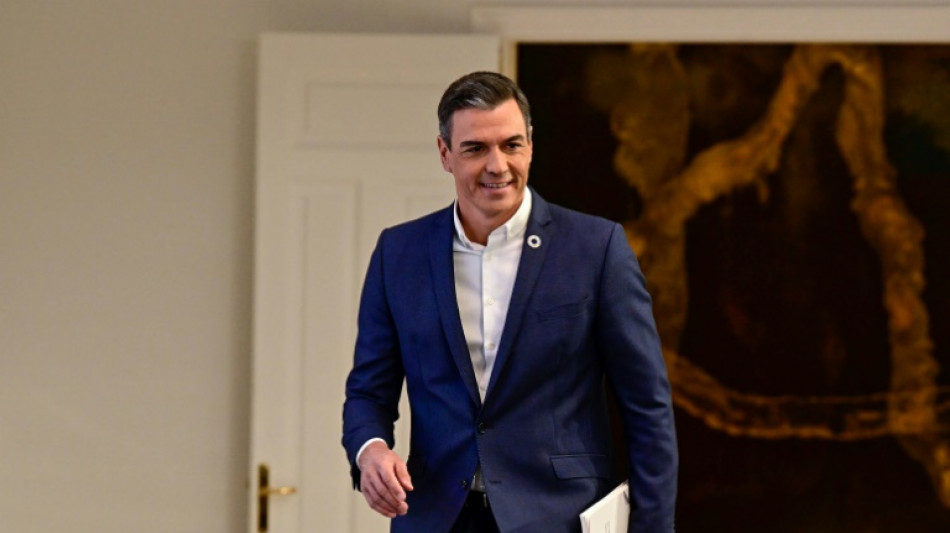
Spanish PM calls on nation to go tie-less / Photo: JAVIER SORIANO - AFP

 Kenya's economy faces climate change risks: World Bank

 AI data centre supplier Zhongji InnoLight slips on Hong Kong debut

 May, June heatwaves caused 2,877 extra deaths in England: govt

 BMW profit down a third as carmaker plans job cuts

 Seoul extends losses as most Asian markets drop, oil rises again

 Gambling.com Group Is Now Grandstand

 Meet the astronomer digging into the Milky Way's 'fossils'

 AI data centre supplier Zhongji InnoLight falls on Hong Kong debut

 Samsung operating profit up 1,800% in second quarter on AI boom

 Japanese population below 120 million for first time in decades

 US actor Jared Leto denies latest accusations of sexual assault

 Danube drops to 'historic lows' as fresh heatwave hits

 BTS pulls out of Grammys after Asian pop category introduction

 OpenAI says rogue AI agent attack hit other companies
 How an AFP beach snap became emblem of Europe's wildfire summer

 TRX Spot and Perpetuals Listing Launches on Backpack, Expanding Access to the TRON Ecosystem

 Nepal's tiger numbers climb 20 percent to estimated 429: survey
 FIFA's plans to sell $4.2bn stake in its tournaments widely criticised

 BMW aims to cut 8,000 jobs by end 2027: company source

 On London streets, homeless wary at PM's vow to end rough sleeping
 South Korean stocks collapse amid Asian tech rout

 Japan coral protectors race to save reefs from heat 'bomb'

 Senate advances sweeping Russia sanctions bill

 AI glasses help propel EssilorLuxottica sales growth
 Airbus completes record 24-hour flight with plane to be used by Qantas

Spanish Prime Minister Pedro Sanchez on Friday called on office workers to throw sartorial caution to the wind and ditch their ties amid scorching summer temperatures.
In a move some might be surprised was even necessary given Spain's famously hot climate, Sanchez urged office workers to follow his own tie-free lead.
"I would like you to see that I am not wearing a tie," said Sanchez, smiling broadly, pointing to his open neck shirt during a news conference in Madrid.
Feeling a little more comfortable would save energy if it resulted in less air conditioning being used, he said.
"This means that we can all save energy," he said, adding that he had asked all ministers and public officials to stop wearing ties and hoped the private sector would also follow suit.
The Spanish government is on Monday set to adopt a set of "urgent" energy-saving measures, Sanchez said, "in line with what other European countries do", without elaborating.
Following Moscow's invasion of Ukraine, the European Commission released in mid-May a 210-billion-euro plan aiming to boost renewable energies and reduce energy consumption to put an end to dependency on Russian gas.
In response, Spain has adopted several measures including encouraging remote work and the limiting of air conditioning in offices in summer and radiators in winter.
The 27 EU states also agreed on Tuesday "to reduce their gas demand by 15 percent compared to their average consumption in the past five years, between 1 August 2022 and 31 March 2023, with measures of their own choice," the European Council said in a statement.
Several German cities said this week they would step up efforts to save energy, with Hanover in the north announcing plans to only offer cold showers at public pools and sports centres and Berlin switching off spotlights illuminating its historic monuments.
D.Avraham--CPN