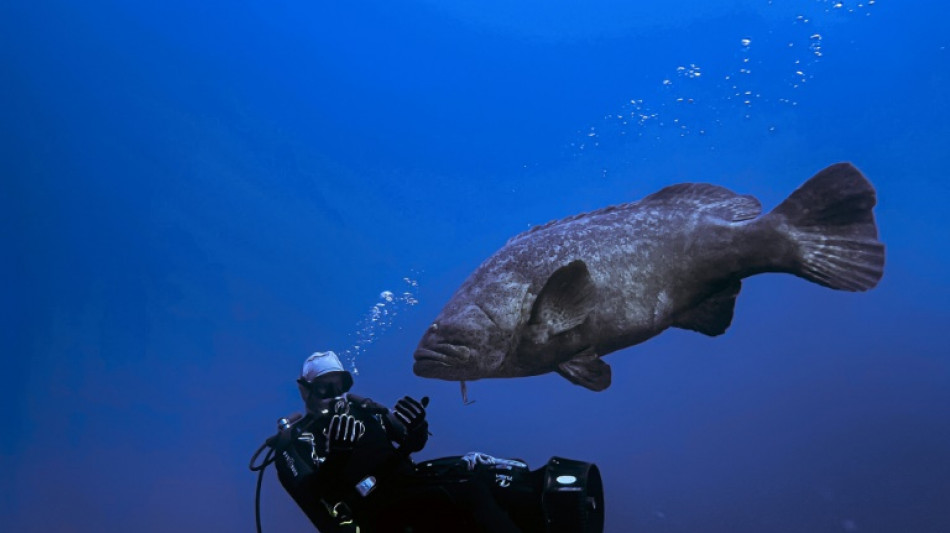
Huge groupers, the joy of Florida divers, are now 'vulnerable' / Photo: Jesus OLARTE - AFP/File

 French firm Safran helps build aircraft wings of the future in UK factory

 World Bank warns of worsening food insecurity as commodity prices soar

 Billionaire Ambani's Jio soars in market debut after India's biggest IPO

 AI chip giant SK hynix posts seven-fold surge in quarterly operating profit
 S.African activists push back on data centre rush

 Billionaire Ambani's Jio to debut after record India IPO

 UK set for cautious budget as borrowing costs climb

 US Fed expected to hold rates steady ahead of key midterm elections

 AI chip giant SK hynix says quarterly operating profit soars 630%

 GA-ASI and Saab Perform Advanced AEW Flight Testing on Uncrewed MQ-9B

 Storied Paris department store seeks bankruptcy protection

 Boeing shares tumble after it releases cautious growth forecast
The goliath grouper, a colossus of a fish that can weigh up to 360 kilograms (nearly 800 pounds), is the delight of divers in Florida, though scientists warn their numbers are down since the US state allowed fishing of the giants resume.
"There's nowhere else you can have an experience with a fish that big while you're diving -- and being this close to it," Dr. James Locascio, a marine biologist with the Mote Marine Laboratory, told AFP.
"And so, really, we feel that the fish is worth a lot more alive than it is dead."
During a sea trip early this month off Boynton Beach, on Florida's Atlantic coast north of Miami, divers were amazed by these giants, which can measure up to 2.4 meters (eight feet) long.
With naturally down-turned mouths, these creatures may appear cranky, but some actually allow themselves to be brushed by a human hand.
- 'Fewer and fewer' -
"We were totally amazed about the amount of groupers that show up to the Boynton Beach area," diver Ben Galemmo told AFP.
Still, he added, "from talking to the locals, (the population) has actually gone down in numbers" in recent years.
A recent study confirms that trend.
"The diving industry has reported that they are seeing fewer and fewer of these fish," said Locascio, the marine biologist.
That could devastate the local diving business.
Last year, when researchers with the Mote laboratory repeated a census of spawning sites first conducted in 2013, they observed significantly fewer goliath groupers in five of the six locations studied.
Overfishing had left the species near extinction in the 1980s, but conservation efforts saved it. Goliath grouper fishing was banned for more than 30 years.
But in the past year Florida authorities deemed the population had recovered sufficiently, and allowed 200 of the fish to be caught and killed each year in state waters.
Unfortunately, the goliath grouper lends itself to overfishing partly because it grows slowly -- it can live as long as 30 years -- and takes a relatively long time to reproduce.
The goliath is now classed as a "vulnerable" species by the International Union for Conservation of Nature, according to Locascio.
Calling the fish "an essential species for maintaining the balance of the ecosystem," he added, "We do not want its population to decline."
The huge fish also lives in the waters of the Gulf of Mexico, the Caribbean, and off the coast of Brazil.
M.Mendoza--CPN