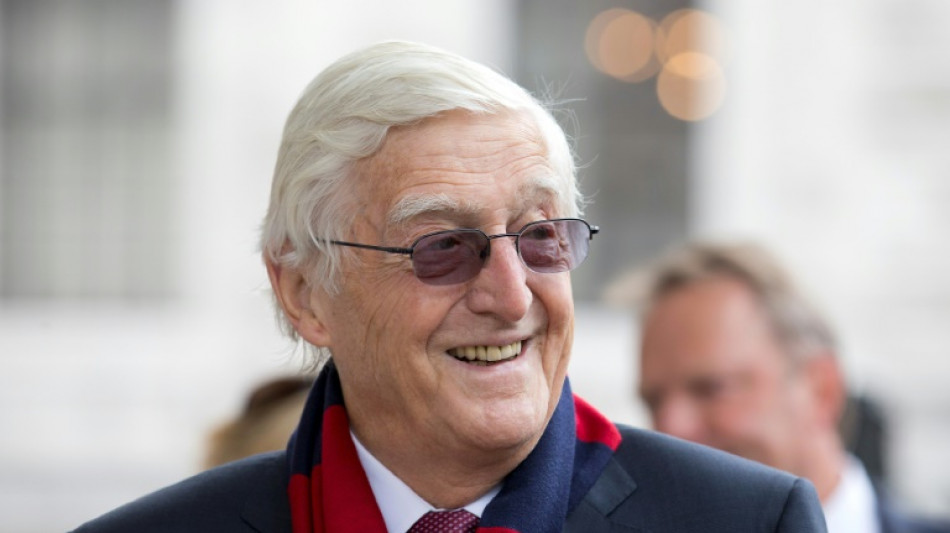
Michael Parkinson: Britain's chatshow king / Photo: JUSTIN TALLIS - AFP

 Kenya's economy faces climate change risks: World Bank
 Japan probe made closest-ever asteroid flyby: space agency
 British oil giant BP aims to sell North Sea business
 China factory activity slides as leaders seek spending boost

 Tech rebound fuels record-breaking rally in South Korean stocks

 Cables and cooling bring AI windfall to Indian suppliers

 Anthropic's models gained unauthorized 'real-world' access during testing

 Apple tops estimates in CEO Cook's final quarter, but shares fall

 Milei demands expulsion of foreigners expressing 'hate' against Argentina

 Italy's Po River valley on drought alert

 Prada profits pinched as growth hard to chase

 Stocks climb on earnings and rates, oil retreats

 US economic growth slows in second quarter, missing expectations

 Russia adds Telegram founder Durov to 'terrorist' blacklist

 Stocks diverge on earnings, as oil steadies

 Eurozone economy grows despite Middle East war

 Singapore group will develop 'most promising' Ebola vaccine

 Shell profit surges as Mideast war fuels oil prices

 Car maker Stellantis says back in profit in second quarter

 Samsung quarterly operating profit up 1,800% on AI boom

 South Korean stocks bounce after rout, oil holds gains on Mideast woes

 South Korea's women web sleuths fight AI deepfake porn

 Anything but programmable: New cost-efficient EC-power-supply-series for the DIN rail by CAMTEC PS

 Meta misses profit expectations, sticks to massive AI spending

 Campari - king of the spritz - hopes to conquer American heartland

Michael Parkinson was a regular first port of call for reporters looking for a tribute on the passing of the rich and famous, so much so that he often picked up the phone and asked: "Who's died now?"
But it was a reflection of how many stars -- from Hollywood A-listers to sporting and actual royalty -- had appeared on his eponymous Saturday night chatshow, which first ran from 1971 to 1982.
When he finally bowed out in December 2007 after his show was revived for a second stint, "Parky", as he was often called, reckoned he had interviewed some 2,000 celebrities.
"Sinatra was the one that got away," he recalled. The great Australian cricketer Don Bradman was another.
"Otherwise, I've met everyone I have ever wanted to meet," he added.
Parkinson, whose death aged 88 was announced Thursday, won fans for his laid-back interviewing style that encouraged guests to talk, in stark contrast to some modern chatshow hosts who are often billed as the main attraction.
But it was also the calibre of people he attracted, in an age when big-name celebrities were rarely seen on prime-time television.
His assessment of his abilities was typically modest.
"I'm not bad at what I do," he told The Guardian in 2000, adding that he knew his limitations and the trick was getting the chemistry right between guests.
- Ali and Billy -
Parkinson, the son of a miner, was the quintessential plain-speaking, flat-vowelled, cricket-loving Yorkshireman.
He once opened the batting for his local club side Barnsley with the future Test umpire Dickie Bird, and tried out for Yorkshire with Geoff Boycott, later an England opener and commentator.
From school he became a newspaper journalist, moving into television in the 1960s after stints on the Manchester Guardian and Daily Express.
Highlights on his chatshow included Marlon Brando, David Niven, Richard Burton, and Orson Welles, Alec Guinness, Fred Astaire and even Princess Anne.
He also appeared on the cover of Paul McCartney and Wing's 1973 album "Band on the Run".
But he will be best remembered for his encounters with the heavyweight boxer Muhammad Ali, whom he called "the most remarkable human being I ever encountered".
"I interviewed him four times and lost on points on just about every occasion," he told the Daily Telegraph in 2016.
Parkinson once recalled that only two guests could add millions to the viewing figures -- Ali and the Scottish comedian Billy Connolly, whose early career he championed.
He sometimes secured scoops, such as in March 2006 when prime minister Tony Blair told him that he believed he would be judged by God for the divisive Iraq War.
There were lows, too, notably with the actress Helen Mirren in 1975, whom he introduced as the "sex queen" of the Royal Shakespeare Company and pursued a prurient line of questioning.
Mirren dismissed him later as a "sexist old fart" but Parkinson was largely unrepentant, assessing it was "over the top" and "of its time" yet still "good television".
- Big band and sport -
After TV, Parkinson moved to radio, briefly presenting the BBC's "Desert Island Discs", on which celebrities and others reminisce about their lives before being cast away to an imaginary desert island.
The widow of the man he replaced, however, decided he was "a rough country boy with a terrible accent", he said, and he left.
Other stints followed ranging from sport to music, particularly jazz and big band.
He also kept up his sports writing, and was president of the Sports Journalists Association.
Parkinson, who married his wife Mary in 1959 after meeting her on the top deck of a bus, earned a knighthood in 2008, becoming "Sir Michael" for his services to broadcasting.
But he admitted he was a print journalist at heart.
"I've never had that fear about what would happen if TV didn't come calling," he told The Guardian in 2000.
"That's terribly important. If they said tomorrow 'we never want to see your face on television again', it wouldn't matter a damn.
"I could still make a living and I'd probably write a book about how crazy they all were on TV, all my secrets."
A.Agostinelli--CPN