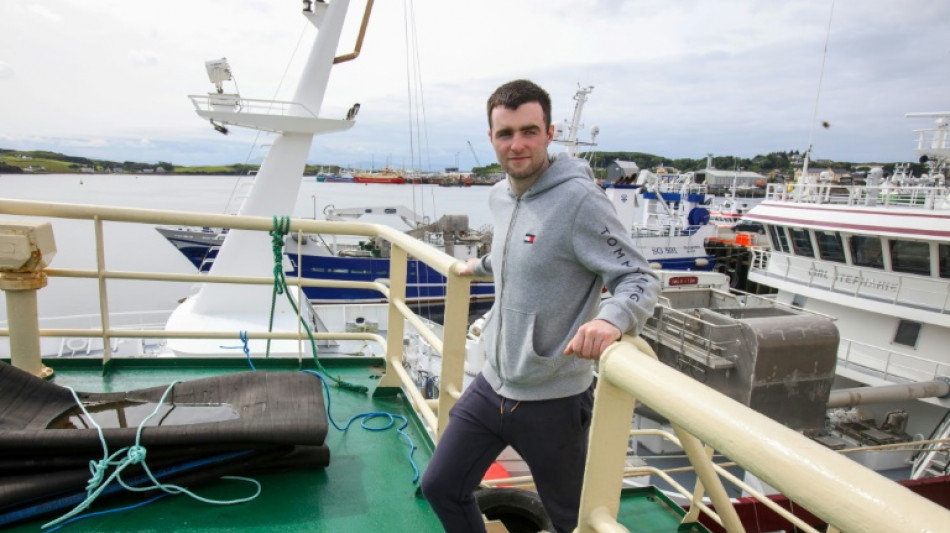
Ireland's fishermen fear species migration as sea temperatures soar / Photo: Paul Faith - AFP

 Kenya's economy faces climate change risks: World Bank
 Fornaro Legal Releases Guidance to Help Businesses Maintain Clear Ownership Records During Growth

 Japan probe made closest-ever asteroid flyby: space agency

 British oil giant BP aims to sell North Sea business

 China factory activity slides as leaders seek spending boost

 Tech rebound fuels record-breaking rally in South Korean stocks
 Cables and cooling bring AI windfall to Indian suppliers
 Anthropic's models gained unauthorized 'real-world' access during testing

 Apple tops estimates in CEO Cook's final quarter, but shares fall

 Milei demands expulsion of foreigners expressing 'hate' against Argentina
 Italy's Po River valley on drought alert

 Prada profits pinched as growth hard to chase
 Stocks climb on earnings and rates, oil retreats

 US economic growth slows in second quarter, missing expectations

 Russia adds Telegram founder Durov to 'terrorist' blacklist

 Stocks diverge on earnings, as oil steadies

 Eurozone economy grows despite Middle East war

 Singapore group will develop 'most promising' Ebola vaccine

 Shell profit surges as Mideast war fuels oil prices

 Car maker Stellantis says back in profit in second quarter

 Samsung quarterly operating profit up 1,800% on AI boom

 South Korean stocks bounce after rout, oil holds gains on Mideast woes

 South Korea's women web sleuths fight AI deepfake porn

 Anything but programmable: New cost-efficient EC-power-supply-series for the DIN rail by CAMTEC PS

 Meta misses profit expectations, sticks to massive AI spending

When he finished school Daragh McGuinness knew he wanted to join a fishing crew but now, at 23, he fears climate change may kill off the industry that has sustained his family for generations.
"It's a massive problem," he told AFP in the pilothouse of the Atlantic Challenge trawler, where he works as a deckhand, docked in the port of Killybegs in northwest Ireland.
"It could really finish the fishing, in Ireland anyway at least."
Soaring temperatures in the North Atlantic Ocean over the summer months have raised fears that fish could be pushed to colder waters, heaping pressure on the already struggling industry.
At the end of July, the US National Oceanic and Atmospheric Administration (NOAA) announced that average surface temperatures in the North Atlantic had reached a new record high of 24.9 degrees Celsius (76.8 degrees Fahrenheit).
The Atlantic Challenge, like many vessels sailing out of Killybegs, catches blue whiting and mackerel, which are highly prized on international markets, returning to port one or two days after a catch so produce is fresh.
"It would just concern you that you would be pushed further, too far north and then it wouldn't be viable to come back to Killybegs," McGuinness explained.
Sean O'Donoghue, chief executive of the Killybegs Fishermen's Organisation, said climate change was having a "dramatic effect" on white fish stocks such as cod which prefer colder waters.
- 'Extreme' -
He feared it was "only a matter of time" before so-called pelagic fish such as mackerel, blue whiting and herring move north permanently.
"If we continue with the warming of the waters, it is inevitable, the pelagic species will move totally out of the waters. And we could end up that we have very little fish," he said.
Among trends emerging, he added, were more mackerel being caught by the Icelandic fleet, while his members were catching more species like anchovies and sardines, which are typically found in warmer southern waters, prompting "overall concern".
The temperature record set in July was particularly worrying as it came weeks before the North Atlantic typically reaches peak temperatures in September.
In June, the NOAA recorded what it characterised as a Category 4 or "extreme" marine heatwave off the coasts of Ireland and the United Kingdom.
Glenn Nolan, who heads oceanographic and climate services at Ireland's Marine Institute, said the month saw "significant" temperatures, 4-5 degrees in excess of what would be normal off the country's coast in the summer months.
"When you're seeing a temperature at 24.5 or 21, as we saw in some of the coastal bays around the county of Galway... it's way above what you would ordinarily expect," he said.
Nolan said he expected a specific study attributing the spike in temperatures in June and July to climate change in due course.
- Double whammy -
The UN's Intergovernmental Panel on Climate Change (IPCC), which assesses the science related to climate change, has attributed the intensity of marine heatwaves to global warming for decades, he noted.
"The IPCC have already looked at marine heatwaves in general and they have high confidence that they can attribute them to manmade climate change," the Galway-based expert said.
Nolan said the extreme temperatures could create the conditions for changes to fish migration, and pointed to algal blooms in warm waters causing "problems typically for shellfish and finfish".
For Irish fishing, the situation is a double whammy, as the industry has been hit by lost EU fishing quotas after Brexit, the UK's departure from the bloc at the end of 2020.
EU member Ireland saw a 15-percent cut to fishing quotas by 2025 as part of the last-minute trade deal between London and Brussels.
"Unfortunately the deal that was done disproportionally hit Ireland," said O'Donoghue.
"The net effect of it is that Ireland is paying 40 percent of the transfer of fish to the UK (from the EU)."
He now wants to see changes to EU fisheries policy to reflect the impact of the Brexit cuts on Ireland's fleet and to mitigate the effects of climate change on his members' catch.
"We're not happy with the way things are on the Common Fisheries Policy at the moment. They need to be changed and Brexit and climate change have to be taken on board," O'Donoghue said.
O.Hansen--CPN