
Croatia targets latest climate-change threat: mosquitoes
/ Photo: DENIS LOVROVIC - AFP

 Kenya's economy faces climate change risks: World Bank

 Japan probe made closest-ever asteroid flyby: space agency

 British oil giant BP aims to sell North Sea business

 China factory activity slides as leaders seek spending boost

 Tech rebound fuels record-breaking rally in South Korean stocks

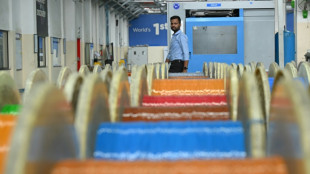 Cables and cooling bring AI windfall to Indian suppliers

 Anthropic's models gained unauthorized 'real-world' access during testing

 Apple tops estimates in CEO Cook's final quarter, but shares fall

 Milei demands expulsion of foreigners expressing 'hate' against Argentina

 Italy's Po River valley on drought alert

 Prada profits pinched as growth hard to chase

 Stocks climb on earnings and rates, oil retreats

 US economic growth slows in second quarter, missing expectations

 Russia adds Telegram founder Durov to 'terrorist' blacklist

 Stocks diverge on earnings, as oil steadies

 Eurozone economy grows despite Middle East war

 Singapore group will develop 'most promising' Ebola vaccine

 Shell profit surges as Mideast war fuels oil prices

 Car maker Stellantis says back in profit in second quarter

 Samsung quarterly operating profit up 1,800% on AI boom

 South Korean stocks bounce after rout, oil holds gains on Mideast woes

 South Korea's women web sleuths fight AI deepfake porn

 Anything but programmable: New cost-efficient EC-power-supply-series for the DIN rail by CAMTEC PS

 Meta misses profit expectations, sticks to massive AI spending

 Campari - king of the spritz - hopes to conquer American heartland

Hordes of buzzing but sterile mosquitoes are being let loose in Zagreb as Croatia gets ahead of worries that climate change could bring tropical diseases to the Mediterranean nation.
The release is part of a pilot project focused on eradicating invasive Asian Tiger mosquitoes known for carrying sicknesses like Dengue Fever, Chikungunya and Zika.
The species has appeared to thrive in the country and across the region in recent years due in part to climate change -- with the warmer weather providing fertile ground for the mosquito.
"It's too early to say whether this one will yield results," Zagreb resident Kruno Lokotar told AFP. "But I'm glad that we are not just sticking with spraying."
Croatia's effort centres on a method that uses sterilised male mosquitoes -- which once released into the wild will mate with females and neutralise the potential for future offspring.
The Zagreb project kickstarted in June, when 100,000 mosquitoes were released in a high-risk area with thick foliage where mosquitoes often congregate.
"If we release a sufficient number of sterile males during a certain period in an area, the mosquito population in that area will decrease," Ana Klobucar, a medical entomologist of the Zagreb-based teaching institute of public health who is overseeing the project, told AFP.
The plan is rooted in the Sterile Insect Technique (SIT) -- a method that has been used for decades across the world to combat various harmful insects, but is still being tested for its effectiveness against mosquitoes in urban areas.
Croatia started using it for mosquitoes last year in northern Istria peninsula.
This year a total of 1.2 million specially treated insects will be released there over a three-month period, entomologist Nediljko Landeka of the regional public health institute told AFP.
- Climate change impact -
The insects -- which have been rendered sterile after exposure to gamma rays -- are sourced from a laboratory in Italy, and shipped 500 kilometres (310 miles) to Croatia in special boxes.
Once received, Klobucar and her assistants carefully remove plastic bowls with the insects from cardboard tubes before they are later dispersed in local gardens in the target area.
Croatia's programme coincides with increasingly dire warning from experts that global warming could make swaths of Europe more vulnerable to infectious diseases spread by mosquito bites.
The presence of the Asian Tiger mosquito in Croatia was first recorded in 2004 after arriving in Europe in the late 1970s, with experts suggesting they made the journey in used tyres that arrived in Albania from China.
The breed has now spread to more than a dozen European countries, with the Mediterranean region having been hit the hardest, according to official figures.
As the mercury rises across the globe, the Asian Tiger mosquito is moving further north including in areas that were considered too cold for the species to thrive, including in Switzerland and Germany.
"We are afraid that together with the species, viruses could also easily adapt in the future to new environments," warned Greek entomologist Antonios Michaelakis.
Michaelakis -- who is also a researcher at the Benaki Phytopathological Institute in Athens -- has been instrumental in sharing his experiences from a programme in Greece with his Croatian counterparts.
In Greece in 2019, the project succeeded in slashing the population of Asian Tiger mosquitoes by 90 percent, he told AFP.
During a trial of the technique last year in Croatia's Istria, up to 14 percent of mosquito eggs in the area were found to be sterile and jumped to nearly 60 percent this year, Landeka added.
M.Davis--CPN