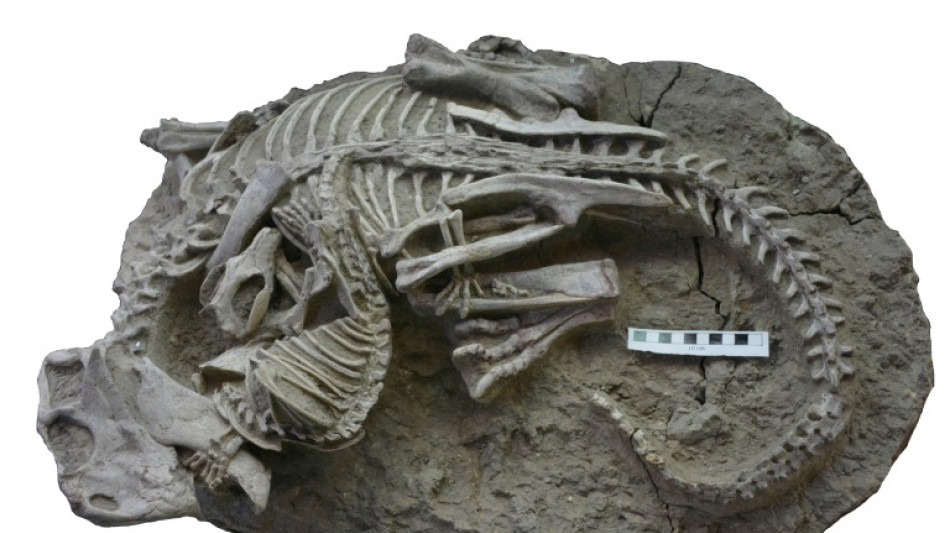
Mammal bites dinosaur in 'once-in-a-lifetime' fossil find / Photo: Gang Han - Canadian Museum of Nature/AFP

 Kenya's economy faces climate change risks: World Bank
 British oil giant BP aims to sell North Sea business

 China factory activity slides as leaders seek spending boost

 Tech rebound fuels record-breaking rally in South Korean stocks

 Cables and cooling bring AI windfall to Indian suppliers

 Anthropic's models gained unauthorized 'real-world' access during testing

 Apple tops estimates in CEO Cook's final quarter, but shares fall

 Milei demands expulsion of foreigners expressing 'hate' against Argentina

 Italy's Po River valley on drought alert

 Prada profits pinched as growth hard to chase

 Stocks climb on earnings and rates, oil retreats

 US economic growth slows in second quarter, missing expectations

 Russia adds Telegram founder Durov to 'terrorist' blacklist

 Stocks diverge on earnings, as oil steadies

 Eurozone economy grows despite Middle East war

 Singapore group will develop 'most promising' Ebola vaccine

 Shell profit surges as Mideast war fuels oil prices

 Car maker Stellantis says back in profit in second quarter

 Samsung quarterly operating profit up 1,800% on AI boom

 South Korean stocks bounce after rout, oil holds gains on Mideast woes

 South Korea's women web sleuths fight AI deepfake porn

 Anything but programmable: New cost-efficient EC-power-supply-series for the DIN rail by CAMTEC PS

 Meta misses profit expectations, sticks to massive AI spending

 Campari - king of the spritz - hopes to conquer American heartland

 Air France-KLM and Lufthansa bid for Portugal's TAP airline

A badger-like mammal was sinking its teeth into the ribs of a dinosaur three times its size when they were buried in volcanic ash 125 million years ago, capturing the pair in a deadly embrace.
The fight scene, preserved in a fossil discovered in China, suggests that small mammals preyed on the dinosaurs that ruled Earth during the Cretaceous period more than previously thought, scientists said on Tuesday.
Jordan Mallon, a palaeontologist at the Canadian Museum of Nature, told AFP that when he first saw the fossil "my eyes popped out of my head".
Mallon, a co-author of a new study led by Chinese researchers, said they believe the fossil is the first ever discovered that shows a mammal and dinosaur fighting each other.
Mammals were generally considered far too small to prey on the dinosaurs that dominated the world during the tens of millions of years they shared on Earth.
But the fossil shows a badger-sized Repenomamus robustus sitting on top of Psittacosaurus lujiatunensis, a plant-eating dinosaur that stood 120 centimetres (47 inches) tall and had a beak like a parrot.
The mammal -- one of the largest of its time but still a third the weight of the dinosaur -- is sinking his sharp teeth into the dinosaur's ribs and gripping onto its leg.
- 'Feisty mammals' -
The way the pair are intertwined shows that the mammal was not scavenging on a dead dinosaur, Mallon said.
"The dinosaur has collapsed down and trapped the hind limb of the mammal in the fold of its knee," indicating it was an attack, he said.
The dinosaur also bears no bite marks, which mammals often leave on scavenged bodies.
While it is rare for mammals to prey on animals so much larger than them, Mallon said one example was how wolverines had been observed hunting far-larger caribou.
It was not possible to tell from the fossil if Repenomamus hunted solo or in a pack, he said, adding that either was possible.
The almost entirely complete skeletons were found in China's northeastern Liaoning province in 2012.
They were discovered at a site nicknamed "Chinese Pompeii" because of how many dinosaurs and other animals have been found preserved by volcanic debris there, similar to the ancient Roman city.
The first fossil suggesting that mammals ate dinosaurs was found at the Chinese site in 2005. It showed a baby Psittacosaurus in the stomach of a Repenomamus.
But the new fossil is the first piece of evidence that "there were at least some feisty mammals around during the Cretaceous... capable of taking down an adult dinosaur," Mallon said.
The "once-in-a-lifetime" fossil is being exhibited at a museum attached to a primary school in the Chinese city of Weihai, he added.
The study was published in the journal Scientific Reports.
L.Peeters--CPN