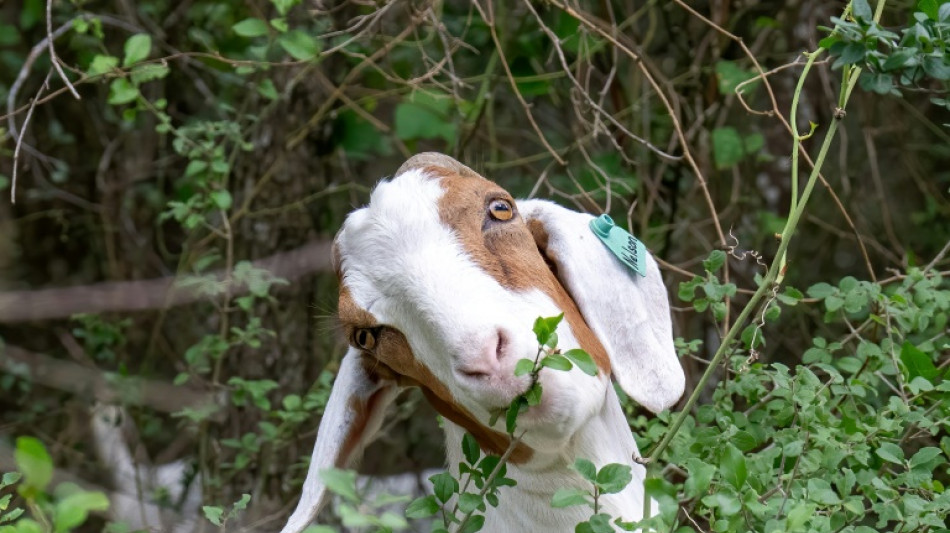
Got weeds? US environmentalists call in the G.O.A.T.s / Photo: SUZANNE CORDEIRO - AFP

 French firm Safran helps build aircraft wings of the future in UK factory

 World Bank warns of worsening food insecurity as commodity prices soar

 Billionaire Ambani's Jio soars in market debut after India's biggest IPO

 AI chip giant SK hynix posts seven-fold surge in quarterly operating profit

 S.African activists push back on data centre rush

 Billionaire Ambani's Jio to debut after record India IPO

 UK set for cautious budget as borrowing costs climb

 US Fed expected to hold rates steady ahead of key midterm elections

 AI chip giant SK hynix says quarterly operating profit soars 630%

 GA-ASI and Saab Perform Advanced AEW Flight Testing on Uncrewed MQ-9B

 Storied Paris department store seeks bankruptcy protection

 Boeing shares tumble after it releases cautious growth forecast
The landscaping squad of Mocha, Wynonna, Nelson and Beckham yank out weeds at a Texas park. They don't carry chainsaws or use herbicides. They are goats, and this environmentally friendly initiative is, for them, merely lunch.
The hungry goats -- who bleat to their master Kyle Carr -- are part of a team of 150 ruminants pruning the brush on a 6.5 acre (2.6 hectare) section of San Antonio's sprawling Brackenridge Park Conservancy, in the southwestern US.
And they are part of a growing trend: as officials and residents across the country seek out more ecological ways to care for the land, the goats are providing a carbon-free -- and surprisingly effective -- solution.
It will take them about two weeks to clear the area of Brackenridge Park Conservancy, whose Twitter account enthusiastically promotes their efforts to human visitors.
They are removing plants such as ligustrum, a highly invasive shrub that can take water and nutrients away from the older oak trees the park seeks to protect, Carr tells AFP.
The 36-year-old and his wife Carolyn own the Texas franchise of Rent-a-Ruminant, which operates in several states.
Goats are natural landscapers, but do need training -- they are accustomed to natural feed, and need to learn to stay with the group and to respect the protective electric fence keeping predators away from the area in which they work.
With that basic training in place, however, they are astonishingly efficient. For example, their digestive tracts sterilize the seeds they eat. "They're not going to propagate the same kind of plant species that you're trying to get rid of," Carr explains.
"It's much more eco-friendly to have goats in here than big machines or herbicides," agrees Charlotte Mitchell, a park board member.
The area is so close to the San Antonio river that using poison in any way would be especially unsafe, she adds.
"Besides, these are way more fun to watch" -- especially for families with young children, Mitchell says.
"I run through here often and I walk my dog every few days. It's very brushy around here... I'm pretty happy to see that these guys are here doing their job," comments 47-year-old San Antonio resident Aaron Rodriguez.
As a bonus, nimble-footed goats can often reach steep or tight areas that humans and machinery can't access, Carr says.
"We've worked with some cities that have had some real injuries, and even fatalities, where machines have kind of rolled over on those steep slopes," he explains.
The goats also adore poison ivy. "It sounds crazy," Carr admits -- but as a method of protecting humans, it works.
The goats get water breaks and sick days, and when they reach the age of 11 they can go on what Carr calls a "retirement program" (they can live up to 15 years).
"Our company has a no-slaughter policy, because, you know, we work with these guys all the time," he explains.
So, when the time comes, "we will take them to a ranch... And they basically get to raise the next generation of goats."
H.Cho--CPN