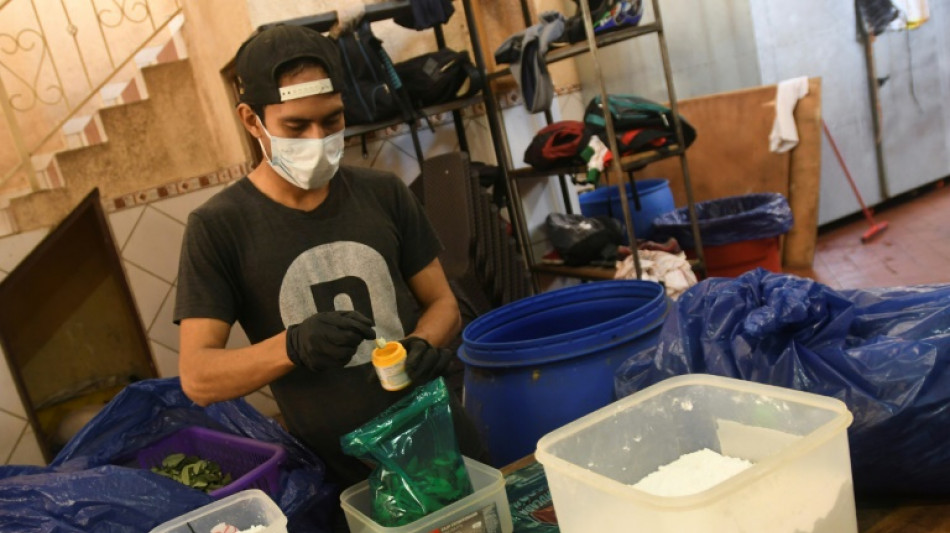
Chewed for millennia, coca leaf gets flavorsome makeover in Bolivia / Photo: RODRIGO URZAGASTI - AFP

 Kenya's economy faces climate change risks: World Bank

 Far right and far left battle for power in polarised Berlin

 The last trio: S.Africa's zoo elephants await their fate

 Oil industry sees war windfall but girds for political blowback

 Amazon beats expectations with cloud and AI growth

 Blowout Microsoft results lift US stocks as oil retreats

 'Beginning of the end': Relief but no party as French wildfire winds down

 Southern Europe 'becoming more flammable' in hotter climate, experts say

 Mammoth bones found on parched bed of Danube in Bulgaria

 MEXC Lists Grvt (GRVT) with $60,000 Worth of GRVT and 10,000 USDT in Airdrop+ Rewards

 George and Amal Clooney flee French home due to wildfire

 MEXC Ventures Supports Alpha Arena's APAC Debut at Coinfest Bali

 AI data centre supplier Zhongji InnoLight slips on Hong Kong debut

 May, June heatwaves caused 2,877 extra deaths in England: govt

 BMW profit down a third as carmaker plans job cuts

 Seoul extends losses as most Asian markets drop, oil rises again

 Gambling.com Group Is Now Grandstand

 Meet the astronomer digging into the Milky Way's 'fossils'

 AI data centre supplier Zhongji InnoLight falls on Hong Kong debut

 Samsung operating profit up 1,800% in second quarter on AI boom

 Japanese population below 120 million for first time in decades

 US actor Jared Leto denies latest accusations of sexual assault

 Danube drops to 'historic lows' as fresh heatwave hits

 BTS pulls out of Grammys after Asian pop category introduction

 OpenAI says rogue AI agent attack hit other companies

Bitter and tough, the coca leaf chewed throughout the South American Andes for thousands of years as a natural pick-me-up has been getting an appetizing makeover in Bolivia.
Traditionally sold as untreated, chopped leaves, several small businesses are now bruising the foliage to make it softer, and adding flavors such as strawberry, mango or coffee.
What started as an experiment about a decade ago has really taken off, especially in Bolivia's economic capital of Santa Cruz -- a city of 3.4 million people.
"The flavoring is like adding seasoning to food. Normally flavors such as bubblegum, banana are used, and it adds a special something," consumer Isaac Salazar, 21, told AFP.
"They come already crushed, soft, with a savory or sweet flavor added, which makes it perfect for passing the time."
The practice of chewing coca has its own verb in Bolivia's Indigenous Aymara language: "pijcheo." It means to masticate the leaves, like chewing gum, without swallowing.
The leaf -- from the same plant that cocaine is manufactured from -- has been ascribed with the wide-ranging properties of quelling hunger, inhibiting stress and imparting an energy boost.
Coca is also consumed in infusions, and in some countries it is included in flour used to make special breads and cakes.
- Bruised coca -
The work of transforming the fibrous leaf into a more easily chewable product is laborious.
At the El Dogor factory and store run by 23-year-old Luis Vasquez in Santa Cruz, about 20 workers share the tasks of removing the hard stems, placing what is left of the foliage into plastic bags, adding flavorings, and pounding away with a mallet.
The flattened end product, labeled Machucada (bruised) Coca El Dogor is placed in the fridge, and sold for $4.30 per unit of four ounces (about 113 grams).
The shop does a brisk business.
"We have a variety of coca leaf products, including fruit-flavored leaves and any other flavor a customer may ask for," said Vasquez.
More and more, clients "prefer it mixed with a flavoring," he said.
Consumer Gary Soleto, 45, said the traditional way of consuming unadulterated coca leaf will never disappear.
"But we change and we have taken on new habits... to continue consuming and tasting new flavors," he said.
Official data show that one in three people in a country of 12 million -- almost a third of them Indigenous -- chew coca or use it for medicinal and ritual purposes.
In 2021, there were 30,500 hectares (75,000 acres) of coca plantations in Bolivia, according to a UN estimate -- up four percent from 2020.
Potential coca leaf production was estimated at 44,900 to 56,200 metric tons with an estimated value of $352 million to $431 million, according to a report by the UN Office on Drugs and Crime.
The Bolivian state authorizes the cultivation of a maximum of 22,000 hectares.
In recent years, there have been clashes between coca leaf producers and police in Bolivia in a dispute over control of commercialization of the plant.
Ng.A.Adebayo--CPN