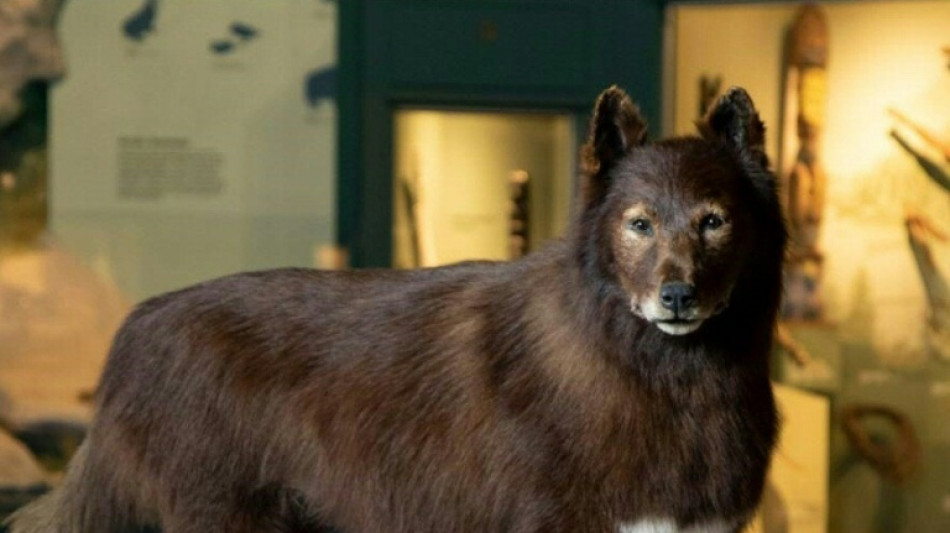
DNA study of famed US sled dog shows what made him so tough / Photo: - - EUREKALERT!/AFP

 Kenya's economy faces climate change risks: World Bank

 Far right and far left battle for power in polarised Berlin

 The last trio: S.Africa's zoo elephants await their fate

 Oil industry sees war windfall but girds for political blowback

 Amazon beats expectations with cloud and AI growth

 Blowout Microsoft results lift US stocks as oil retreats

 'Beginning of the end': Relief but no party as French wildfire winds down

 Southern Europe 'becoming more flammable' in hotter climate, experts say

 Mammoth bones found on parched bed of Danube in Bulgaria

 MEXC Lists Grvt (GRVT) with $60,000 Worth of GRVT and 10,000 USDT in Airdrop+ Rewards

 George and Amal Clooney flee French home due to wildfire

 MEXC Ventures Supports Alpha Arena's APAC Debut at Coinfest Bali

 AI data centre supplier Zhongji InnoLight slips on Hong Kong debut

 May, June heatwaves caused 2,877 extra deaths in England: govt

 BMW profit down a third as carmaker plans job cuts

 Seoul extends losses as most Asian markets drop, oil rises again

 Gambling.com Group Is Now Grandstand

 Meet the astronomer digging into the Milky Way's 'fossils'

 AI data centre supplier Zhongji InnoLight falls on Hong Kong debut

 Samsung operating profit up 1,800% in second quarter on AI boom

 Japanese population below 120 million for first time in decades

 US actor Jared Leto denies latest accusations of sexual assault

 Danube drops to 'historic lows' as fresh heatwave hits

 BTS pulls out of Grammys after Asian pop category introduction

 OpenAI says rogue AI agent attack hit other companies

New York's Central Park has a statue dedicated to him, and there's even been a movie about him: a sled dog named Balto. Now he is the focus of a DNA study, 90 years after he died, to see what made the pooch so famously tough.
In 1925, this Siberian husky was part of an expedition in Alaska called the serum run, the goal of which was to bring life-saving medicine to young people in the remote town of Nome that were threatened by diphtheria.
The mission in horrendous blizzards conditions involved a series of sled dog teams transporting the anti-toxin relay-style from the city of Anchorage. Balto led the dog team that covered the last stretch of the grueling journey.
The dog died in 1933, and its mounted body has been on display at the Cleveland Museum of Natural History ever since.
"Balto’s fame and the fact that he was taxidermied gave us this cool opportunity 100 years later to see what that population of sled dogs would have looked like genetically and to compare him to modern dogs," said Katherine Moon, a postdoctoral researcher at the University of California, Santa Cruz and the main author of the study.
It was published Thursday in the journal Science.
Her team took skin samples from the dog's belly and reconstructed its genome -- the complete set of genes in an organism.
They compared this genetic material with that of 680 contemporary dogs from 135 breeds.
Contrary to a legend that held that Balto was half wolf -- as suggested in an animated Universal Pictures film that came out in 1995 -- this analysis found no evidence he had wolf blood.
It turned out Balto shared ancestors with modern day Siberian Huskies and the sled dogs of Alaska and Greenland.
Zoom's team also compared Balto's genes with the genomes of 240 other species of mammals as part of an international effort called the Zoonomia Project.
This allowed researchers to determine which DNA fragments were common across all those species and have not therefore changed over the course of millions of years of evolution.
This stability suggests that these stretches of DNA are associated with important functions in the animal, and that mutations there could be dangerous.
The bottom line from the research was that Balto had fewer potentially dangerous mutations than modern breeds of dogs did, suggesting he was healthier.
"Balto had variants in genes related to things like weight, coordination, joint formation and skin thickness, which you would expect for a dog bred to run in that environment," Moon wrote in a statement.
C.Peyronnet--CPN