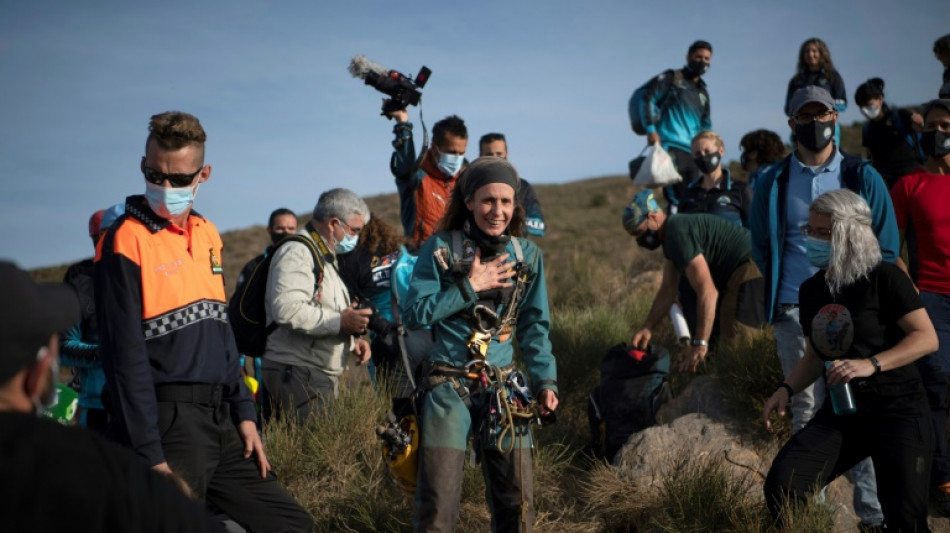
Spanish climber ends 500 days of isolation in underground cave / Photo: JORGE GUERRERO - AFP

 Kenya's economy faces climate change risks: World Bank
 Far right and far left battle for power in polarised Berlin

 The last trio: S.Africa's zoo elephants await their fate

 Oil industry sees war windfall but girds for political blowback

 Amazon beats expectations with cloud and AI growth

 Blowout Microsoft results lift US stocks as oil retreats

 'Beginning of the end': Relief but no party as French wildfire winds down

 Southern Europe 'becoming more flammable' in hotter climate, experts say

 Mammoth bones found on parched bed of Danube in Bulgaria

 MEXC Lists Grvt (GRVT) with $60,000 Worth of GRVT and 10,000 USDT in Airdrop+ Rewards

 George and Amal Clooney flee French home due to wildfire

 MEXC Ventures Supports Alpha Arena's APAC Debut at Coinfest Bali

 AI data centre supplier Zhongji InnoLight slips on Hong Kong debut

 May, June heatwaves caused 2,877 extra deaths in England: govt

 BMW profit down a third as carmaker plans job cuts

 Seoul extends losses as most Asian markets drop, oil rises again

 Gambling.com Group Is Now Grandstand

 Meet the astronomer digging into the Milky Way's 'fossils'

 AI data centre supplier Zhongji InnoLight falls on Hong Kong debut

 Samsung operating profit up 1,800% in second quarter on AI boom

 Japanese population below 120 million for first time in decades

 US actor Jared Leto denies latest accusations of sexual assault

 Danube drops to 'historic lows' as fresh heatwave hits
 BTS pulls out of Grammys after Asian pop category introduction
 OpenAI says rogue AI agent attack hit other companies
A 50-year-old Spanish mountain climber emerged Friday from an underground cave where she spent 500 days in seclusion as part of an experiment on the effects of isolation on the human body.
Wearing dark sunglasses, Beatriz Flamini smiled and embraced family members who had gathered to greet her as she climbed out of the cave near Motril in southern Spain.
"I haven't talked to anyone for a year and a half, only myself," the experienced mountaineer and solo climber told reporters, calling the experience "excellent, unbeatable".
Flamini began her challenge on November 21, 2021 -- before Russia's invasion of Ukraine and while the world was still in the grip of the Covid-19 pandemic.
She remained 70 metres (230 feet) underground, except for a week when she was forced to leave the cave because an internet router that allowed her to call for help in an emergency broke down.
While the problem was being fixed, Flamini remained in isolation in a tent, she and members of her team told daily newspaper El Pais and other Spanish media.
"I don't know what has happened in the world... for me it is still November 21, 2021," she told reporters after leaving the cave.
Flamini said she spent her time reading with the aid of artificial lights, exercising, and knitting woolly hats.
She was monitored by a technical team, who left food at an exchange point in the cave without having contact with her.
Flamini had two cameras to document her experience, which will be turned into a documentary by Spanish production company Dokumalia.
"There have been many challenges of this type, but none with all the rules that were set," said David Reyes of the Andalusian Federation of Speleology, who was in charge of her security.
"Being alone and in total isolation, without contact with the outside, without (natural) light, without time references," he told reporters.
Spanish Tourism Minister Hector Gomez called it an "extreme endurance test", which he hoped would have "great value" for science.
Flamini said one of the toughest moments came when the cave was invaded by flies, but she "never" considered abandoning the challenge.
"There have been difficult moments, and it is true that there have been very beautiful moments, and both are what made it possible to carry one," she said.
"I got along very well with myself," she added.
M.Anderson--CPN