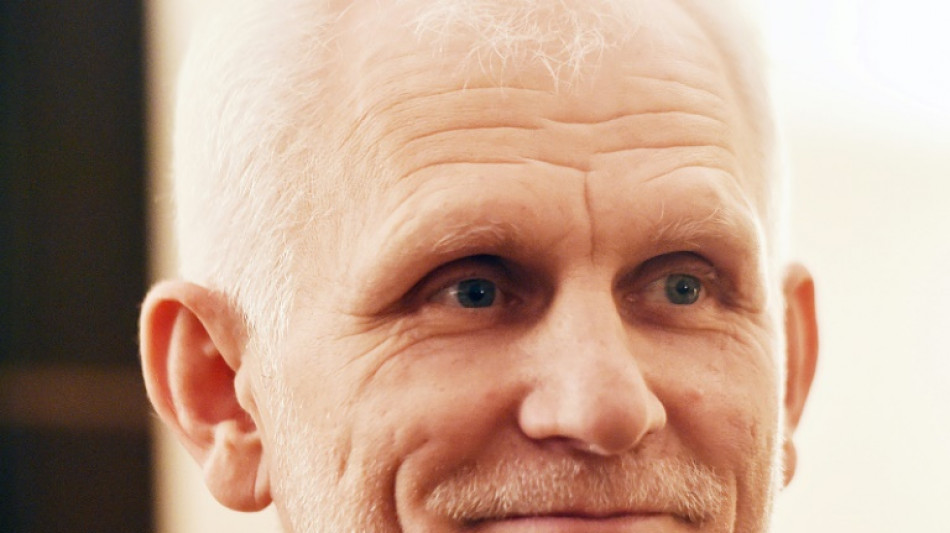
Bialiatski: rights champion in authoritarian Belarus / Photo: Sergei GAPON - AFP

 Kenya's economy faces climate change risks: World Bank
 Tech rebound fuels record-breaking rally in South Korean stocks
 Cables and cooling bring AI windfall to Indian suppliers

 Anthropic's models gained unauthorized 'real-world' access during testing

 Apple tops estimates in CEO Cook's final quarter, but shares fall

 Milei demands expulsion of foreigners expressing 'hate' against Argentina

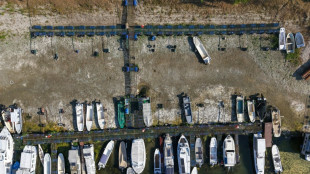
 Italy's Po River valley on drought alert

 Prada profits pinched as growth hard to chase

 Stocks climb on earnings and rates, oil retreats

 US economic growth slows in second quarter, missing expectations

 Russia adds Telegram founder Durov to 'terrorist' blacklist

 Stocks diverge on earnings, as oil steadies

 Eurozone economy grows despite Middle East war

 Singapore group will develop 'most promising' Ebola vaccine

 Shell profit surges as Mideast war fuels oil prices

 Car maker Stellantis says back in profit in second quarter

 Samsung quarterly operating profit up 1,800% on AI boom

 South Korean stocks bounce after rout, oil holds gains on Mideast woes

 South Korea's women web sleuths fight AI deepfake porn

 Anything but programmable: New cost-efficient EC-power-supply-series for the DIN rail by CAMTEC PS

 Meta misses profit expectations, sticks to massive AI spending

 Campari - king of the spritz - hopes to conquer American heartland
 Air France-KLM and Lufthansa bid for Portugal's TAP airline

 Profits soar at Airbus as it delivers more planes

 Rheinmetall shares surge after armsmaker reports record profit

Nobel Prize winner Ales Bialiatski, who was handed a 10-year prison term Friday, has battled against repression for a quarter of a century in authoritarian Belarus.
The 60-year-old founded Viasna, the country's most prominent rights group, soon after strongman Alexander Lukashenko became the first president of ex-Soviet Belarus in 1994.
He was detained alongside associates in 2021 in the wake of historic demonstrations against Lukashenko and a severe crackdown that followed that saw many government critics jailed or forced into exile.
On Friday Bialiatski was found guilty of smuggling and financing activities that "violate public order" and jailed for ten years in prison, a thinly veiled tactic to silence his work.
"This trial is obviously against human rights defenders for their human rights work," his wife Natalya Pinchuk said in response, describing the trial as a sham and calling the verdict "cruel".
Last year, while he was in jail waiting for the trial to begin, he was co-awarded the Nobel Peace Prize, along with Russia's Memorial group and Ukraine's Center for Civil Liberties.
- 'He doesn't complain' -
"He always writes that everything is fine. He doesn't complain about his health -- he tries not to upset me," Pinchuk said after he won the Nobel, referring to his letters from prison.
Bialiatski's organisation -- which translates to "Spring" and was founded in 1996 -- is Belarus's most prominent rights group, whose work has charted the increasingly authoritarian tendencies of Lukashenko and his security forces.
Established during mass pro-democracy protests several years after the collapse of the Soviet Union, it sought to help detained protesters and their families.
In the years since, Viasna and Bialiatski have gained prominence as Lukashenko's regime has leaned on more brutal ways of retaining its tight grip on power.
When massive rallies broke out against Lukashenko's claim to a sixth presidential term in August 2020, Viasna meticulously tracked numbers of people detained at protests and after police raids across Belarus in the months afterwards.
In the wake of the vote, Bialiatski described "real terror" taking hold of regional towns and in the capital Minsk as authorities worked to quash dissent.
"(Lukashenko's) goal is very simple -- to retain power at any cost and instil fear in society so that there are no protests against the falsification of these elections," he said in an interview.
Bialiatski was also part of a council of opposition figures -- which included Belarusian Nobel laureate Svetlana Alexievich -- tasked with organising new free and fair elections.
- A 'purge' of activists -
But in July 2021, Lukashenko's crackdown came to his doorstep with coordinated raids on a range of civil society groups, including Viasna's offices and Bialiatski's home, in a sweep that the group called a "new wave" of repression.
"The brutal crackdown on Viasna is part of the wider 'purge' of civil society declared by President Alexander Lukashenko," Human Rights Watch has said.
It was not the first time Bialiatski had run into trouble with security forces in Belarus, which is often described as "Europe's last dictatorship".
In August 2011, he was handed a 4.5-year prison sentence for tax evasion in a move seen as politically motivated in the wake of an earlier presidential election claimed by Lukashenko.
But he was released from prison in 2014, 18 months early.
"During his 25 years of activism, Bialiatski has faced serial repression," Human Rights Watch said after his pretrial detention was extended.
Bialiatski has also authored several books.
His activism has been recognised with several awards, mostly from Western institutions, including the Andrei Sakharov Freedom Award. He was previously nominated for the Nobel Peace Prize five times.
He was born in 1962 in a region of the Soviet Union near Finland and served in the military before studying philology.
X.Wong--CPN