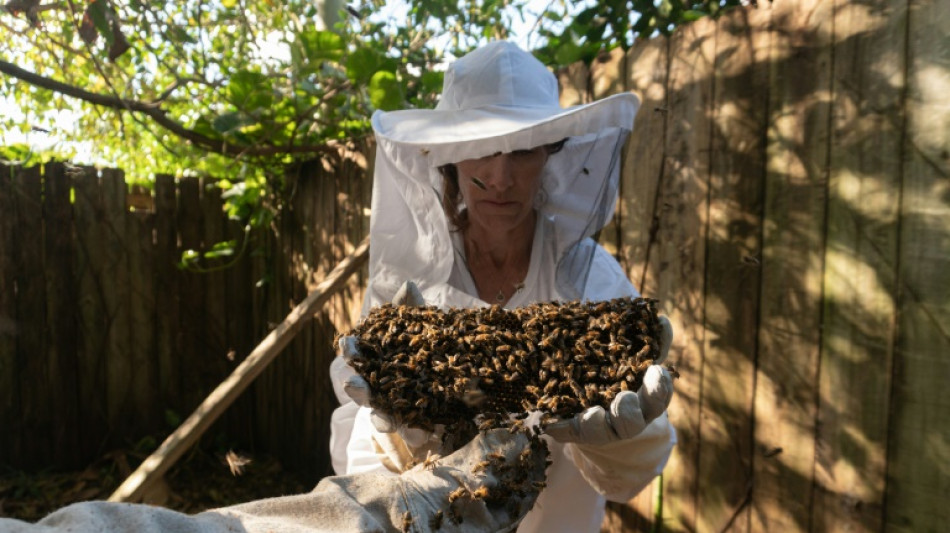
For a best friend to Florida bees, each rescue is personal / Photo: Jesus Olarte - AFP

 Kenya's economy faces climate change risks: World Bank

 Cables and cooling bring AI windfall to Indian suppliers

 Anthropic's models gained unauthorized 'real-world' access during testing

 Apple tops estimates in CEO Cook's final quarter, but shares fall

 Milei demands expulsion of foreigners expressing 'hate' against Argentina

 Italy's Po River valley on drought alert

 Prada profits pinched as growth hard to chase

 Stocks climb on earnings and rates, oil retreats

 US economic growth slows in second quarter, missing expectations

 Russia adds Telegram founder Durov to 'terrorist' blacklist

 Stocks diverge on earnings, as oil steadies

 Eurozone economy grows despite Middle East war

 Singapore group will develop 'most promising' Ebola vaccine

 Shell profit surges as Mideast war fuels oil prices

 Car maker Stellantis says back in profit in second quarter

 Samsung quarterly operating profit up 1,800% on AI boom

 South Korean stocks bounce after rout, oil holds gains on Mideast woes

 South Korea's women web sleuths fight AI deepfake porn

 Anything but programmable: New cost-efficient EC-power-supply-series for the DIN rail by CAMTEC PS

 Meta misses profit expectations, sticks to massive AI spending

 Campari - king of the spritz - hopes to conquer American heartland

 Air France-KLM and Lufthansa bid for Portugal's TAP airline

 Profits soar at Airbus as it delivers more planes

 Rheinmetall shares surge after armsmaker reports record profit

 FIFA hit by furious backlash over plans to sell stake in competitions

Melissa Sorokin sees herself as "a bee advocate," deeply passionate about helping to rescue the at-risk creatures that play such a critical role in biodiversity.
Often called in by spooked or concerned residents, she acts as emergency responder for the vital pollinators, spending the substantial time it takes to move threatening or threatened hives to safer locations.
Sorokin, who lives in Florida, says rescuing hives is infinitely better than homeowners or businesses allowing pest control services to swoop in and simply kill the bees.
"If they don't call me, as a beekeeper, they are most likely going to get an exterminator, who instead kills the bees. It's easy, it's quick, it's good money, cheap for them," says Sorokin, 54.
On the other hand, "I'm like a bee advocate, a bee tender," she says. "I love them. And I have a friendship with them."
Sorokin's mission is vital, she adds, because bees are under threat from climate change, pesticides, large cultivation of single crops, urbanization and invasive species.
The honey bee population is in freefall. A December study from Penn State University found that the United States experienced a 43 percent colony loss between April 2019 and April 2020.
The knock-on effects are immense, with the US Food and Drug Administration noting that about one third of food eaten by Americans comes from crops pollinated by honey bees, including apples, melons, cranberries, pumpkins and broccoli.
On a sunny afternoon, Sorokin heads to a client's garden in Coral Gables, near Miami, to remove a beehive.
She first scouts out the place where she suspects the bees are hiding: a shed attached to a house.
Once the presence of the insects is confirmed, she burns pieces of wood in a smoker, dons a mesh head net, and blows smoke into the shed's eaves to calm the bees.
She then grabs a chainsaw and cuts a wooden rectangle in the roof eave. Pulling back the planks reveals a humming, heaving hive.
Sorokin, wearing protective gloves, carefully removes panels of honeycomb covered with bees, and places them like racks in an artificial hive.
"It's not very complicated to move bees. They sleep at night. So you can move them at night or you can move them in the morning keeping everything nice and close," she explains.
"My goal, my wish," is to help the bees, she says. "I hope that they have a better life with me because I help them."
When Sorokin finishes transferring the insects from the shed, she closes up the new box hive and takes it to her car, where she straps it in with a seat belt.
Y.Tengku--CPN