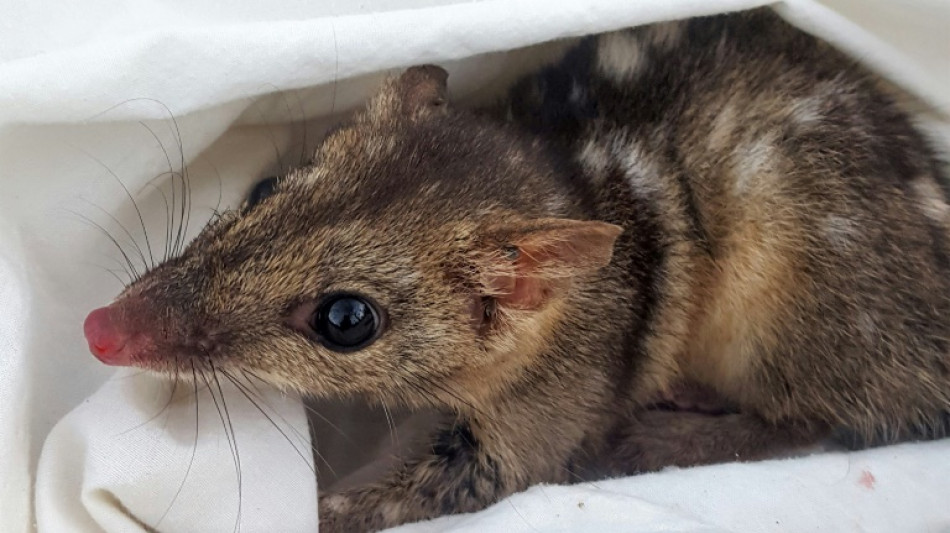
Relentless sex drive may threaten survival of quolls / Photo: KAYLAH DEL SIMONE - UNIVERSITY OF QUEENSLAND/AFP

 Kenya's economy faces climate change risks: World Bank

 Anthropic's models gained unauthorized 'real-world' access during testing

 Apple tops estimates in CEO Cook's final quarter, but shares fall

 Milei demands expulsion of foreigners expressing 'hate' against Argentina

 Italy's Po River valley on drought alert

 Prada profits pinched as growth hard to chase

 Stocks climb on earnings and rates, oil retreats

 US economic growth slows in second quarter, missing expectations

 Russia adds Telegram founder Durov to 'terrorist' blacklist

 Stocks diverge on earnings, as oil steadies

 Eurozone economy grows despite Middle East war

 Singapore group will develop 'most promising' Ebola vaccine

 Shell profit surges as Mideast war fuels oil prices

 Car maker Stellantis says back in profit in second quarter

 Samsung quarterly operating profit up 1,800% on AI boom

 South Korean stocks bounce after rout, oil holds gains on Mideast woes

 South Korea's women web sleuths fight AI deepfake porn

 Anything but programmable: New cost-efficient EC-power-supply-series for the DIN rail by CAMTEC PS

 Meta misses profit expectations, sticks to massive AI spending

 Campari - king of the spritz - hopes to conquer American heartland

 Air France-KLM and Lufthansa bid for Portugal's TAP airline

 Profits soar at Airbus as it delivers more planes

 Rheinmetall shares surge after armsmaker reports record profit

 FIFA hit by furious backlash over plans to sell stake in competitions

 MEXC Integrates World-Check to Fortify Institutional Grade Compliance Architecture
For male northern quolls, sex is a death sentence.
The cute marsupials native to northern Australia are the world's largest semelparous mammal, which means that the males drop dead after their first breeding season.
But what exactly causes them to die has remained a mystery.
Research published on Wednesday suggests that the males are depriving themselves of rest in their relentless pursuit to mate with females, potentially threatening the survival of their already endangered species.
Hoping to shed light on this sex-driven death frenzy, a team of researchers strapped tiny backpacks carrying tracking devices to seven male and six female northern quolls on Groote Eylandt, an island off the coast of Australia's Northern Territory.
The data, collected over 42 days that included breeding season, was entered into a machine learning algorithm which analysed different quoll behaviours.
The males were found to be far more active than females, who live for up to four breeding seasons.
And while females rested or laid around nearly 24 percent of the time, the proportion for males was just seven percent, according to a study published in the journal Royal Society Open Science.
The study's lead author, Joshua Gaschk of the University of the Sunshine Coast, told AFP that the "males didn't seem to be sleeping anywhere near as much as they should".
For the first time, "we might have a smoking gun" for what is causing the males to die after breeding, he said.
Smaller relatives of the northern quoll, such as the antechinus, are also semelparous.
But research has found that their males die from internal haemorrhaging and infection due to escalating stress hormones during mating season -- which is not what is killing the northern quolls.
- 'Mating frenzy' -
Gaschk said the yearly male die-off could threaten the survival of the northern quoll, which has been badly affected by the introduction of non-native cane toads, cats and foxes to Australia.
But the carnivorous marsupials have been using this extreme breeding strategy, also known as suicidal reproduction, "for thousands of years -- there's got to be a benefit to it," Gaschk said.
Indeed on Groote Eylandt, an island with no cane toads and few cats, the northern quolls are "not just surviving, but doing really well", he said.
Adrian Bradley of the University of Queensland, who was not involved in the study, called the new research "significant".
Bradley said he was quite certain that the "mating frenzy" of smaller semelparous marsupials like the antechinus is "stimulated as an irresistible response to the release of perfume-like pheromones from the cloacal glands of females."
The amount of weight lost during these frenzies likely explains why only smaller members of the dasyuridae family are semelparous, he said.
But for the larger northern quoll, Bradley warned it was not yet "possible to conclusively say" why some "males generally do not survive the breeding season," calling for further research.
X.Cheung--CPN