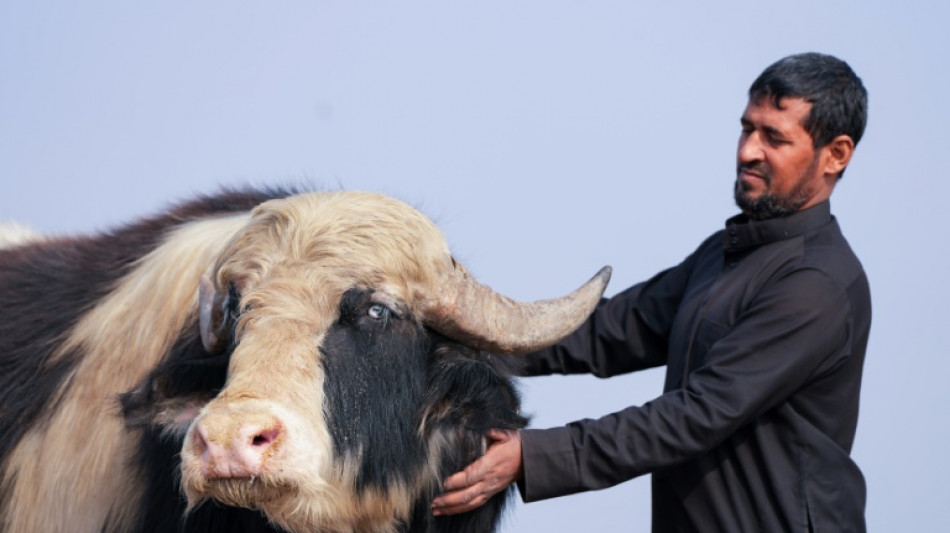
After drought, winter rains revive Iraq's famed marshlands / Photo: Asaad NIAZI - AFP

 Kenya's economy faces climate change risks: World Bank
 Anthropic's models gained unauthorized 'real-world' access during testing

 Apple tops estimates in CEO Cook's final quarter, but shares fall

 Milei demands expulsion of foreigners expressing 'hate' against Argentina

 Italy's Po River valley on drought alert

 Prada profits pinched as growth hard to chase

 Stocks climb on earnings and rates, oil retreats

 US economic growth slows in second quarter, missing expectations

 Russia adds Telegram founder Durov to 'terrorist' blacklist

 Stocks diverge on earnings, as oil steadies

 Eurozone economy grows despite Middle East war

 Singapore group will develop 'most promising' Ebola vaccine

 Shell profit surges as Mideast war fuels oil prices

 Car maker Stellantis says back in profit in second quarter

 Samsung quarterly operating profit up 1,800% on AI boom

 South Korean stocks bounce after rout, oil holds gains on Mideast woes

 South Korea's women web sleuths fight AI deepfake porn

 Anything but programmable: New cost-efficient EC-power-supply-series for the DIN rail by CAMTEC PS

 Meta misses profit expectations, sticks to massive AI spending

 Campari - king of the spritz - hopes to conquer American heartland
 Air France-KLM and Lufthansa bid for Portugal's TAP airline

 Profits soar at Airbus as it delivers more planes

 Rheinmetall shares surge after armsmaker reports record profit
 FIFA hit by furious backlash over plans to sell stake in competitions

 MEXC Integrates World-Check to Fortify Institutional Grade Compliance Architecture
Black buffaloes wade through the waters of Iraq's Mesopotamian marshes, leisurely chewing on reeds. After years of drought, winter rains have brought some respite to herders and livestock in the famous wetlands.
Listed as a UNESCO World Heritage Site, the marshes were parched and dusty last summer by drought in the climate-stressed country and by reduced flow from the Tigris and Euphrates rivers due to dams built upstream in Turkey and Iran.
Winter brings seasonal rains, offering relief in marshes like those of Huwaizah -- which straddles the border with Iran -- and Chibayish, located in nearby Dhi Qar province.
Among the reeds of Chibayish, buffalo farmer Rahim Daoud now uses a stick to punt his boat across an expanse of water.
"This summer, it was dirt here; there was no water," said the 58-year-old. "With the rain that has fallen, the water level has risen."
Last summer, AFP photographers travelled to the Huwaizah and Chibayish marshes to document the disappearance of large portions of the wetlands, observing vast expanses of dry and cracked soil dotted with yellowed shrubs.
In October, an official in the impoverished rural province of Dhi Qar told AFP that in the previous six months, 1,200 families had left the marshes and other agricultural areas of southern Iraq and more than 2,000 buffaloes had died.
- Scorching summers -
Iraq has faced three consecutive years of severe drought and scorching heat, with temperatures regularly exceeding 50 degrees Celsius (122 Fahrenheit) during the summer of 2022.
"There is a gradual improvement," Hussein al-Kenani said after the recent rains.
He heads the governmental centre in charge of protecting the wetlands and said rainwater collected in canals and rivers has been redirected to the marshes.
"The water level in Chibayish's swamps has increased by more than 50 centimetres (20 inches) compared with December and by more than 30 centimetres for the Huwaizah swamps," Kenani said.
In July, the UN Food and Agriculture Organization deplored the "unprecedented low water levels" in the marshes, highlighting "the disastrous impact" for more than 6,000 families, whose buffaloes and livelihoods were being lost.
The relief of rainfall early this month was welcomed by the UN agency, which noted in a statement that in the Chibayish region "salinity levels decreased" to the point that people and animals could again drink the water.
"This has had a great positive impact, especially on buffalo herders," it said.
T.Morelli--CPN