
'Love hormone'? Not so fast, new study suggests / Photo: TORSTEN BLACKWOOD - AFP

 Kenya's economy faces climate change risks: World Bank

 Anthropic's models gained unauthorized 'real-world' access during testing

 Apple tops estimates in CEO Cook's final quarter, but shares fall

 Milei demands expulsion of foreigners expressing 'hate' against Argentina

 Italy's Po River valley on drought alert

 Prada profits pinched as growth hard to chase

 Stocks climb on earnings and rates, oil retreats

 US economic growth slows in second quarter, missing expectations

 Russia adds Telegram founder Durov to 'terrorist' blacklist

 Stocks diverge on earnings, as oil steadies

 Eurozone economy grows despite Middle East war

 Singapore group will develop 'most promising' Ebola vaccine

 Shell profit surges as Mideast war fuels oil prices

 Car maker Stellantis says back in profit in second quarter

 Samsung quarterly operating profit up 1,800% on AI boom

 South Korean stocks bounce after rout, oil holds gains on Mideast woes

 South Korea's women web sleuths fight AI deepfake porn

 Anything but programmable: New cost-efficient EC-power-supply-series for the DIN rail by CAMTEC PS

 Meta misses profit expectations, sticks to massive AI spending

 Campari - king of the spritz - hopes to conquer American heartland

 Air France-KLM and Lufthansa bid for Portugal's TAP airline

 Profits soar at Airbus as it delivers more planes

 Rheinmetall shares surge after armsmaker reports record profit

 FIFA hit by furious backlash over plans to sell stake in competitions

 MEXC Integrates World-Check to Fortify Institutional Grade Compliance Architecture
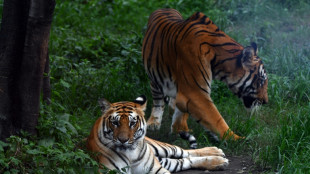
The "love hormone" oxytocin has long been thought key to behaviours including pairing up with a partner and nurturing offspring, but a new study in prairie voles is raising doubts.
The research found that voles bred to lack functioning receptors for oxytocin were still able to form strong pairs, produce young and nurse -- all behaviours previously believed to depend on the hormone.
Prairie voles are one of the few mammals that mate for life, and are often used to study social behaviours like pair-forming in animals.
In past studies, voles given drugs that stopped oxytocin being processed no longer formed pairs, and mothers failed to produce milk for their young.
Psychiatrist Devanand Manoli and neurobiologist Nirao Shah produced genetically altered prairie voles without working oxytocin receptors, and then observed how the mutant male and female voles behaved.
To their shock, the mutant voles appeared to have no difficulty pairing up with non-genetically altered partners, and mutant females could still deliver and nurse young, unlike those in the drug-driven studies.
"We were certainly surprised," said Manoli, an assistant professor at the University of California, San Francisco.
The results suggest that oxytocin is not the main, or only, driver of activities like partnering or nursing, he said.
"What the genetics reveals is that there isn't a 'single point of failure' for behaviours that are so critical to the survival of the species," he told AFP.
- 'Very complex behaviours' -
That didn't mean there were no differences, however.
Some male mutant voles that paired with ordinary female partners didn't show the aggression towards interloping females that would normally be expected.
And while mutant females produced and nursed litters, some had fewer pups per litter than their counterparts, and fewer of their offspring survived to weaning, the paper published Friday in the journal Neuron explains.
Pups born to mutant mothers also tended to weigh less, suggesting that they were not able to nurse as effectively.
The study only involved pairing of mutant voles with "wild-type" partners, and the researchers said pairings with two mutant partners could produce different results.
Still, as a whole, the findings suggest a different picture of oxytocin's role in several important behaviours.
That could be because animals bred without the receptors developed "other compensatory pathways" that helped them pair up and nurse, said Shah, a professor at Stanford University.
But the researchers suggest it likely means oxytocin is only part of a set of genetic factors that control social behaviour.
"What I think our studies reveal is that there are multiple pathways that regulate these very complex behaviours," said Manoli.
Oxytocin has sometimes been suggested as a way to treat attachment disorders and other neuropsychiatric issues, but there is little settled science on how effective it is.
Now the researchers hope to investigate what other hormones and receptors may be involved in behaviours like pairing and nursing.
"These other pathways might serve as new therapeutic targets," Manoli said.
Ng.A.Adebayo--CPN